Introduction
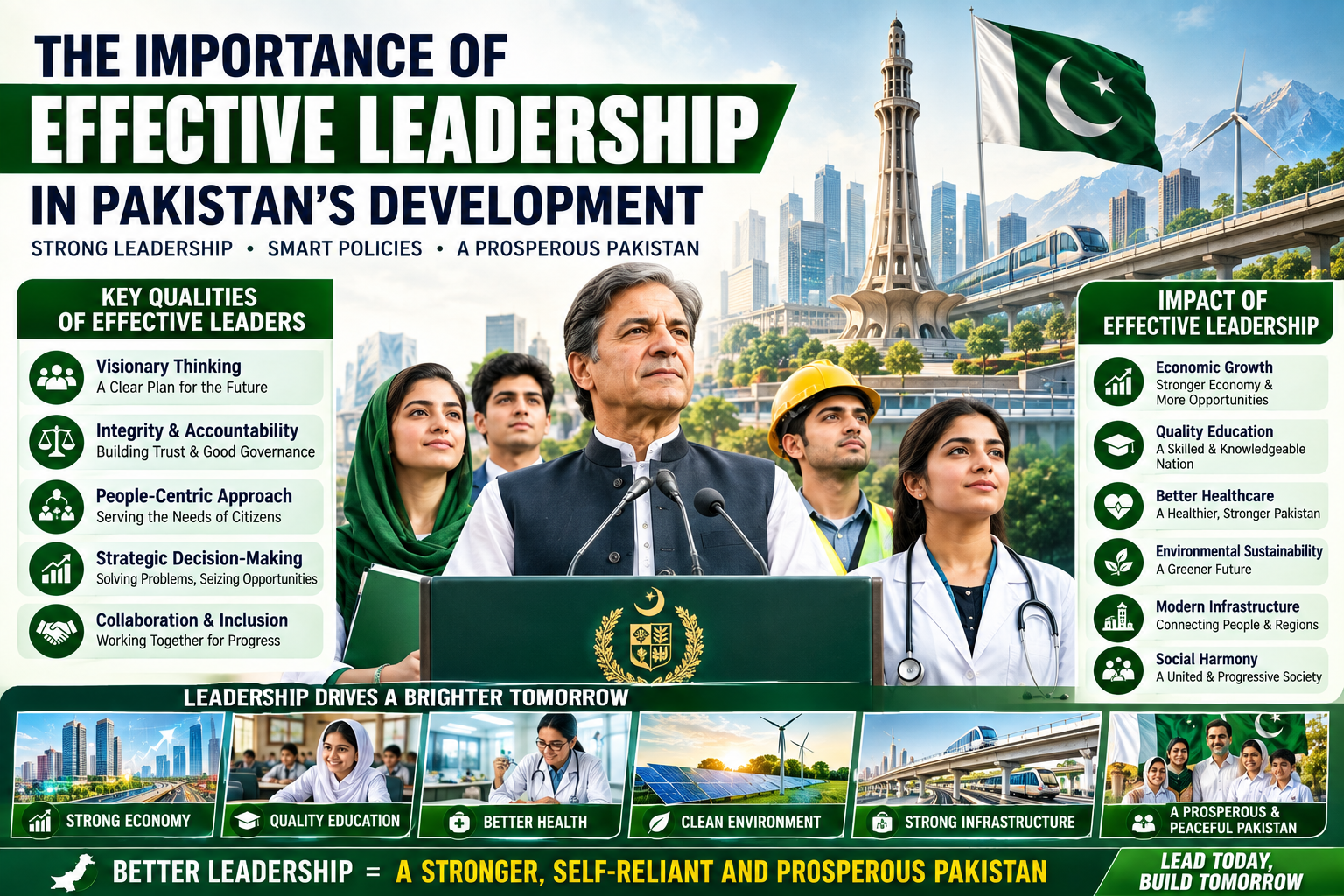
Leadership plays a vital role in the progress of every country. A nation may have natural resources, talented people, modern technology, and economic opportunities, but these strengths cannot be used effectively without responsible and capable leadership. In Pakistan, effective leadership is particularly important because the country faces challenges in education, healthcare, economic development, governance, employment, technology, and social development.
Effective leadership does not simply mean holding an important political position. It means having a clear vision, making responsible decisions, listening to people, respecting institutions, and working consistently toward long-term goals. Good leadership can help Pakistan use its human and natural resources more effectively and create opportunities for future generations.
Recent discussions on Pakistan’s governance have also emphasized that strong institutions, accountability, coordination, and effective implementation are essential for turning development plans into real improvements.
What Is Effective Leadership?
Effective leadership is the ability to guide people toward a common goal while making responsible and ethical decisions. An effective leader understands problems, develops practical solutions, communicates clearly, and accepts responsibility for decisions.
Leadership is not limited to politicians. Teachers, business owners, community members, students, civil servants, entrepreneurs, and professionals can all demonstrate leadership in their areas of responsibility.
A good leader should have qualities such as:
Vision
Honesty and integrity
Responsibility
Communication skills
Decision-making ability
Patience
Accountability
Problem-solving skills
Respect for others
Commitment to long-term goals
These qualities help leaders earn trust and encourage people to work together.
Why Leadership Matters for Pakistan
Pakistan has a large population and significant human potential. However, having resources alone does not guarantee development. Effective leadership is needed to organize resources, establish priorities, implement policies, and maintain public confidence.
Good leadership can help Pakistan move toward sustainable development by focusing on important areas such as education, economic growth, healthcare, technology, infrastructure, and employment.
The Pakistan Governance Forum 2026 highlighted the connection between leadership capability and effective governance, while emphasizing principles such as merit, transparency, accountability, and citizen-centered service delivery.
Leadership and Economic Development
Economic development is one of Pakistan's major priorities. Strong leadership can contribute to economic progress by supporting entrepreneurship, encouraging investment, improving institutions, and creating an environment where businesses can grow.
Effective leaders understand that economic development requires long-term planning rather than temporary solutions. They can encourage policies that support small businesses, industries, agriculture, technology, exports, and innovation.
Leadership also plays a role in creating employment opportunities. When young people receive appropriate education, skills, training, and opportunities, they can contribute significantly to the national economy.
A successful economic strategy therefore requires leaders who can think beyond short-term gains and focus on sustainable growth.
Leadership and Education
Education is one of the strongest foundations of national development. A country cannot build a successful future without an educated and skilled population.
Effective leadership in education means improving the quality of schools, supporting teachers, encouraging practical learning, and making educational opportunities more accessible.
Leadership is also important in developing skills that match the needs of the modern economy. Pakistan's young population can become a major national strength if students receive quality education, career guidance, technical training, and opportunities to use their knowledge.
Research on youth governance in Pakistan has emphasized the importance of education, training, guidance, and meaningful opportunities in developing future leaders.
The Role of Youth Leadership
Young people are an important part of Pakistan's future. They have the energy, creativity, and ability to adopt new technologies and ideas.
Youth leadership means giving young people opportunities to participate in decision-making, community development, entrepreneurship, education, technology, and social initiatives.
Young Pakistanis can contribute by:
Developing innovative ideas
Starting responsible businesses
Participating in community projects
Learning modern technologies
Promoting education
Volunteering
Supporting environmental initiatives
Developing problem-solving skills
UNDP has described Pakistan's young population as having significant potential to contribute to sustainable and inclusive development, while also emphasizing the need for youth-centered leadership and meaningful participation.
Leadership and Good Governance
Good governance is closely connected with effective leadership. Governments and institutions need leaders who can make decisions fairly, transparently, and responsibly.
Important principles of good governance include:
Transparency: People should be able to understand how decisions are made.
Accountability: Leaders and institutions should accept responsibility for their actions.
Rule of law: Laws should be respected and applied fairly.
Participation: Citizens should have opportunities to contribute to public decision-making.
Efficiency: Public institutions should use resources responsibly.
When these principles are practiced, people are more likely to trust institutions.
Research on leadership and governance also identifies transparency, accountability, participation, and the rule of law as important dimensions of effective governance.
Leadership in Healthcare
Healthcare is another area where effective leadership can make a major difference. Leaders in government and healthcare institutions must focus on improving services, supporting medical professionals, strengthening public health systems, and ensuring that resources are used effectively.
Good leadership can encourage better planning and coordination between different healthcare institutions.
It can also help create awareness about preventive healthcare, nutrition, cleanliness, and healthy lifestyles.
Leadership and Technology
Technology is changing the way people learn, communicate, work, and conduct business. Pakistan has opportunities to benefit from digital technology, artificial intelligence, software development, e-commerce, and online services.
Effective leadership can help the country adapt to technological change by supporting digital education, technology businesses, research, innovation, and digital public services.
Young people can play an especially important role in this area because many are already familiar with digital tools and online learning.
Leaders who understand technological change can help Pakistan prepare its workforce for the future.
Leadership and Social Development
National development is not only about economic growth. A successful country also needs social progress.
Effective leaders can encourage:
Quality education
Equal opportunities
Community development
Respect for different viewpoints
Social responsibility
Environmental awareness
Support for vulnerable communities
Leadership should bring people together rather than create unnecessary divisions. A strong society depends on cooperation, tolerance, responsibility, and respect.
The Importance of Integrity in Leadership
Integrity is one of the most important qualities of an effective leader. A leader may have knowledge and authority, but without honesty and ethical behavior, public trust can decline.
An honest leader tries to make decisions based on principles rather than personal benefit. Integrity also means accepting mistakes and learning from them.
For Pakistan, strengthening ethical leadership can help build greater confidence in institutions and public services.
Leadership and National Unity
Pakistan is home to people from different regions, languages, cultures, and backgrounds. Effective leadership should recognize this diversity while promoting common national goals.
Strong leaders can encourage cooperation by focusing on shared objectives such as education, economic opportunity, peace, technological development, and national progress.
National unity does not require everyone to think exactly alike. Instead, it requires people to work together despite their differences.
Challenges to Effective Leadership in Pakistan
Pakistan faces several challenges in developing effective leadership.
1. Short-Term Thinking
Long-term development requires patience and consistent planning. Focusing only on immediate results can make sustainable progress difficult.
2. Weak Implementation
A good policy is not enough if it is not properly implemented. Leaders need strong institutions and capable teams to turn plans into results.
3. Lack of Accountability
Accountability helps ensure that people in positions of responsibility answer for their decisions and actions.
4. Limited Leadership Training
Leadership skills can be developed through education, mentorship, experience, and training. Pakistan can benefit from stronger leadership-development programs.
A 2026 government statement on leadership training similarly emphasized that leadership can be cultivated through training, vision, and continuous learning rather than being treated simply as an inborn quality.
Young people need opportunities to develop leadership skills through education, internships, community projects, entrepreneurship, and civic participation.
How Pakistan Can Develop Better Leaders
Pakistan can strengthen its leadership culture through several practical steps.
Improve Education
Schools and universities should encourage critical thinking, communication, teamwork, creativity, and problem-solving.
Promote Leadership Training
Leadership programs can teach students and professionals how to communicate, manage teams, solve problems, and make responsible decisions.
Encourage Merit
People should be given opportunities according to their abilities, qualifications, and performance.
Strengthen Institutions
Strong institutions reduce dependence on individual personalities and create systems that continue working over time.
Encourage Youth Participation
Young people should have meaningful opportunities to contribute to communities and national development.
Promote Ethical Values
Honesty, responsibility, respect, fairness, and public service should be encouraged from an early age.
Support Innovation
Leaders should create an environment where young people, researchers, entrepreneurs, and technology professionals can develop new ideas.
The Role of Schools and Families
Leadership development begins long before a person enters politics or professional life. Schools and families can help young people develop leadership qualities.
Teachers can encourage students to work in teams, participate in projects, express ideas respectfully, and take responsibility for their tasks.
Families can teach children values such as honesty, discipline, kindness, responsibility, and respect.
These basic qualities can later become the foundation of responsible leadership.
The Role of Businesses and Entrepreneurs
Leadership is also important in Pakistan's private sector. Business leaders can create jobs, introduce innovative products, support employees, and contribute to economic growth.
Entrepreneurs who solve local problems through technology and business can make a positive contribution to society.
Responsible businesses can also support education, environmental initiatives, skills development, and community programs.
Leadership and Pakistan's Future
Pakistan has significant potential because of its people, young population, natural resources, geographical position, and growing interest in technology and entrepreneurship.
However, potential must be converted into results through effective leadership and strong institutions.
The future of Pakistan will depend not only on government leaders but also on teachers, students, entrepreneurs, professionals, researchers, community leaders, and ordinary citizens.
Leadership should therefore be viewed as a shared responsibility.
Conclusion
Effective leadership is one of the most important foundations for Pakistan's development. Good leaders can help improve governance, education, economic growth, healthcare, technology, social development, and national unity.
However, leadership is not simply about authority or position. True leadership requires vision, integrity, accountability, knowledge, communication, and a willingness to serve others.
Pakistan can build a stronger future by investing in leadership development, education, youth participation, strong institutions, and ethical values. Young people in particular should be given opportunities to learn, innovate, participate, and take responsibility.
The development of Pakistan cannot depend on a single leader or institution. It requires collective leadership and consistent effort from society as a whole. With responsible leadership and strong institutions, Pakistan can make better use of its human potential and move toward a more stable, prosperous, and sustainable future.
FAQs
1. Why is effective leadership important for Pakistan?
Effective leadership helps Pakistan improve governance, economic development, education, institutions, and social progress.
2. What are the qualities of a good leader?
Important qualities include integrity, vision, accountability, communication, responsibility, and decision-making skills.
3. How can youth contribute to leadership in Pakistan?
Young people can contribute through education, entrepreneurship, technology, community projects, and civic participation.
4. How does leadership affect good governance?
Responsible leadership can strengthen transparency, accountability, participation, and institutional performance.
5. How can Pakistan develop better leaders?
Pakistan can develop better leaders through quality education, leadership training, mentorship, merit-based opportunities, and youth participation.