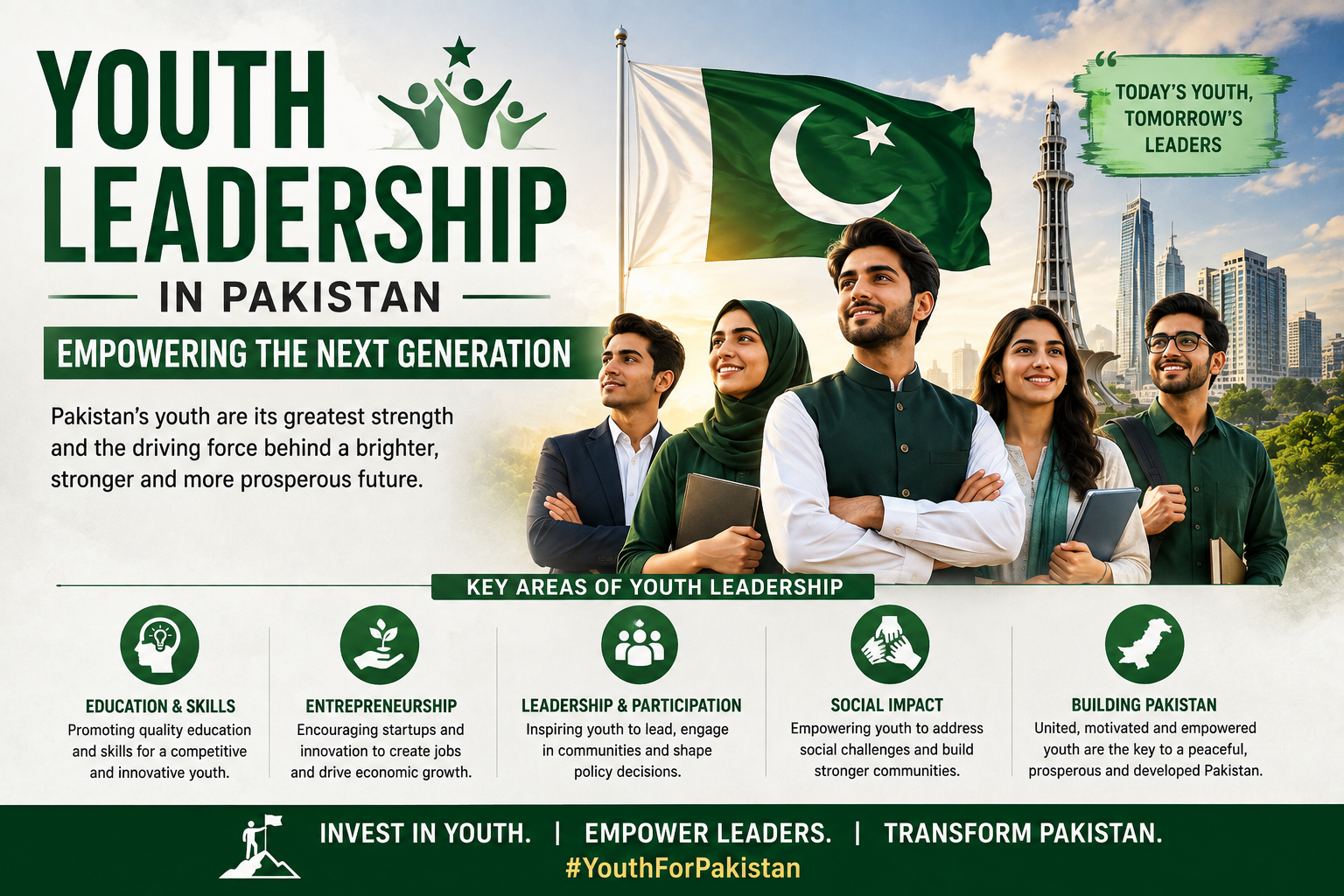
Pakistan is a country with a large and energetic young population. Young people have the potential to become an important force for economic development, social progress, innovation and national leadership. However, turning this potential into meaningful progress requires more than simply having a large youth population. Young people need education, skills, opportunities, responsible guidance and platforms where they can participate constructively in society.
Youth leadership in Pakistan is therefore becoming an increasingly important topic. It is not limited to politics or government. Young leaders can contribute through education, technology, entrepreneurship, community service, environmental initiatives, research, media, business and many other fields.
Leadership means taking responsibility, solving problems and helping others move toward a positive goal. A young leader does not necessarily need an official position or a famous title. A student who organizes a community project, a young entrepreneur who creates employment, or a volunteer who helps improve their local community can all demonstrate leadership.
Pakistan’s future will depend greatly on how effectively it develops and supports its younger generation.
What Is Youth Leadership?
Youth leadership refers to the ability of young people to take responsibility, make positive decisions, influence others constructively and contribute to their communities.
A youth leader may work in many different areas. Some young people become entrepreneurs, while others become teachers, researchers, social workers, technology professionals, journalists, public servants or community organizers.
Good youth leadership is based on qualities such as:
Responsibility
Confidence
Honesty
Communication
Critical thinking
Teamwork
Problem-solving
Creativity
Empathy
Decision-making
These qualities can be developed through education, experience and participation.
Why Youth Leadership Matters in Pakistan
Youth leadership matters because young people will eventually become the country’s professionals, business owners, educators, policymakers and community leaders.
If young people receive appropriate opportunities, they can contribute new ideas to longstanding problems.
Pakistan faces challenges related to education, employment, economic development, environmental sustainability, technology and governance. Young people can contribute innovative approaches to many of these areas.
Youth participation can also strengthen communities.
When young people volunteer, organize educational activities or participate in community projects, they develop practical leadership skills while contributing to society.
Young People and Pakistan’s Future
A country’s future depends heavily on the abilities of its younger generation.
Pakistan needs skilled workers and professionals who can compete in an increasingly digital and interconnected global economy.
Young people can help Pakistan develop industries such as information technology, software development, digital services, engineering, research, renewable energy and entrepreneurship.
However, education needs to go beyond memorization.
Students should also have opportunities to develop communication, creativity, teamwork and problem-solving skills.
These skills can help young people become more effective leaders in their professional and personal lives.
Education as the Foundation of Leadership
Education is one of the strongest foundations for youth leadership.
Schools, colleges and universities can help students develop knowledge and confidence.
A strong education system should encourage students to ask questions, analyze information and develop independent thinking.
Leadership education can also be incorporated into extracurricular activities.
Debates, student societies, sports, volunteer projects, technology competitions and academic clubs can give students opportunities to practice leadership.
A student who learns how to organize an event, communicate with a team and solve a problem is gaining practical leadership experience.
The Role of Universities and Colleges
Colleges and universities have a particularly important role in developing young leaders.
Higher education institutions can provide students with opportunities to participate in societies, research projects, competitions and community activities.
Student-led initiatives can teach valuable skills that cannot always be learned from textbooks.
Universities can also connect students with entrepreneurs, professionals and organizations.
These connections can help young people understand real-world challenges and identify career opportunities.
Technology and Youth Leadership
Technology has transformed the way young people communicate and work.
Pakistan’s young population has access to smartphones, social media, online learning platforms and digital tools that can support education and entrepreneurship.
Young people can use technology to learn new skills, create businesses and communicate ideas with audiences around the world.
Information technology is also creating opportunities for remote work and digital services.
A young person in Pakistan can develop skills in software development, graphic design, digital marketing, animation or other fields and potentially work with international clients.
This makes technology an important part of modern youth leadership.
Digital Skills for Future Leaders
Future leaders need strong digital literacy.
Digital skills can help young people understand modern industries and participate in the global economy.
Important areas include:
Computer literacy
Programming
Artificial intelligence
Cybersecurity
Data analysis
Digital marketing
Graphic design
Online communication
Digital entrepreneurship
Not every young person needs to become a software engineer. However, understanding technology can help almost every future professional.
Youth Entrepreneurship
Entrepreneurship is another important area of youth leadership.
Young entrepreneurs can create businesses that provide products, services and employment opportunities.
Pakistan has many young people with creative business ideas.
However, turning an idea into a successful business requires more than enthusiasm.
Young entrepreneurs need knowledge about:
Business planning
Financial management
Marketing
Customer service
Technology
Market research
Team management
Entrepreneurship education can help young people understand these areas before starting businesses.
Freelancing and the Digital Economy
The digital economy has created new opportunities for young Pakistanis.
Freelancing allows skilled individuals to work with clients beyond their local areas.
Young people can develop skills in writing, programming, design, video editing, digital marketing and other fields.
Beyond earning income, freelancing can also teach leadership skills.
A successful freelancer needs to manage deadlines, communicate with clients, organize projects and maintain professional standards.
These experiences can prepare young people for larger leadership responsibilities.
Youth and Community Service
Leadership is not only about career success.
Community service is another important form of youth leadership.
Young people can participate in activities such as educational support, environmental projects, community awareness campaigns and volunteer initiatives.
Community service teaches empathy and responsibility.
It also helps young people understand the challenges faced by people from different backgrounds.
These experiences can create leaders who are more aware of the needs of society.
Youth Leadership and Social Development
Young leaders can contribute to social development by identifying problems and working toward practical solutions.
For example, students can organize literacy activities, awareness campaigns or environmental projects in their communities.
Social media can also help young people spread useful information.
However, responsible communication is essential.
Young leaders should verify information before sharing it and avoid spreading rumors or misleading content.
Responsible digital behavior is becoming an important part of modern leadership.
Women and Youth Leadership
Young women are an important part of Pakistan’s future leadership.
Providing equal opportunities in education, professional development and entrepreneurship can allow more talented young women to contribute to national development.
Women can become leaders in science, education, business, technology, healthcare, law, public service and many other fields.
Creating supportive environments can help young women develop confidence and leadership abilities.
A country benefits when talented young people—regardless of gender—have opportunities to develop their skills.
Leadership Through Sports
Sports can also develop leadership qualities.
Team sports teach cooperation, discipline, communication and responsibility.
Young athletes learn how to work with teammates, handle challenges and pursue common goals.
Sports programmes can therefore contribute to youth development beyond physical activity.
Schools and communities can use sports as a platform for building confidence and teamwork.
Importance of Communication Skills
Effective communication is one of the most important qualities of a leader.
A leader needs to explain ideas clearly, listen to others and communicate respectfully.
Young people can improve communication through debates, presentations, public speaking and group projects.
English proficiency can also provide access to international educational and professional opportunities, while strong Urdu and local-language communication remains important for connecting with communities.
Critical Thinking and Decision-Making
Modern leaders face complicated problems.
Young people therefore need to learn how to evaluate information and make thoughtful decisions.
Critical thinking helps individuals distinguish facts from opinions and reliable information from misinformation.
This is especially important in the digital age, where large amounts of information are available through social media.
Young leaders should develop the habit of asking questions, checking sources and considering different perspectives.
Ethics and Integrity
Leadership without integrity can create serious problems.
Young leaders should understand the importance of honesty, fairness and responsibility.
A leader may have authority or influence, but that influence should be used responsibly.
Integrity means doing the right thing even when it is difficult.
Teaching ethical values alongside academic and professional skills can help develop trustworthy future leaders.
Challenges Facing Youth Leadership in Pakistan
Despite the potential of Pakistan’s youth, several challenges can limit their participation.
These include:
Limited employment opportunities
Unequal access to quality education
Lack of practical training
Limited access to finance for entrepreneurs
Digital inequality
Lack of mentorship
Social and economic barriers
Limited leadership platforms
Mismatch between education and job-market requirements
Addressing these challenges requires cooperation between government institutions, educational organizations, businesses and communities.
Employment and Youth Leadership
Employment opportunities are particularly important.
A young person who cannot find suitable employment may struggle to develop professional experience.
Pakistan needs economic policies that encourage businesses to create jobs and invest in young talent.
Skills-based training can also help young people match their abilities with market demand.
The growth of IT, entrepreneurship, manufacturing and other sectors can provide additional opportunities.
The Importance of Mentorship
Mentorship can play a major role in youth leadership.
Young people can benefit from guidance provided by experienced teachers, professionals, entrepreneurs and community leaders.
A mentor can help a young person understand career choices, develop skills and learn from mistakes.
Schools and universities can establish mentorship programmes connecting students with professionals.
Such programmes can make leadership development more practical.
Youth Leadership and Innovation
Young people often bring fresh perspectives to existing problems.
Innovation requires curiosity and a willingness to experiment.
Pakistan can benefit from encouraging young people to develop solutions in areas such as agriculture, education, healthcare, transportation, energy and technology.
Innovation competitions, startup programmes and research opportunities can give young people platforms to develop their ideas.
Startups and Young Entrepreneurs
The startup ecosystem can provide another pathway for youth leadership.
Young entrepreneurs can develop technology-based solutions and create businesses around them.
However, startups need access to finance, mentorship, market knowledge and supportive regulations.
Universities can contribute by establishing entrepreneurship centres and innovation labs.
Such initiatives can help students turn ideas into practical projects.
Youth Leadership in Rural Areas
Youth leadership should not be limited to major cities.
Young people in rural areas can also contribute to agriculture, education, community development and local entrepreneurship.
Digital connectivity can help rural youth access online education and markets.
Agricultural technology can also provide opportunities for young people interested in modern farming and agribusiness.
Supporting rural youth can help reduce regional economic inequalities.
Environmental Leadership
Climate and environmental issues are becoming increasingly important.
Young people can contribute by participating in tree-planting campaigns, recycling initiatives, water conservation projects and environmental awareness programmes.
Environmental leadership can also involve innovation.
Young entrepreneurs can develop businesses around renewable energy, waste management and sustainable products.
Education can help young people understand the economic and social importance of environmental protection.
Youth Leadership and Tourism
Pakistan’s tourism industry also provides opportunities for young leadership.
Young people can contribute through tourism businesses, digital travel platforms, hospitality services, photography, content creation and local guiding services.
Responsible tourism can create economic opportunities while encouraging communities to protect natural and cultural heritage.
Young entrepreneurs can use digital platforms to promote lesser-known destinations and cultural experiences.
Leadership Through Media
Young people are increasingly involved in digital media.
Content creation can provide opportunities to communicate ideas and highlight social issues.
However, media leadership requires responsibility.
Young creators should avoid spreading misinformation and should understand the importance of privacy, respect and accurate reporting.
Responsible digital creators can contribute positively to public awareness.
Role of Government
Government institutions have an important role in creating opportunities for youth.
Youth-focused policies can support education, employment, entrepreneurship and skills development.
Government programmes can provide training and opportunities for young people to participate in community and economic activities.
However, programmes need effective implementation and transparency to produce meaningful results.
Role of the Private Sector
Businesses can also support youth leadership.
Companies can offer internships, apprenticeships, mentorship programmes and entry-level opportunities.
Partnerships between businesses and educational institutions can help students understand workplace requirements.
Private-sector investment in skills development can benefit both young people and companies.
Role of Families
Families are often the first environment where leadership qualities develop.
Parents and guardians can encourage young people to take responsibility, communicate respectfully and make thoughtful decisions.
Young people also need space to learn from mistakes.
Constructive guidance can help them become more confident and independent.
Role of Teachers
Teachers can have a lasting influence on young leaders.
A teacher can encourage students to ask questions, participate in activities and develop confidence.
Teachers can also identify students who demonstrate leadership potential and encourage them to take part in projects and competitions.
Education becomes more powerful when students are encouraged not only to learn but also to apply what they know.
Youth Participation in Public Life
Young people can contribute to public life through lawful and constructive civic participation.
They can learn about public institutions, community issues and national development.
Civic education can help young people understand their responsibilities as members of society.
Responsible participation can strengthen communities and encourage informed decision-making.
Leadership and National Unity
Youth leadership can also promote cooperation among different communities.
Pakistan has diverse cultures, languages and traditions.
Young leaders can help build understanding by promoting respect and cooperation.
Student exchanges, cultural activities and community projects can bring young people from different backgrounds together.
Unity does not require everyone to be identical. It can be built through mutual respect and shared goals.
Building Confidence Among Young People
Confidence is an important leadership quality.
However, confidence should be based on preparation rather than simply speaking loudly or seeking attention.
Young people can build genuine confidence by developing skills, gaining experience and completing meaningful projects.
Small achievements can gradually create the confidence needed for larger responsibilities.
Failure as a Learning Opportunity
Young leaders will sometimes make mistakes.
Failure can be an important learning experience when handled constructively.
Instead of being discouraged by every setback, young people can analyze what went wrong and improve their approach.
Schools and organizations should create environments where young people can experiment responsibly and learn from mistakes.
Future of Youth Leadership in Pakistan
The future of youth leadership in Pakistan has significant potential.
Technology is opening new opportunities, while entrepreneurship and digital services are creating new career paths.
At the same time, traditional fields such as education, agriculture, manufacturing and public service continue to need talented young professionals.
The country can benefit greatly if young people receive the right combination of education, skills, mentorship and opportunities.
A Roadmap for Stronger Youth Leadership
Pakistan can strengthen youth leadership through several practical measures:
1. Improve Education Quality
Education should develop knowledge as well as critical thinking, creativity and communication.
2. Expand Skills Training
Technical and digital skills should be accessible to young people across different regions.
3. Encourage Entrepreneurship
Young entrepreneurs need mentorship, business education and suitable access to finance.
4. Increase Internship Opportunities
Internships can give students valuable practical experience.
5. Support Youth Innovation
Competitions, research programmes and innovation centres can help young people develop solutions.
6. Strengthen Digital Literacy
Young people should learn how to use technology productively and responsibly.
7. Encourage Community Service
Volunteering can help young people develop responsibility and empathy.
8. Expand Mentorship
Experienced professionals can guide young people toward productive career paths.
9. Support Equal Opportunities
Young people should have fair opportunities to develop their abilities.
10. Promote Ethical Leadership
Honesty, responsibility and respect should remain central to leadership development.
Why Youth Leadership Is an Investment
Investing in young people is an investment in Pakistan’s future.
A young person who gains useful skills can become a productive professional.
A young entrepreneur can create employment.
A trained teacher can educate future generations.
A technology professional can develop solutions for global markets.
A community volunteer can help improve local conditions.
The benefits of youth development therefore extend far beyond individual careers.
Conclusion
Youth leadership has the potential to become one of Pakistan’s strongest sources of social and economic progress. The country’s young generation can contribute to technology, entrepreneurship, education, agriculture, business, tourism, environmental protection and community development.
However, potential alone is not enough. Young people need access to quality education, practical skills, mentorship, employment opportunities and platforms where they can use their abilities.
Schools and universities can develop leadership through student activities, research and community projects. Businesses can provide internships and professional opportunities. Government institutions can create supportive policies and programmes. Families and teachers can encourage responsibility and confidence.
Young people themselves also have an important responsibility. They can develop useful skills, stay informed, communicate respectfully, participate in constructive activities and use technology responsibly.
Pakistan’s future leadership will not be created overnight. It will develop gradually through education, experience, mentorship and opportunities.
The most important goal is to create a generation of young Pakistanis who are skilled, responsible, innovative, confident and committed to positive development.
When young people are given the opportunity to lead, they do not simply prepare themselves for the future—they can begin contributing to the country’s progress today.
5 FAQs
1. What is youth leadership in Pakistan?
Youth leadership means young people taking responsibility, solving problems and contributing positively to their communities and country.
2. Why is youth leadership important for Pakistan?
Young leaders can contribute to education, technology, entrepreneurship, employment, social development and innovation.
3. How can Pakistan develop young leaders?
Pakistan can support youth through quality education, skills training, mentorship, internships, entrepreneurship programmes and community activities.
4. What skills do young leaders need?
Important skills include communication, critical thinking, teamwork, decision-making, creativity, responsibility and digital literacy.
5. How can young people contribute to Pakistan’s development?
Young people can contribute through education, entrepreneurship, technology, community service, research, environmental projects and responsible civic participation.