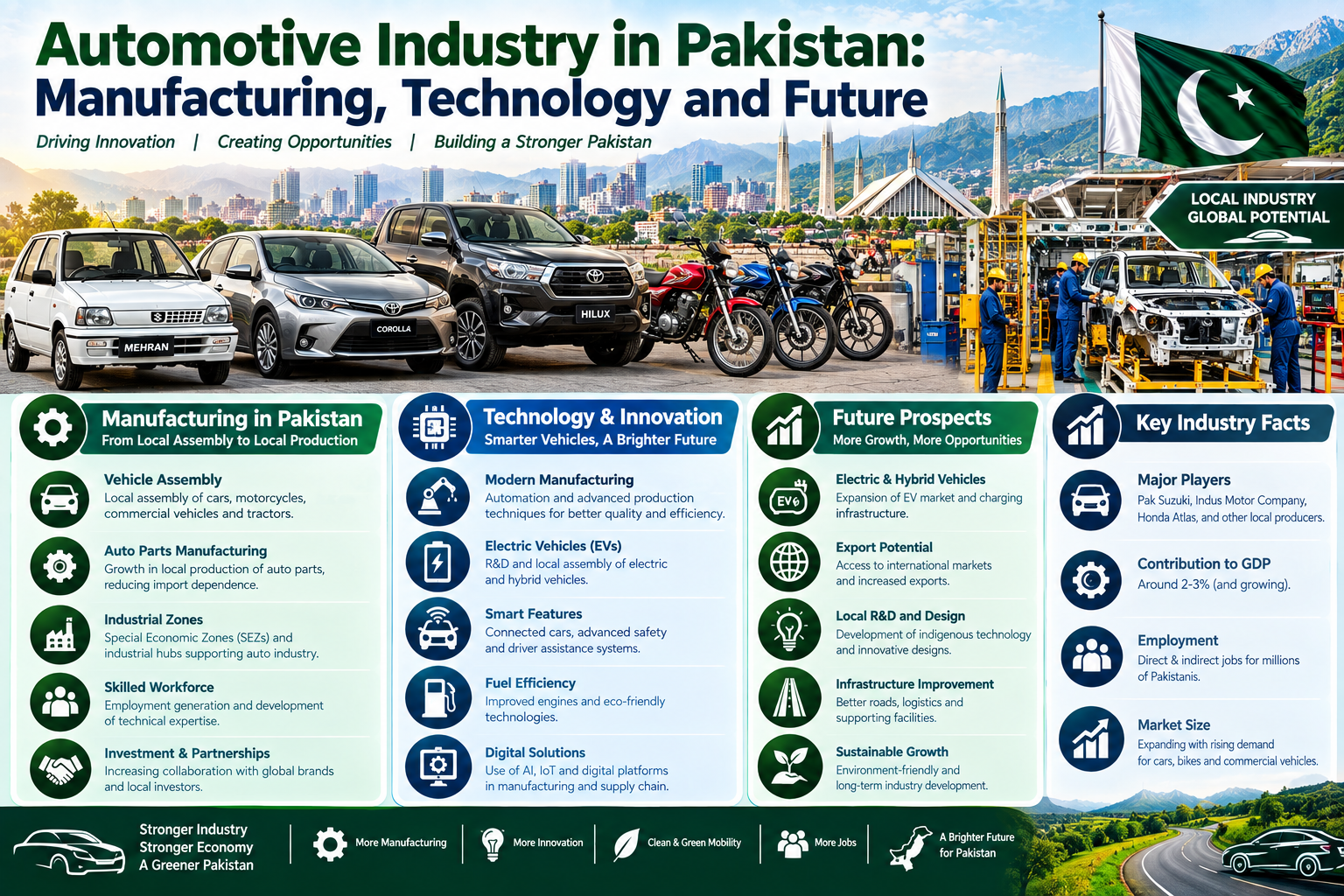
The automotive industry is an important part of Pakistan's economy and transportation system. Cars, motorcycles, commercial vehicles and automotive parts support the daily movement of people and goods across the country. The industry also contributes to manufacturing, employment, retail, workshops, logistics and other connected businesses.
Pakistan has a long history of vehicle assembly and manufacturing. Over the years, the country's automotive sector has developed from a market dominated by conventional vehicles toward a more diverse environment that includes modern technologies, improved safety features, hybrid vehicles and growing interest in electric mobility.
The automotive industry is also influenced by changing consumer preferences. Buyers increasingly consider fuel efficiency, comfort, technology, safety, reliability and maintenance costs when selecting vehicles. At the same time, manufacturers and businesses are exploring new technologies that could change how vehicles are produced and used.
This article explores the automotive industry in Pakistan, including local manufacturing, vehicle assembly, motorcycle production, auto parts, employment, technology, electric vehicles, consumer trends and the future of transportation.
Importance of the Automotive Industry in Pakistan
The automotive industry plays an important role in supporting transportation and economic activity.
Cars and motorcycles are used by millions of people for:
Daily commuting
Education
Business
Family travel
Delivery services
Commercial transportation
Intercity journeys
The industry also supports many related sectors, including:
Auto parts
Repair workshops
Tire businesses
Lubricants
Insurance
Financing
Vehicle dealerships
Transportation services
Logistics
Because of these connections, developments in the automotive sector can affect many areas of the wider economy.
Automotive Manufacturing in Pakistan
Pakistan has established automotive manufacturing and assembly capabilities.
Vehicles sold in the country can involve different levels of local manufacturing, assembly and imported components depending on the company and vehicle category.
Local production can support employment and industrial development while also creating demand for suppliers and technical workers.
The automotive manufacturing process involves numerous components, including:
Engines or electric motors
Transmissions
Body panels
Electrical systems
Interior components
Braking systems
Suspension components
Tires
Glass
Seats
Electronic systems
Automobile Assembly Plants
Vehicle assembly is an important part of Pakistan's automotive sector.
Assembly plants bring together different vehicle components to produce finished vehicles.
Modern vehicle assembly involves several stages, including:
Component preparation
Body construction
Painting
Mechanical assembly
Electrical installation
Interior installation
Quality inspection
Testing
Final preparation
The exact manufacturing process differs between companies and vehicle types.
Motorcycle Industry in Pakistan
Motorcycles have a particularly important role in Pakistan's transportation market.
They are widely used because they can be practical for urban commuting and local travel.
Pakistan has developed a substantial motorcycle manufacturing and assembly sector, with many businesses involved in producing, assembling, distributing and servicing motorcycles.
The motorcycle industry also supports a large network of dealers, mechanics and spare-parts businesses.
Auto Parts Industry
The automotive industry depends heavily on parts suppliers.
Auto parts can include:
Engine components
Filters
Brake components
Suspension parts
Electrical components
Body parts
Interior components
Tires
Batteries
Glass
Lighting systems
A strong local parts industry can support vehicle production and maintenance.
It can also create opportunities for small and medium-sized businesses.
Employment Opportunities
The automotive sector provides employment directly and indirectly.
Direct employment can exist in:
Manufacturing
Assembly
Engineering
Quality control
Sales
Management
Vehicle design
Maintenance
Indirect employment can involve:
Dealerships
Mechanics
Parts suppliers
Transport services
Logistics
Insurance
Advertising
Vehicle financing
The development of new vehicle technologies may also create demand for new technical skills.
Role of Engineers and Technical Workers
Modern vehicles require knowledge of mechanical engineering, electrical systems, electronics and computer technology.
Automotive engineers may work with:
Vehicle systems
Engines
Electric motors
Battery systems
Manufacturing processes
Safety systems
Software
Quality control
Technicians are also becoming increasingly important because modern vehicles contain more electronic systems than older vehicles.
Growth of Automotive Technology
Technology has transformed the automotive industry worldwide, and Pakistan is gradually experiencing these changes as well.
Modern vehicles can include features such as:
Digital instrument displays
Electronic safety systems
Parking sensors
Cameras
Navigation systems
Smartphone connectivity
Automatic climate control
Driver-assistance technologies
The availability of these features varies by vehicle and market segment.
Fuel Efficiency and Consumer Preferences
Fuel efficiency is an important consideration for many Pakistani consumers.
People who travel long distances may pay particular attention to fuel consumption because transportation expenses can become a significant part of their monthly budget.
Manufacturers therefore have incentives to develop vehicles that provide efficient use of fuel or electricity while maintaining practical performance.
Hybrid Vehicles in Pakistan
Hybrid vehicles combine an internal-combustion engine with an electric motor and battery system.
They have attracted interest in Pakistan because they can provide an alternative to conventional petrol-only vehicles.
Hybrid technology can help reduce fuel consumption in suitable driving conditions.
However, hybrid vehicles also have more complex power systems, and buyers should consider battery condition, service availability and replacement costs when purchasing used hybrid vehicles.
Electric Vehicles in Pakistan
Electric vehicles are becoming an important part of discussions about Pakistan's future transportation system.
Electric cars and motorcycles use batteries and electric motors rather than relying entirely on conventional petrol engines.
Potential advantages include:
Reduced dependence on petrol
Quiet operation
Lower local exhaust emissions
Potentially lower energy costs
New opportunities for technology development
However, electric vehicles also face challenges related to charging infrastructure, battery costs, service networks and consumer awareness.
Electric Motorcycles
Electric motorcycles may be especially relevant to Pakistan because motorcycles already play a major role in daily transportation.
Many urban trips are relatively short, making two-wheel electric transportation potentially practical for some users.
However, battery range, charging facilities, battery replacement and after-sales service remain important factors.
Charging Infrastructure
The expansion of electric vehicles requires suitable charging infrastructure.
Charging facilities may be needed at:
Homes
Offices
Shopping areas
Parking facilities
Service centers
Public locations
For electric motorcycles, home charging can be particularly useful when the vehicle is designed for it.
The development of reliable charging infrastructure can influence consumer confidence in electric transportation.
Battery Technology
Battery technology is one of the most important areas of electric vehicle development.
The battery affects:
Driving range
Charging time
Vehicle weight
Performance
Cost
Long-term ownership
As battery technology develops, electric vehicles may become more practical for a wider range of transportation needs.
Battery recycling and responsible disposal will also become increasingly important as the number of electric vehicles grows.
Local Production and Industrial Development
Local vehicle production can contribute to industrial development by creating demand for suppliers and manufacturing services.
A strong automotive ecosystem can encourage investment in:
Parts production
Engineering
Electronics
Battery technology
Software
Manufacturing equipment
Research and development
Local production can also support technical training and employment.
Challenges Facing Pakistan's Automotive Industry
The automotive sector faces several challenges.
These can include:
Economic uncertainty
Currency fluctuations
Import-related difficulties
Production costs
Consumer affordability
Limited financing options
Supply-chain disruptions
Technology costs
Infrastructure limitations
The industry can be affected by changes in both domestic and international economic conditions.
Vehicle Affordability
Vehicle affordability is an important issue for Pakistani consumers.
The final cost of a vehicle depends on multiple factors, including:
Manufacturing cost
Imported components
Taxes and duties
Currency exchange rates
Distribution costs
Technology
Market demand
Changes in these factors can influence vehicle prices and consumer purchasing decisions.
Financing and Vehicle Ownership
Vehicle financing can help some consumers purchase cars or motorcycles through installment-based arrangements.
However, financing costs and eligibility requirements vary.
Consumers considering vehicle financing should understand the complete repayment amount, fees, terms and conditions before entering an agreement.
Used Vehicle Market
Pakistan has a large used-car and used-motorcycle market.
Used vehicles can provide consumers with alternatives to purchasing new vehicles.
Important factors when purchasing a used vehicle include:
Mechanical condition
Accident history
Mileage
Documentation
Ownership history
Maintenance records
Spare-parts availability
Resale value
A professional inspection can help identify mechanical issues before purchase.
Role of Dealerships
Dealerships connect manufacturers with consumers.
They can provide:
New vehicles
Financing information
Service facilities
Spare parts
Warranty support
Customer assistance
The quality and availability of dealership services can influence the overall ownership experience.
After-Sales Service
After-sales service is an important part of the automotive industry.
A vehicle may require maintenance and repairs throughout its life.
Manufacturers and dealerships may provide:
Scheduled servicing
Warranty repairs
Diagnostic services
Genuine parts
Technical support
A strong service network can make vehicle ownership more convenient.
Automotive Workshops in Pakistan
Independent workshops are an important part of Pakistan's vehicle-maintenance ecosystem.
Many car and motorcycle owners depend on local mechanics for routine repairs and servicing.
As vehicles become more technologically advanced, workshops increasingly need diagnostic equipment and technicians with knowledge of electronic systems.
Digital Transformation in Automotive Services
Digital technology is changing how consumers interact with automotive businesses.
Modern automotive services can include:
Online vehicle research
Digital service booking
Online parts ordering
Vehicle-history services
Mobile applications
Digital payment options
Online customer support
These developments can make vehicle ownership more convenient.
Connected Vehicles
Connected-car technology allows vehicles to communicate with smartphones, networks or other digital systems.
Potential features can include:
Remote vehicle information
Navigation
Vehicle diagnostics
Location services
Maintenance reminders
As connectivity develops, software may become increasingly important in vehicle ownership.
Safety Technology
Vehicle safety technology continues to develop.
Modern cars may include features such as:
Airbags
Anti-lock braking systems
Electronic stability systems
Parking sensors
Rear cameras
Collision-warning technologies
The exact safety equipment depends on the vehicle and model.
For consumers, understanding available safety features can be an important part of vehicle selection.
Importance of Road Infrastructure
The automotive industry is closely connected with road infrastructure.
Road quality, traffic management, parking facilities and public transportation all influence vehicle usage.
Urban development can affect the types of vehicles consumers choose.
For example, congested city environments may increase interest in motorcycles and compact vehicles, while longer intercity journeys can create different transportation requirements.
Automotive Industry and Urbanization
Pakistan's cities continue to grow, increasing demand for transportation.
As urban populations increase, mobility becomes an important issue.
Cars and motorcycles provide personal transportation, but cities also need efficient public transport, pedestrian facilities and organized traffic systems.
The future of mobility is therefore likely to involve multiple transportation options rather than a single vehicle type.
Commercial Vehicles
The automotive industry also includes commercial vehicles such as:
Trucks
Buses
Vans
Delivery vehicles
Specialized transport vehicles
These vehicles support trade, logistics, public transportation and business activities.
Commercial transportation is particularly important for moving products between factories, warehouses, markets and customers.
Logistics and E-Commerce
The growth of online shopping has increased demand for delivery and logistics services.
Motorcycles, vans and other vehicles are used for last-mile delivery.
This creates opportunities for automotive businesses, especially in areas such as fuel efficiency, electric delivery motorcycles and fleet management.
Electric Vehicles for Commercial Use
Electric vehicles may have potential in commercial transportation where routes are predictable.
Delivery companies can potentially use electric motorcycles or vehicles for repeated urban routes.
However, commercial users must carefully evaluate:
Daily distance
Charging time
Battery durability
Maintenance
Vehicle availability
Total operating cost
Future of Automotive Manufacturing
The future of automotive manufacturing in Pakistan may increasingly involve advanced technology.
Possible areas of development include:
Electric vehicles
Hybrid technology
Advanced electronics
Digital manufacturing
Automation
Battery systems
Vehicle software
Improved safety technology
Manufacturers may also increasingly focus on efficiency and environmental considerations.
Role of Young Professionals
Pakistan's younger workforce can play an important role in the future of the automotive sector.
Students and professionals with knowledge of:
Mechanical engineering
Electrical engineering
Electronics
Computer science
Artificial intelligence
Data analysis
Industrial automation
may find opportunities in modern automotive businesses.
The combination of automobiles and software is creating new technical fields.
Automotive Software
Modern vehicles increasingly depend on software.
Software can control or support:
Instrument displays
Battery management
Driver assistance
Entertainment systems
Navigation
Diagnostics
Vehicle connectivity
This means that future automotive careers may involve both traditional engineering and software development.
Artificial Intelligence in Vehicles
Artificial intelligence is being used internationally in areas such as driver assistance, vehicle diagnostics, traffic analysis and manufacturing.
The adoption of advanced AI features in Pakistan will depend on vehicle availability, infrastructure, affordability and regulatory development.
AI may also be useful outside the vehicle itself, including logistics, traffic management and manufacturing.
Environmental Considerations
Environmental concerns are becoming increasingly important in the global automotive sector.
Traditional petrol and diesel vehicles produce tailpipe emissions. Electric vehicles do not produce tailpipe exhaust during operation, although their overall environmental impact includes battery production and electricity generation.
The automotive industry can contribute to environmental improvement through:
Cleaner vehicle technologies
Efficient engines
Electric mobility
Better public transportation
Recycling
Responsible waste management
Recycling in the Automotive Sector
Vehicles contain many recyclable materials.
These can include:
Metals
Glass
Rubber
Plastics
Batteries
Electronic components
Proper recycling can reduce waste and recover useful materials.
Battery recycling will become increasingly important as electric vehicles become more common.
Importance of Research and Development
Research and development can help the automotive industry adapt to changing consumer needs.
Areas for research can include:
Fuel efficiency
Electric motors
Batteries
Safety
Lightweight materials
Manufacturing efficiency
Software
Vehicle connectivity
Investment in technical education and research can support long-term industrial development.
Future Trends in Pakistan's Automotive Market
Several trends may influence the automotive sector in the coming years.
These include:
1. Growing Interest in Electric Mobility
Electric cars, motorcycles and other vehicles may become more visible as technology and infrastructure develop.
2. More Digital Features
Consumers may increasingly encounter digital dashboards, smartphone connectivity and connected services.
3. Greater Focus on Efficiency
Fuel and energy efficiency are likely to remain important considerations.
4. Development of Local Components
The expansion of local parts production could support the wider automotive ecosystem.
5. New Technical Skills
Electric vehicles, electronics and software may create demand for specialized workers.
What Consumers Should Look For
Consumers can make more informed vehicle decisions by considering their actual transportation needs.
Important factors include:
Purchase cost
Fuel or electricity consumption
Safety features
Maintenance cost
Spare-parts availability
Service network
Comfort
Resale value
Vehicle size
Daily travel distance
A vehicle should be selected according to practical requirements rather than appearance alone.
Conclusion
Pakistan's automotive industry is an important part of the country's transportation and manufacturing landscape. It supports vehicle production, motorcycle assembly, auto parts, dealerships, workshops, logistics and many other connected businesses.
The industry is gradually experiencing technological changes. Hybrid vehicles, electric motorcycles, electric cars, connected systems and advanced safety technologies are creating new possibilities for manufacturers and consumers.
At the same time, challenges such as affordability, infrastructure, supply chains, service networks and technology costs remain important considerations.
The future automotive sector in Pakistan is likely to involve a combination of conventional vehicles and newer technologies. Local manufacturing, technical education, digital transformation and investment in new mobility solutions can all contribute to the industry's development.
As transportation needs continue to change, the Pakistani automotive industry will remain an important part of the country's economic and technological landscape. The development of cleaner vehicles, better services, modern manufacturing and skilled professionals can help shape the next stage of automotive transportation in Pakistan.
FAQs
1. Why is the automotive industry important in Pakistan?
The automotive industry supports transportation, manufacturing, employment, dealerships, auto parts, repair services, logistics and many other connected businesses.
2. Is Pakistan moving toward electric vehicles?
Electric vehicles are receiving increasing attention in Pakistan, including electric cars and motorcycles. Their wider adoption depends on factors such as affordability, charging infrastructure, battery technology and service networks.
3. What role does the auto parts industry play?
The auto parts industry supplies components for vehicle production, maintenance and repairs. It also creates opportunities for local manufacturing and small and medium-sized businesses.
4. What technologies may shape Pakistan's automotive future?
Electric vehicles, hybrid systems, advanced safety features, digital connectivity, battery technology, software and automated manufacturing may influence the future automotive sector.
5. What should consumers consider when buying a vehicle?
Consumers should consider purchase cost, fuel or electricity consumption, safety, comfort, maintenance, spare-parts availability, service support, daily travel needs and resale value.
Future