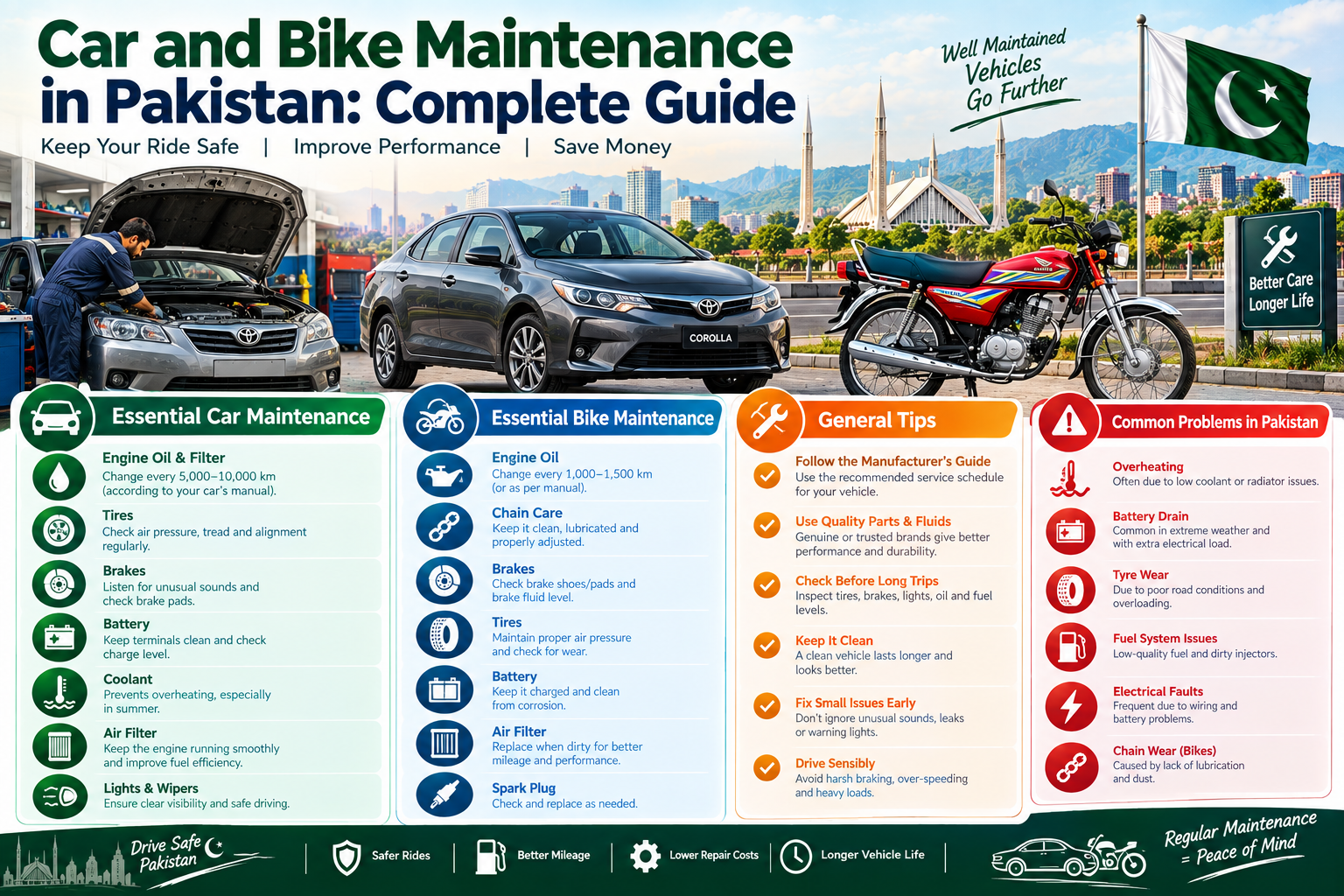
Cars and motorcycles are an important part of everyday transportation in Pakistan. People use them for going to work, attending educational institutions, running businesses, shopping, visiting family members and travelling between cities. Because vehicles are used regularly, proper maintenance is necessary to keep them safe, reliable and efficient.
Vehicle maintenance is not only about repairing a problem after it appears. Regular inspection and servicing can help identify small issues before they develop into expensive mechanical problems. Proper maintenance can also improve the overall driving or riding experience and help preserve the value of a vehicle.
Pakistan's roads, weather conditions and traffic patterns can create different challenges for vehicle owners. Hot summers, dust, rain, heavy traffic, potholes and long-distance travel can affect different parts of cars and motorcycles.
This complete guide explains important car and bike maintenance practices for Pakistani vehicle owners. It covers engines, oil, tires, brakes, batteries, cooling systems, electrical components, air conditioning, cleaning, seasonal maintenance, used vehicles and general safety.
Why Vehicle Maintenance Is Important
Regular maintenance helps a vehicle remain in better working condition.
A poorly maintained vehicle can experience problems such as:
Reduced performance
Higher fuel consumption
Starting difficulties
Brake problems
Tire damage
Battery failure
Engine overheating
Electrical issues
Suspension problems
Some maintenance tasks are simple, while others require professional assistance.
Ignoring a small warning sign can sometimes turn a relatively minor repair into a much more expensive problem.
Car Maintenance in Pakistan
Cars contain many mechanical and electrical systems that work together. Regular servicing helps keep these systems operating properly.
Important car maintenance areas include:
Engine oil
Cooling system
Brakes
Tires
Battery
Air filter
Fuel system
Suspension
Steering
Electrical system
Air conditioning
The exact maintenance schedule depends on the vehicle's manufacturer, model, age and usage.
Motorcycle Maintenance in Pakistan
Motorcycles are generally simpler than cars, but they still require regular attention.
Important motorcycle maintenance areas include:
Engine oil
Chain
Brakes
Tires
Battery
Lights
Suspension
Clutch
Cables
Electrical components
Because motorcycles are often used daily, routine checks can help identify problems early.
Engine Oil
Engine oil is essential for lubricating internal engine components.
Over time, engine oil becomes contaminated and its performance can change. Therefore, it should be replaced according to the manufacturer's recommended schedule.
When changing engine oil, vehicle owners should use the appropriate oil specification for their vehicle.
Using unsuitable oil or delaying oil changes for excessive periods may increase engine wear.
Checking Engine Oil
For vehicles where manual oil-level checking is applicable, the oil level should be checked according to the manufacturer's instructions.
The vehicle should be parked safely and on an appropriate level surface when required.
If the oil level is consistently falling, the vehicle should be inspected for possible leakage or other mechanical problems.
Air Filter Maintenance
The air filter helps prevent dust and other particles from entering the engine's air-intake system.
Pakistan's dusty roads can make air-filter maintenance particularly important.
A dirty or clogged filter may affect airflow and engine performance.
The filter should be inspected and replaced or cleaned according to the manufacturer's recommendations.
Fuel System Maintenance
A properly functioning fuel system is important for smooth engine operation.
Vehicle owners should use suitable fuel and follow manufacturer recommendations.
If a vehicle develops symptoms such as difficult starting, irregular engine operation or unusual performance changes, it should be inspected by a qualified technician.
Cooling System
The cooling system helps maintain the engine's operating temperature.
Cars commonly use coolant and a radiator-based cooling system. Motorcycles may use air cooling, liquid cooling or other designs depending on the model.
A vehicle that repeatedly overheats should not simply be driven without investigation.
Possible causes can include:
Low coolant
Cooling-system leaks
Radiator problems
Thermostat issues
Fan problems
Other mechanical faults
A qualified mechanic should diagnose repeated overheating.
Car Radiator and Coolant
Car owners should periodically inspect coolant levels according to the manufacturer's instructions.
Using the correct coolant is important. Mixing unsuitable coolant types or using plain water for long periods where proper coolant is required can create maintenance problems.
Coolant should be replaced according to the vehicle manufacturer's recommended schedule.
Motorcycle Engine Cooling
Motorcycles use different cooling systems depending on their design.
Some commuter motorcycles rely primarily on air cooling, while other motorcycles use liquid cooling.
Owners should understand which system their motorcycle uses and follow the relevant maintenance requirements.
Brake Maintenance
Brakes are among the most important safety components of any vehicle.
Car owners should pay attention to:
Brake pedal feel
Brake noise
Brake fluid
Brake pads
Brake discs
Brake drums
Motorcycle owners should regularly inspect front and rear braking components.
If braking performance changes noticeably, the vehicle should be inspected promptly.
Tire Maintenance
Tires directly connect the vehicle to the road.
Correct tire pressure can affect:
Handling
Braking
Comfort
Fuel consumption
Tire life
Tire pressure should be checked regularly according to the manufacturer's recommended specifications.
Drivers and riders should also inspect tires for cracks, punctures, uneven wear and excessive tread wear.
Tire Rotation for Cars
Some cars require periodic tire rotation to promote more even tire wear.
The exact rotation pattern depends on the vehicle's drivetrain, tire type and manufacturer recommendations.
Car owners should follow the vehicle's maintenance manual.
Motorcycle Tire Care
Motorcycle tires require particular attention because balance and grip are important for safe riding.
Inspect tires for visible damage and excessive wear.
Maintaining correct pressure can also support handling and tire performance.
Battery Maintenance
The battery is responsible for important electrical functions.
In cars, the battery is commonly involved in starting the engine and powering electrical systems when appropriate.
Motorcycle batteries can support starting, lighting and other electrical components.
Signs of battery problems can include:
Slow engine starting
Dim lights
Electrical irregularities
Repeated battery discharge
If a battery repeatedly loses charge, the charging system should also be checked.
Car Battery in Hot Weather
Pakistan's hot weather can be challenging for vehicle batteries.
High temperatures can affect battery performance and lifespan.
Car owners should keep battery terminals clean and ensure the charging system is functioning correctly.
A weak battery may become more noticeable during periods of extreme weather.
Motorcycle Battery Maintenance
Motorcycle batteries should also be inspected periodically.
For applicable battery types, terminals should remain clean and connections should be secure.
If the motorcycle is not used for long periods, the owner should follow appropriate battery-storage practices recommended for that particular model.
Chain Maintenance for Motorcycles
A motorcycle chain transfers power from the engine to the rear wheel.
The chain should be checked for:
Excessive looseness
Excessive tightness
Rust
Damage
Wear
Appropriate lubrication and adjustment should be performed according to the motorcycle manufacturer's recommendations.
A severely worn chain or sprocket set should be professionally inspected.
Clutch Maintenance
Both cars and motorcycles may use clutch systems, although their designs differ.
For motorcycles, riders may notice changes in clutch engagement if the clutch requires adjustment or service.
In manual cars, difficulty changing gears or unusual clutch behavior can indicate a problem.
Ignoring persistent clutch issues can lead to additional wear.
Transmission Maintenance
Automatic and manual transmissions have different maintenance requirements.
Transmission fluid, where applicable, should be checked and replaced according to the manufacturer's recommended schedule.
Unusual noises, delayed engagement or difficulty changing gears should be investigated by a qualified technician.
Suspension Maintenance
Suspension systems help improve comfort, handling and road contact.
Pakistan's uneven roads, potholes and speed breakers can place additional stress on suspension components.
Signs of possible suspension problems can include:
Unusual noise
Excessive bouncing
Uneven tire wear
Poor ride quality
Vehicle instability
Professional inspection is recommended when such symptoms appear.
Steering System
A car's steering system should operate smoothly.
If the steering becomes unusually difficult, loose or noisy, the vehicle should be inspected.
Wheel alignment and suspension problems can also affect steering behavior.
Motorcycle handlebars and steering components should also be checked if the rider notices unusual movement or resistance.
Wheel Alignment
Proper wheel alignment helps a car travel correctly and can reduce uneven tire wear.
Signs of alignment problems can include:
Uneven tire wear
Vehicle pulling to one side
Steering wheel not remaining centered
Changes in handling
Alignment should be checked when recommended or when symptoms appear.
Air Conditioning Maintenance
Air conditioning is especially important for many Pakistani drivers because of hot summer temperatures.
A car's air-conditioning system may include:
Compressor
Condenser
Evaporator
Refrigerant
Cabin filter
Blower system
If the air conditioner stops cooling effectively, professional diagnosis may be required.
Simply adding refrigerant without finding a possible leak may not solve the underlying problem.
Cabin Air Filter
Many cars use cabin air filters to help clean air entering the passenger compartment.
A dirty cabin filter can reduce airflow and affect air-conditioning performance.
It should be inspected and replaced according to the vehicle manufacturer's maintenance schedule.
Windshield Wipers
Good visibility is essential for safe driving.
Wiper blades can become hard, cracked or ineffective over time, particularly after exposure to intense sunlight.
Drivers should replace worn wipers when they no longer clean the windshield properly.
Lights and Indicators
Vehicle lights are important for visibility and communication with other road users.
Drivers and riders should periodically check:
Headlights
Brake lights
Indicators
Parking lights
Hazard lights
Number-plate illumination where applicable
A damaged or non-functioning light should be repaired promptly.
Vehicle Cleaning
Regular cleaning is not only about appearance.
Dust and dirt can accumulate on:
Body panels
Wheels
Engine compartments
Chain components
Electrical areas
Appropriate cleaning can help protect a vehicle's exterior and identify leaks or damage.
However, electrical and sensitive components should not be exposed unnecessarily to high-pressure water.
Car Maintenance During Summer
Pakistan's summers can be extremely hot in many regions.
Summer maintenance should include attention to:
Coolant
Engine oil
Battery
Tires
Air conditioning
Belts
Hoses
Drivers should also avoid ignoring signs of overheating.
If the temperature warning appears or the engine shows signs of overheating, the vehicle should be handled according to the manufacturer's instructions and professionally inspected if necessary.
Motorcycle Maintenance During Summer
Motorcycles also need attention during hot weather.
Owners should check engine oil, tires, chain, brakes and battery.
Long periods of heavy use can place additional stress on components, so regular inspection is useful.
Maintenance During Rainy Weather
Rain can affect visibility, braking conditions, electrical components and vehicle cleanliness.
After driving through significant water, vehicle owners should inspect the vehicle according to the manufacturer's recommendations.
Cars and motorcycles should also be cleaned appropriately because mud and road contaminants can accumulate on different components.
Monsoon and Flooded Roads
Waterlogged roads can create serious risks for vehicles.
Drivers and riders should avoid entering deep or uncertain water whenever possible.
If a vehicle has been exposed to significant flooding, professional inspection may be necessary before normal use.
Water can affect electrical systems, brakes, bearings, fluids and other components.
Importance of a Maintenance Schedule
A written maintenance schedule can help vehicle owners remember important service tasks.
The schedule can include:
Oil changes
Filter replacement
Brake inspection
Tire checks
Battery checks
Coolant service
Transmission service
Chain maintenance
General inspection
The manufacturer's maintenance manual should remain the primary reference.
Maintenance for Older Vehicles
Older cars and motorcycles may require more frequent attention because components naturally wear over time.
Owners of older vehicles should pay particular attention to:
Rubber components
Hoses
Belts
Suspension
Brakes
Electrical connections
Battery
Seals
Tires
A regular professional inspection can help identify aging components.
Maintaining a Used Vehicle
Used vehicles require special attention because their previous maintenance history may not always be complete.
After purchasing a used car or motorcycle, it can be useful to establish a maintenance baseline.
This may involve checking important fluids, filters, tires, brakes, battery and other components.
Keeping records of future servicing can make ownership easier.
Importance of Genuine and Suitable Parts
Replacement parts should be compatible with the vehicle.
Using unsuitable or poor-quality parts may affect reliability and performance.
For important components such as brakes, tires and electrical systems, owners should choose appropriate parts and have them installed correctly.
Choosing a Good Mechanic
A qualified and trustworthy mechanic can make a major difference in vehicle maintenance.
When choosing a mechanic, consider:
Experience with your vehicle type
Understanding of modern diagnostic systems
Transparent communication
Quality of replacement parts
Proper tools
Willingness to explain repairs
Vehicle owners should ask for an explanation when an expensive repair is recommended.
Keeping Maintenance Records
Keeping records can help owners understand a vehicle's maintenance history.
Records can include:
Date of service
Mileage
Oil changes
Parts replaced
Brake service
Tire replacement
Battery replacement
Major repairs
Maintenance records can also be useful when selling a vehicle.
Signs That a Vehicle Needs Attention
Vehicle owners should not ignore unusual changes.
Possible warning signs include:
Strange noises
Unusual smells
Smoke
Warning lights
Reduced braking performance
Difficulty starting
Engine overheating
Unusual vibrations
Fluid leaks
Reduced performance
These signs do not always indicate the same problem, so professional diagnosis may be necessary.
How Maintenance Can Improve Fuel Efficiency
Maintenance can contribute to efficient vehicle operation.
Factors that may affect fuel consumption include:
Tire pressure
Engine condition
Air filter condition
Fuel-system condition
Driving conditions
Vehicle load
Alignment
However, fuel consumption varies significantly depending on traffic, driving habits, vehicle design and road conditions.
Maintenance and Resale Value
A well-maintained vehicle can be more attractive to future buyers.
Maintenance records provide evidence that the vehicle received regular attention.
Clean appearance, functioning components and good mechanical condition can all influence a buyer's assessment.
Basic Maintenance Checklist for Cars
Car owners can use the following general checklist:
Check engine oil
Check coolant
Inspect tires
Check tire pressure
Inspect brakes
Check battery
Inspect lights
Check windshield wipers
Monitor warning lights
Service the air conditioner when needed
Follow the manufacturer's maintenance schedule
Basic Maintenance Checklist for Bikes
Motorcycle owners can regularly check:
Engine oil
Chain
Tires
Brakes
Lights
Battery
Suspension
Clutch
Horn
General condition
Regular checks can help identify problems before they become serious.
Maintenance and Road Safety
Vehicle maintenance is closely connected with road safety.
A properly maintained braking system, suitable tires, functioning lights and reliable steering can help the vehicle perform as designed.
Maintenance does not eliminate every road risk, but it helps ensure that the vehicle's important systems are working properly.
Future of Vehicle Maintenance in Pakistan
Vehicle maintenance is becoming increasingly connected with technology.
Modern cars and electric motorcycles may use electronic control systems, sensors and computer diagnostics.
Diagnostic tools can help technicians identify certain faults more efficiently.
Electric vehicles will also create demand for technicians with knowledge of batteries, electric motors, controllers and high-voltage systems.
As Pakistan's automotive market develops, technical skills and professional service centers are likely to become increasingly important.
Conclusion
Regular car and motorcycle maintenance is an important part of responsible vehicle ownership in Pakistan. Proper maintenance can support reliability, safety, comfort and long-term value.
Simple tasks such as checking tires, monitoring fluids, inspecting brakes and following service schedules can help identify problems early. More complicated repairs should be handled by qualified professionals.
Pakistan's weather, traffic conditions and road quality make regular maintenance particularly useful. Hot temperatures, dust, rain and uneven roads can place additional demands on vehicles.
Whether someone owns a small motorcycle, a family car, an older used vehicle or a modern electric motorcycle, maintenance should be treated as a regular responsibility rather than something to consider only after a breakdown.
By keeping service records, using suitable parts, following manufacturer recommendations and responding to warning signs, Pakistani vehicle owners can better protect their investment and enjoy more dependable transportation.
FAQs
1. How often should a car be serviced?
The correct service interval depends on the vehicle's manufacturer, model, age and usage. Owners should follow the maintenance schedule provided in the vehicle manual.
2. What are the most important motorcycle maintenance tasks?
Important tasks include checking engine oil, brakes, tires, chain, battery, lights and suspension according to the motorcycle manufacturer's recommendations.
3. Why is tire pressure important?
Correct tire pressure can support handling, braking, comfort, fuel efficiency and tire life. The manufacturer's recommended pressure should be followed.
4. What should I do if my car overheats?
Follow the vehicle manufacturer's safety instructions and avoid continuing to operate an overheating vehicle. Have the cooling system professionally inspected to identify the cause.
5. Can regular maintenance improve a vehicle's resale value?
A properly maintained vehicle with good condition and documented service history can be more attractive to potential buyers, although resale value also depends on market demand, age, model and overall condition.