Introduction
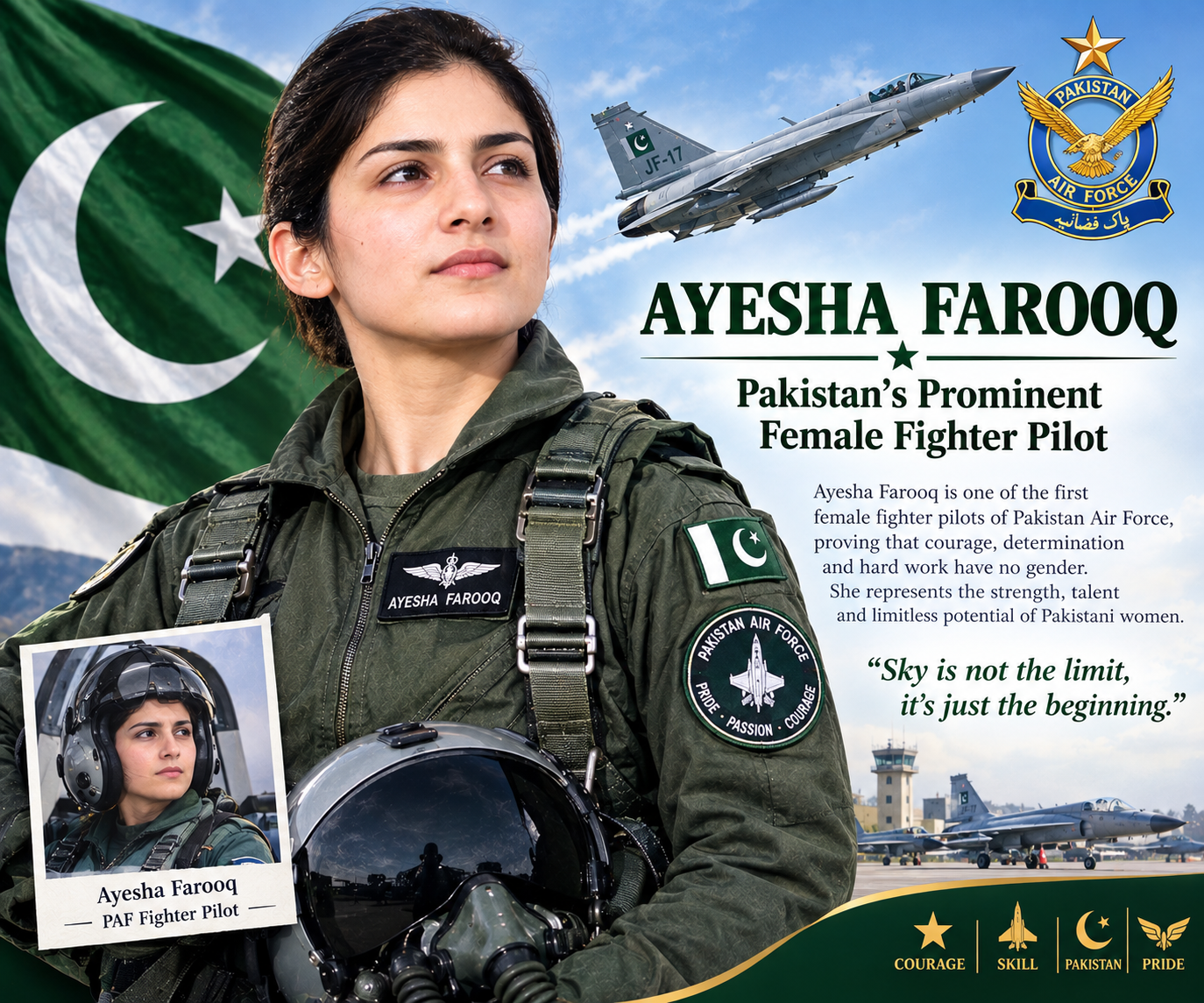
Ayesha Farooq is known as one of Pakistan's prominent female fighter pilots. Her career in the Pakistan Air Force (PAF) became an important example of women entering demanding professional fields traditionally associated with men. Through her training, discipline, and commitment, she became known as one of Pakistan's early female fighter pilots.
Ayesha Farooq attracted public attention because she pursued a career in military aviation at a time when the number of women serving as fighter pilots in Pakistan was still very limited. Her journey showed that aviation requires dedication, technical knowledge, physical preparation, and professional discipline.
Her story is important not only because of her role as a pilot but also because it highlights the changing opportunities available to women in Pakistan. She became an example of how education and determination can help young people enter specialized careers.
Ayesha Farooq's career has therefore been discussed in connection with Pakistan's aviation history, the Pakistan Air Force, and the increasing participation of women in professional and national institutions.
Early Life
Ayesha Farooq was born in Karachi and developed an interest in aviation at a young age. Like many young people, she had ambitions about her future career and wanted to choose a profession that would allow her to take on meaningful responsibilities.
Growing up in a large city exposed her to different educational and professional opportunities. Her interest in aviation gradually became stronger, and she considered the possibility of becoming a military pilot.
Choosing a career as a fighter pilot required considerable commitment. It was not only a question of learning how to fly an aircraft. It also required the ability to work under pressure, follow strict procedures, maintain discipline, and understand complex technical information.
Ayesha pursued the education and training necessary to enter the Pakistan Air Force and began the journey that would eventually make her one of Pakistan's better-known female military pilots.
Interest in Flying
Flying has always attracted people because it combines technology, skill, and responsibility. For Ayesha Farooq, aviation developed from an interest into a professional goal.
Becoming a fighter pilot is considerably different from becoming a commercial airline pilot. Military pilots receive specialized training in aircraft systems, navigation, tactical flying, communication, and emergency procedures.
Ayesha had to develop the knowledge and skills necessary to meet the standards of military aviation.
Her decision to enter this field was significant because female fighter pilots were still relatively uncommon in Pakistan. Her career therefore received attention from the public and media.
The story of her journey demonstrates how a personal interest can become a demanding professional career through continuous effort.
Joining the Pakistan Air Force
Ayesha Farooq joined the Pakistan Air Force and began professional training as a pilot. Like other PAF trainees, she underwent rigorous instruction and had to meet the required standards.
Pilot training includes classroom education as well as practical flying experience. Trainees learn about aircraft controls, flight procedures, navigation, communication, weather, and safety.
Military pilot training also requires a strong understanding of teamwork. Pilots do not work alone. They operate within a larger system involving instructors, engineers, ground crews, controllers, and commanders.
Ayesha successfully completed the training needed to become a fighter pilot.
Her achievement was important because it demonstrated that women could participate in highly specialized areas of military aviation when given the opportunity and when they met the required professional standards.
Becoming a Fighter Pilot
Ayesha Farooq became known as one of Pakistan's early female fighter pilots. She flew military aircraft as part of her professional service.
Being a fighter pilot requires concentration, technical ability, and the capacity to make quick decisions. Military aviation can involve complex situations in which a pilot has to respond rapidly while maintaining control of the aircraft.
Ayesha's role demonstrated the demanding nature of the profession.
Her career was also significant because it challenged assumptions about the types of careers women could pursue. Instead of choosing a conventional profession, she entered one of the most specialized branches of military aviation.
Her achievements brought attention to the changing role of women in Pakistan's armed forces.
Training and Discipline
Training is one of the most important parts of becoming a fighter pilot.
Ayesha's career involved extensive preparation. Pilots must learn how their aircraft operates and understand how to respond to different flying conditions.
Discipline is equally important. Military pilots have to follow strict procedures and maintain professional standards during both training and operations.
The training environment also teaches pilots how to work with others. Aviation depends heavily on communication and coordination.
Ayesha's experience demonstrates that success in a specialized profession does not happen suddenly. It is developed through education, practice, repetition, and consistent effort.
Flying Military Aircraft
Ayesha Farooq became associated with the Chengdu J-7 fighter aircraft during her service. The aircraft was one of the fighter platforms operated by the Pakistan Air Force.
Flying a fighter aircraft requires extensive technical knowledge. Pilots must understand speed, altitude, navigation, aircraft performance, communication, and safety procedures.
A military aircraft can operate under demanding conditions, making pilot training particularly important.
Ayesha's work therefore required a combination of technical skill and disciplined decision-making.
Her career helped draw public attention to the specialized nature of military aviation and to the role women could play within the PAF.
Her Public Recognition
Ayesha Farooq became widely known in Pakistan after media reports highlighted her achievement as a female fighter pilot.
Her story attracted attention because women in fighter aviation were still relatively rare. She became a recognizable example of women's participation in Pakistan's defense institutions.
Media coverage often focused on her journey, training, and experience as a fighter pilot.
This public recognition helped introduce many Pakistanis to the idea that women could pursue careers in aviation and other highly technical fields.
Her story also became a source of inspiration for students interested in science, engineering, aviation, and military service.
Women in the Pakistan Air Force
The participation of women in the Pakistan Air Force has developed over time.
Women have served in different professional areas, including medical, administrative, engineering, education, and aviation-related roles.
The entry of women into fighter aviation represented a further expansion of these opportunities.
Ayesha Farooq became one of the most recognizable names associated with this development.
Her career demonstrated that the modern armed forces include opportunities for women with the necessary qualifications, training, and professional commitment.
Her story is therefore part of a larger history of changing opportunities for women in Pakistan.
Breaking Traditional Expectations
Ayesha Farooq's career received attention partly because military aviation has historically been seen as a male-dominated field.
By entering fighter aviation, she became an example of a woman working in a demanding technical environment.
Her achievement did not mean that the profession became easy. Fighter aviation remained a highly specialized career requiring strict training and performance standards.
Instead, her career highlighted the fact that women were increasingly entering fields that had previously had very limited female participation.
This made her story particularly meaningful for young girls interested in science, technology, aviation, and defense.
Importance of Education
Education played an important role in Ayesha Farooq's career.
A pilot needs a strong educational foundation because aviation involves mathematics, physics, technology, navigation, and communication.
Before becoming a military pilot, a candidate must meet educational and professional requirements.
Ayesha's career therefore demonstrates why students should take their studies seriously.
Young people who dream of becoming pilots can benefit from developing strong knowledge in science and mathematics, while also improving communication and problem-solving skills.
Education opens doors to careers that may initially seem difficult or unreachable.
Physical and Mental Preparation
Military aviation requires both physical and mental preparation.
Pilots need to maintain their fitness because flying a high-performance aircraft can place demands on the body.
They also need concentration and the ability to remain calm while following procedures.
Ayesha Farooq's professional training required her to prepare for these challenges just as other military pilots do.
Her career demonstrates that specialized professions require preparation in multiple areas rather than relying on interest or ambition alone.
For students, this provides a useful lesson: achieving a difficult goal requires preparation of the whole skill set needed for that profession.
Professional Responsibility
A fighter pilot carries significant responsibility.
The pilot must operate aircraft safely, follow instructions, communicate clearly, and perform assigned duties professionally.
Ayesha's career was therefore built around responsibility as much as flying skill.
Military aviation also involves teamwork. Every flight depends on planning and support from many people.
The pilot is one important part of a larger organization.
This teaches an important lesson about professional life: individual success is often connected with cooperation and responsibility toward others.
Ayesha Farooq as an Inspiration
Ayesha Farooq became an inspirational figure for many young women in Pakistan.
Her career demonstrated that women could enter specialized professional fields with proper education and training.
For students, her story can encourage them to think about careers based on their abilities and interests.
Aviation is only one example. Women have also entered engineering, computing, medicine, law, business, science, and many other professional fields.
Ayesha's story is therefore broader than the story of a single pilot. It reflects changing career opportunities and the importance of professional preparation.
Interest Among Young Girls
Stories about female pilots can have a strong effect on young girls because they provide examples of women working in technical professions.
Ayesha Farooq's public profile introduced the idea of a female fighter pilot to many people who had not previously thought about it.
For girls interested in aviation, her career showed that the field required hard work but could also be pursued as a serious profession.
The broader message is that students should explore their abilities and understand the educational path required for the careers they want.
Ayesha's journey can encourage young people to set realistic goals and work patiently toward them.
Importance for Pakistan's Aviation History
Ayesha Farooq holds a notable place in Pakistan's modern aviation story because she became associated with the development of female participation in fighter aviation.
The Pakistan Air Force has a long history, and the involvement of women has been one part of its changing structure.
Her career represents a period when more Pakistani women were entering areas of military and technical service.
This makes her important not only as an individual pilot but also as part of a broader institutional development.
Challenges of Becoming a Fighter Pilot
Becoming a fighter pilot is difficult for anyone.
Candidates must pass selection procedures, complete training, learn complex technical material, and develop practical flying skills.
They also have to meet medical and physical standards.
For women entering a traditionally male-dominated environment, there may also be additional social expectations and public attention.
Ayesha's experience illustrates that entering such a profession requires confidence and consistent effort.
Her career demonstrates the importance of focusing on training and professional performance.
The Role of Confidence
Confidence is useful in aviation because pilots need to make decisions and trust their training.
However, professional confidence comes from preparation rather than simply believing that one can succeed.
Ayesha Farooq's career shows the connection between training and confidence.
A trained pilot is better prepared to handle complex situations because she has practiced the necessary procedures.
For students, the same principle applies. Confidence in studies often grows when students prepare well, practice regularly, and understand their subjects.
Teamwork in Military Aviation
No fighter pilot works alone.
Although the pilot controls the aircraft, many people contribute to each mission. Ground crews maintain the aircraft, controllers provide information, instructors develop pilot skills, and commanders plan operations.
Ayesha's role as a fighter pilot was therefore part of a much larger system.
This illustrates the importance of teamwork in professional environments.
Students can apply the same principle in school projects, sports, and future careers. Learning to cooperate with others is an important professional skill.
Technology and Aviation
Modern aviation depends heavily on technology.
Military pilots must understand aircraft systems, radar information, communication equipment, navigation tools, and other technologies.
For this reason, students interested in aviation can benefit from studying science, mathematics, and computing.
Ayesha Farooq's career demonstrates how aviation brings together multiple fields of knowledge.
The pilot is not simply someone who sits in a cockpit. She is a trained professional who must understand a complex technical system.
Role of Women in National Institutions
Ayesha Farooq's career is also important in the context of women's participation in Pakistan's national institutions.
Women have contributed to Pakistan in many fields, including education, healthcare, science, business, public administration, and the armed forces.
Female fighter pilots represent a particularly specialized area of this broader participation.
Ayesha became one of the public faces of this change.
Her career helped demonstrate that women could undertake demanding technical responsibilities when they completed the required training and qualifications.
Influence on Popular Perception
Before women began entering fighter aviation in greater numbers, many people associated military flying almost exclusively with men.
The visibility of pilots such as Ayesha Farooq changed that perception for some members of the public.
News reports, interviews, and photographs introduced people to the reality of women serving as military pilots.
Her story became especially interesting to students because it connected education, aviation, technology, and national service.
The attention also helped create greater awareness of the professional opportunities available to women.
A Career Based on Merit and Training
A military pilot must meet professional standards.
Regardless of gender, pilots need proper training, technical knowledge, and the ability to perform their duties safely and effectively.
Ayesha's career illustrates the importance of these professional requirements.
Her story can therefore be viewed through the broader principle that specialized careers require specialized preparation.
For students, the lesson is straightforward: ambition is the beginning, but education and training are what make a career possible.
Lessons for Students
Ayesha Farooq's life offers several lessons for students.
The first is goal setting. She developed an interest in aviation and worked toward it as a profession.
The second is education. Technical careers require strong academic foundations.
The third is discipline. Military aviation demands strict professional standards.
The fourth is persistence. Difficult careers require continuous effort.
The fifth is confidence. Students need confidence to enter challenging fields, but that confidence should be supported by preparation.
Another important lesson is to consider careers based on skills and interests rather than stereotypes about which professions belong to particular genders.
Ayesha Farooq and Young Pakistan
Young Pakistanis are increasingly interested in technology, aviation, engineering, business, and other specialized careers.
The examples set by professionals such as Ayesha Farooq can help students understand that career possibilities are broader than traditional assumptions.
Her story can be especially meaningful for girls who are interested in science and technology.
It encourages the idea that professional goals should be approached through education, training, and consistent effort.
In this way, her career has significance beyond the Pakistan Air Force.
Her Place Among Pakistani Pilots
Pakistan has produced many well-known pilots, including both military and civilian aviators.
Ayesha Farooq is notable because she became one of the recognizable female figures in Pakistani fighter aviation.
Her story can be considered alongside the stories of earlier PAF pilots whose careers helped shape Pakistan's aviation history.
While different pilots are remembered for different achievements, Ayesha's contribution is particularly connected with women's participation in fighter aviation.
The Importance of Role Models
Role models can influence how young people imagine their futures.
When students see people working in careers that they once believed were impossible or unusual, they may become more open to considering those careers themselves.
Ayesha Farooq became such a figure for many young Pakistani girls.
Her story showed that aviation could be a professional goal for women who were willing to complete the necessary training.
Role models do not replace education or hard work, but they can help young people imagine what might be possible through preparation.
Continuing Importance of Her Story
Ayesha Farooq's story continues to be relevant because women's participation in technical and professional careers remains an important topic in Pakistan.
Her career represents a stage in the development of female participation in military aviation.
For students, the story remains useful because it connects education with professional achievement.
It also shows how individual careers can become part of broader social change.
Ayesha's name is therefore associated not only with flying but also with the expanding visibility of women in specialized national services.
Conclusion
Ayesha Farooq is remembered as one of Pakistan's prominent female fighter pilots and as an important figure in the development of women's participation in military aviation.
Her journey began with an interest in flying and developed through education, professional training, discipline, and determination. By joining the Pakistan Air Force and becoming associated with fighter aviation, she entered a highly specialized field that had historically included relatively few women.
Her career attracted public attention and became an example for many young girls interested in aviation, science, technology, and professional service.
The story of Ayesha Farooq also demonstrates that success in a demanding profession requires much more than ambition. It requires education, technical knowledge, physical preparation, teamwork, responsibility, and continuous learning.
Her contribution is therefore significant both in Pakistan's aviation history and in the broader story of women's professional participation.
For students, her life offers valuable lessons about setting goals, studying seriously, developing skills, and having the confidence to pursue challenging careers. Her journey remains a notable chapter in the story of Pakistani aviation and an important example of a woman entering a demanding technical profession.
FAQs
1. Who is Ayesha Farooq?
Ayesha Farooq is a Pakistani female fighter pilot who served in the Pakistan Air Force and became known for her role in military aviation.
2. Why is Ayesha Farooq famous?
She became widely known as one of Pakistan's prominent female fighter pilots and helped draw attention to women's participation in fighter aviation.
3. Which aircraft did Ayesha Farooq fly?
She became associated with the Chengdu J-7 fighter aircraft during her service in the Pakistan Air Force.
4. What can students learn from Ayesha Farooq?
Students can learn about discipline, education, preparation, confidence, persistence, and pursuing professional goals beyond traditional stereotypes.
5. Why is Ayesha Farooq important in Pakistan's aviation history?
She is notable for her role as a female fighter pilot and for representing the increasing participation of women in specialized areas of the Pakistan Air Force.