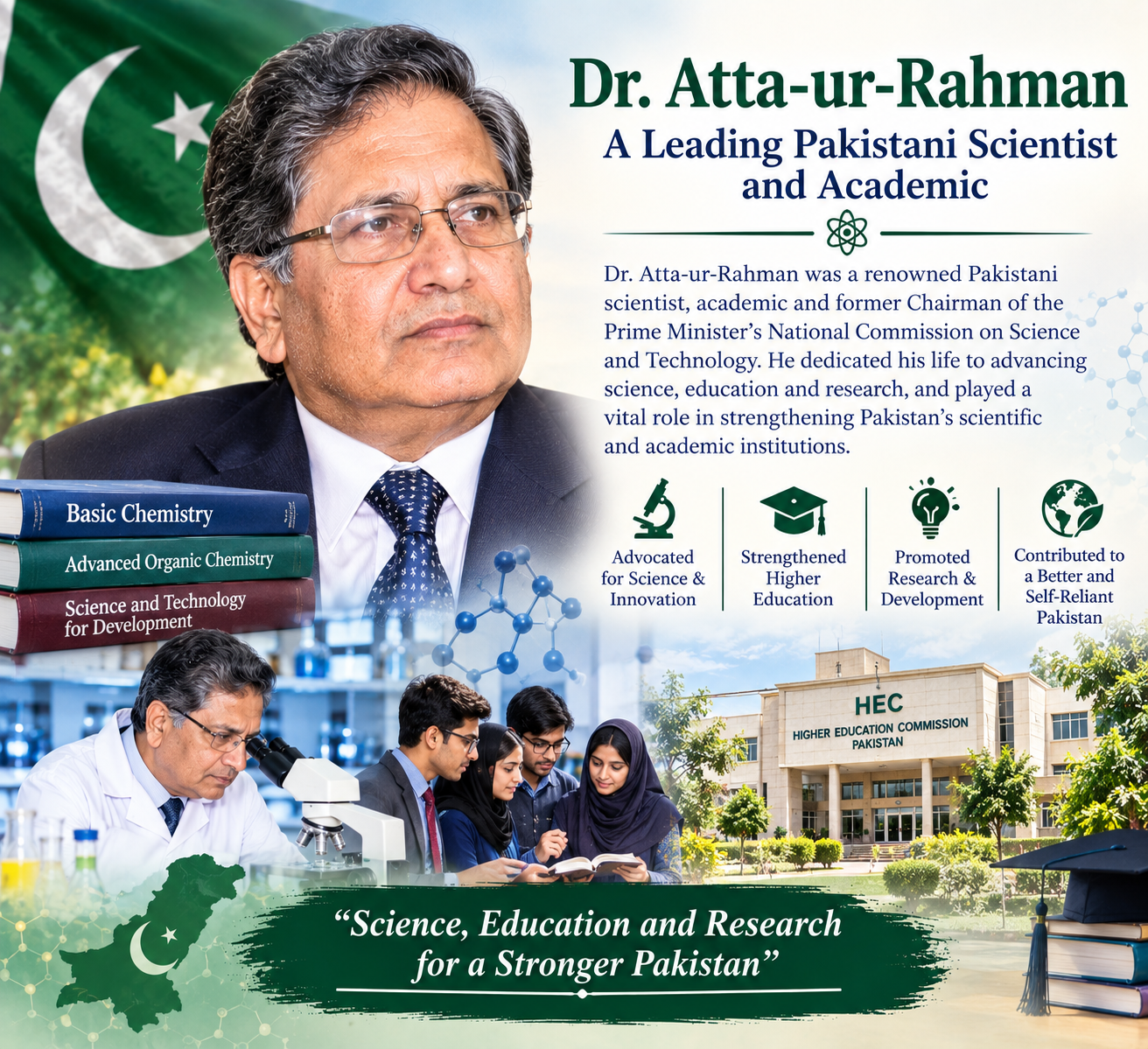
Dr. Atta-ur-Rahman is one of Pakistan's most respected scientists, researchers, academics, and scientific leaders. Although he is not primarily known as a practicing medical doctor, his contribution to science, higher education, research, and the development of Pakistan's scientific institutions has made him an important national personality.
His career is especially significant because he worked to strengthen science and research in Pakistan at a time when the country needed greater investment in universities, laboratories, technology, and scientific education. Through his academic work and leadership, he encouraged young people to study science and pursue research.
Dr. Atta-ur-Rahman's field is chemistry, particularly organic chemistry and natural products. His scientific career has earned him national and international recognition. He has also played important roles in higher education and science policy.
His life provides an inspiring example of how education, research, discipline, and leadership can contribute to the progress of a country.
Early Life and Education
Dr. Atta-ur-Rahman was born in Delhi in 1942 and later moved to Pakistan with his family. He developed an interest in education and science and eventually pursued higher studies in chemistry.
Chemistry is a major branch of science that studies substances, their properties, structures, and reactions. It is connected with many areas of everyday life, including medicine, agriculture, materials, food, energy, and industry.
As a student, Dr. Atta-ur-Rahman developed a strong academic foundation. His interest in research later became an important part of his professional career.
Education played a central role in his development. His academic journey demonstrates how scientific knowledge can open opportunities for research and national service.
Higher Education
Dr. Atta-ur-Rahman studied chemistry at the University of Karachi and later continued his education in the United Kingdom.
His advanced studies allowed him to work in a research environment with access to modern scientific facilities.
Higher education is particularly important for scientific development because universities provide opportunities for students and researchers to investigate new questions.
A scientist does not simply learn existing information. Scientists also conduct experiments, analyze evidence, and attempt to discover new knowledge.
Dr. Atta-ur-Rahman's academic career developed around this research-oriented approach.
Career as a Chemist
Dr. Atta-ur-Rahman became an internationally recognized chemist. His research has focused mainly on organic chemistry and natural products.
Natural products are chemical substances that come from natural sources such as plants and other organisms. Studying these substances can help scientists understand their properties and potential uses.
Organic chemistry has applications in medicine, pharmaceuticals, agriculture, and many other industries.
Through his research, Dr. Atta-ur-Rahman contributed to the development of scientific knowledge in his field.
Research Contributions
Research is one of the most important parts of a scientist's career.
Scientists spend years studying specific questions, conducting experiments, analyzing results, and publishing their findings.
Dr. Atta-ur-Rahman has produced a large body of scientific research and has authored numerous books and research publications.
His work has helped increase the visibility of Pakistani science internationally.
Research also provides opportunities for young scientists to learn from experienced researchers and develop their own careers.
Scientific Publications
Scientific publications are important because they allow researchers to share discoveries with the wider scientific community.
A research paper normally explains a scientific question, describes the methods used to study it, presents the results, and discusses what those results mean.
Dr. Atta-ur-Rahman has contributed extensively to scientific literature.
His publications have covered different areas of organic chemistry and natural products.
Writing scientific papers requires accuracy, patience, and careful analysis. His large research output reflects a long-term commitment to scientific work.
Contribution to Higher Education
One of Dr. Atta-ur-Rahman's most important contributions has been his work in higher education.
Universities are essential for the development of a country's human resources.
They educate doctors, engineers, teachers, scientists, lawyers, computer professionals, and many other specialists.
However, universities need more than classrooms. They also require laboratories, libraries, trained teachers, research funding, and modern technology.
Dr. Atta-ur-Rahman strongly emphasized the importance of research and higher education in national development.
Leadership in Science and Technology
Dr. Atta-ur-Rahman has held important leadership positions related to science and higher education in Pakistan.
During his public service career, he worked to improve research institutions and strengthen the country's scientific capacity.
Science and technology can contribute to economic development by creating new industries, improving production, developing medicines, and solving practical problems.
Countries that invest in scientific education and research can develop greater technological independence.
Dr. Atta-ur-Rahman's work reflected this understanding.
Role in the Higher Education Commission
Dr. Atta-ur-Rahman played a major role in Pakistan's Higher Education Commission, commonly known as HEC.
During his leadership, significant attention was given to improving universities, research opportunities, scholarships, laboratories, and faculty development.
The goal was to strengthen Pakistan's higher education system and increase the country's research capacity.
Scholarships are particularly important because they allow talented students to pursue advanced degrees.
By supporting postgraduate education, a country can develop more researchers and university teachers.
Scholarships for Students
One of the important areas of higher education development is providing opportunities for talented students to study advanced subjects.
Students who want to become researchers often need master's or doctoral degrees.
Such education can be expensive and may not always be accessible to students from less wealthy families.
Scholarship programs can help talented students continue their education.
Dr. Atta-ur-Rahman's efforts in higher education included a strong emphasis on developing human resources through advanced education and research.
Development of Research Laboratories
Scientific research requires proper facilities.
A chemistry researcher needs laboratories, instruments, chemicals, safety equipment, and trained technical staff.
Similarly, researchers in physics, biology, computer science, and engineering require specialized facilities.
Dr. Atta-ur-Rahman's science policy work emphasized the importance of research infrastructure.
Better laboratories give researchers the opportunity to conduct experiments and produce internationally competitive research.
This also benefits students because they can gain practical experience rather than relying only on textbooks.
Promoting Science in Pakistan
Pakistan has many talented students who are interested in science.
However, students need encouragement, resources, and opportunities to develop their abilities.
Scientists and academic leaders can play an important role by showing students that research can become a meaningful career.
Dr. Atta-ur-Rahman's public and academic work has helped promote the idea that science should be a national priority.
His career has encouraged discussions about research, innovation, technology, and education.
Importance of Scientific Research
Scientific research helps societies solve problems.
Research can lead to better medicines, improved agricultural methods, stronger materials, cleaner technologies, and new digital systems.
It can also help governments make decisions based on evidence.
For a developing country, research can reduce dependence on imported knowledge and technology.
Dr. Atta-ur-Rahman has repeatedly emphasized the importance of science and technology for Pakistan's development.
Science and Economic Development
Science is closely connected with economic growth.
Modern economies depend on technology, innovation, skilled workers, and research.
Industries need scientists and engineers to develop new products and improve existing processes.
Universities can also work with industries to solve practical problems.
When research is connected with industry, scientific discoveries can become useful products and services.
Dr. Atta-ur-Rahman's vision for Pakistan included strengthening the country's scientific and technological capacity.
Importance of Technology
Technology affects almost every part of modern life.
Communication, transportation, healthcare, education, agriculture, banking, and industry all depend on technology.
Countries that develop technological skills can become more competitive in the global economy.
Technology also creates new career opportunities for young people.
Dr. Atta-ur-Rahman's work in science policy emphasized the importance of developing Pakistan's technological capabilities through education and research.
Encouraging Young Researchers
Young researchers are essential for the future of science.
Experienced scientists can guide younger researchers by providing training, mentorship, and opportunities to conduct research.
A strong research culture allows students to ask questions and explore new ideas.
Dr. Atta-ur-Rahman's academic career has included teaching and mentoring roles, allowing him to contribute to the development of younger scientists.
His work demonstrates that experienced academics have an important responsibility to support the next generation.
International Recognition
Dr. Atta-ur-Rahman has received significant international recognition for his scientific work.
His achievements have brought attention to Pakistani research and demonstrated that scientists from Pakistan can contribute to international science.
International recognition can also help create research partnerships between universities and scientific institutions.
Such cooperation allows researchers to share knowledge, equipment, ideas, and expertise.
Awards and Honors
Dr. Atta-ur-Rahman has received numerous awards and honors for his scientific and academic contributions.
Among the most important national recognitions is the Nishan-e-Imtiaz, one of Pakistan's highest civilian honors.
He has also received international scientific recognition.
Awards are not the only measure of a scientist's success, but they can highlight the importance of long-term research and public service.
Leadership Qualities
Dr. Atta-ur-Rahman's career demonstrates several important leadership qualities.
One is vision. Scientific development requires thinking about the future rather than only immediate problems.
Another is persistence. Research can involve years of experimentation and study.
A third quality is commitment to education.
Without educated researchers, laboratories and scientific institutions cannot grow.
His career shows the importance of combining academic expertise with institutional leadership.
Science and National Progress
A country's development depends on many factors, including education, healthcare, infrastructure, economic policy, and technology.
Science connects with many of these areas.
For example, scientific research can improve agriculture, healthcare, environmental protection, and industrial production.
A country that invests in science can develop solutions suited to its own needs.
Dr. Atta-ur-Rahman's work has emphasized the role of science in national progress.
Importance of Chemistry
Chemistry may seem like a specialized subject, but it affects everyday life.
Medicines, fertilizers, plastics, fuels, cleaning products, food ingredients, cosmetics, and many other materials involve chemistry.
Organic chemistry is particularly important because many medicines and biological substances contain organic compounds.
Research in natural products can also help scientists investigate substances that may have useful biological properties.
Dr. Atta-ur-Rahman's scientific specialization therefore has relevance to many areas of science and technology.
Contribution to Pakistani Universities
Universities need strong academic environments to produce quality research.
This includes qualified faculty, modern laboratories, research funding, postgraduate programs, and international collaboration.
Dr. Atta-ur-Rahman's work in higher education focused strongly on improving these areas.
His efforts contributed to a greater emphasis on research productivity and postgraduate education.
The long-term goal of such reforms is to create universities that can compete internationally while also addressing Pakistan's local needs.
Importance of Research Culture
A research culture develops when students and teachers are encouraged to ask questions, investigate problems, and share new knowledge.
It is different from an education system based only on memorization.
Students who participate in research learn how to analyze information and solve problems.
Dr. Atta-ur-Rahman's career strongly reflects the importance of research-based education.
His example can encourage Pakistani students to look beyond examination marks and develop curiosity about the world around them.
Inspiration for Students
Students can learn many lessons from Dr. Atta-ur-Rahman's life.
The first is the importance of education.
The second is the value of hard work and consistency.
The third is the importance of research and curiosity.
The fourth is the value of serving the country through one's profession.
Students interested in chemistry, biology, physics, computer science, engineering, or other scientific fields can look at his career as an example of how academic knowledge can lead to national and international contributions.
Inspiration for Future Scientists
Pakistan needs scientists who can work on important national challenges.
These challenges include water shortages, climate change, food security, energy, disease, environmental pollution, and technological development.
Future scientists will need strong educational foundations and opportunities for research.
They will also need creativity and the courage to investigate difficult problems.
Dr. Atta-ur-Rahman's career provides an example of how scientific knowledge can become part of a broader national mission.
Science Education for the Future
The future of Pakistan depends heavily on the quality of its education system.
Schools can encourage curiosity, while universities can provide advanced knowledge and research opportunities.
Students should have access to laboratories and practical learning.
Science education should also connect classroom knowledge with real-world problems.
This can help students understand why science matters.
Dr. Atta-ur-Rahman's work in education and research highlights these priorities.
Role of Teachers
Teachers play an important role in developing future scientists.
A good teacher does more than explain a textbook. A teacher encourages students to ask questions, think critically, and explore ideas.
University professors can also introduce students to research.
Dr. Atta-ur-Rahman's academic career demonstrates the long-term influence that teachers and researchers can have on their students.
Many students continue their careers because an experienced teacher inspired them to pursue a particular field.
A Scientist with a National Vision
Dr. Atta-ur-Rahman's career is notable because he combined scientific research with national-level leadership.
He did not limit his contribution to his own research field.
He also worked on the development of institutions, higher education, research funding, and science policy.
This broader vision is important for countries that want to develop their scientific capacity.
Scientific progress requires both individual researchers and strong institutions.
Challenges for Scientific Development
Pakistan still faces challenges in science and higher education.
Research requires financial investment, modern equipment, qualified faculty, and stable institutions.
Researchers also need opportunities to collaborate with scientists in other countries.
Universities need to maintain high academic standards while making education accessible to more students.
These challenges cannot be solved overnight.
They require long-term planning and consistent support.
Dr. Atta-ur-Rahman's career demonstrates the importance of maintaining a long-term focus on scientific development.
Legacy
Dr. Atta-ur-Rahman's legacy includes his scientific research, academic publications, teaching, leadership, and efforts to strengthen science and higher education in Pakistan.
His work has influenced discussions about the importance of research and technological development.
For students, his life provides an example of how education can become a source of personal achievement and national service.
For Pakistan's scientific community, his career represents the importance of investing in researchers and institutions.
Conclusion
Dr. Atta-ur-Rahman is one of Pakistan's prominent scientists and academic leaders. His career in chemistry, research, higher education, and science policy has made a lasting contribution to the country's scientific development.
Although he is not primarily a medical doctor, his contribution to science and education makes him an important Pakistani personality for an article series about professionals who have served the country.
His journey demonstrates the power of education, research, discipline, and leadership.
He has shown that scientists can contribute to society not only through laboratory research but also by strengthening universities, encouraging young researchers, and supporting national science and technology policies.
For young students, his life carries a valuable message: knowledge becomes more powerful when it is used to solve problems and serve society.
Pakistan's future depends on educated and skilled young people. By encouraging students to study science, conduct research, and develop new ideas, the country can build a stronger future.
Dr. Atta-ur-Rahman's career remains an inspiring example of how one dedicated academic can contribute to science, education, and national progress.
FAQs
1. Who is Dr. Atta-ur-Rahman?
Dr. Atta-ur-Rahman is a renowned Pakistani scientist, chemist, researcher, and academic leader.
2. What is Dr. Atta-ur-Rahman known for?
He is known for his research in organic chemistry and natural products and his contributions to science and higher education.
3. Is Dr. Atta-ur-Rahman a medical doctor?
No. He is a scientist and chemist rather than a medical doctor.
4. What role did he play in higher education?
He played an important leadership role in Pakistan's higher education and research development, including work associated with the Higher Education Commission.
5. Why is Dr. Atta-ur-Rahman an inspiration for students?
His career shows how education, scientific research, and dedication can be used to achieve professional success and contribute to national development.