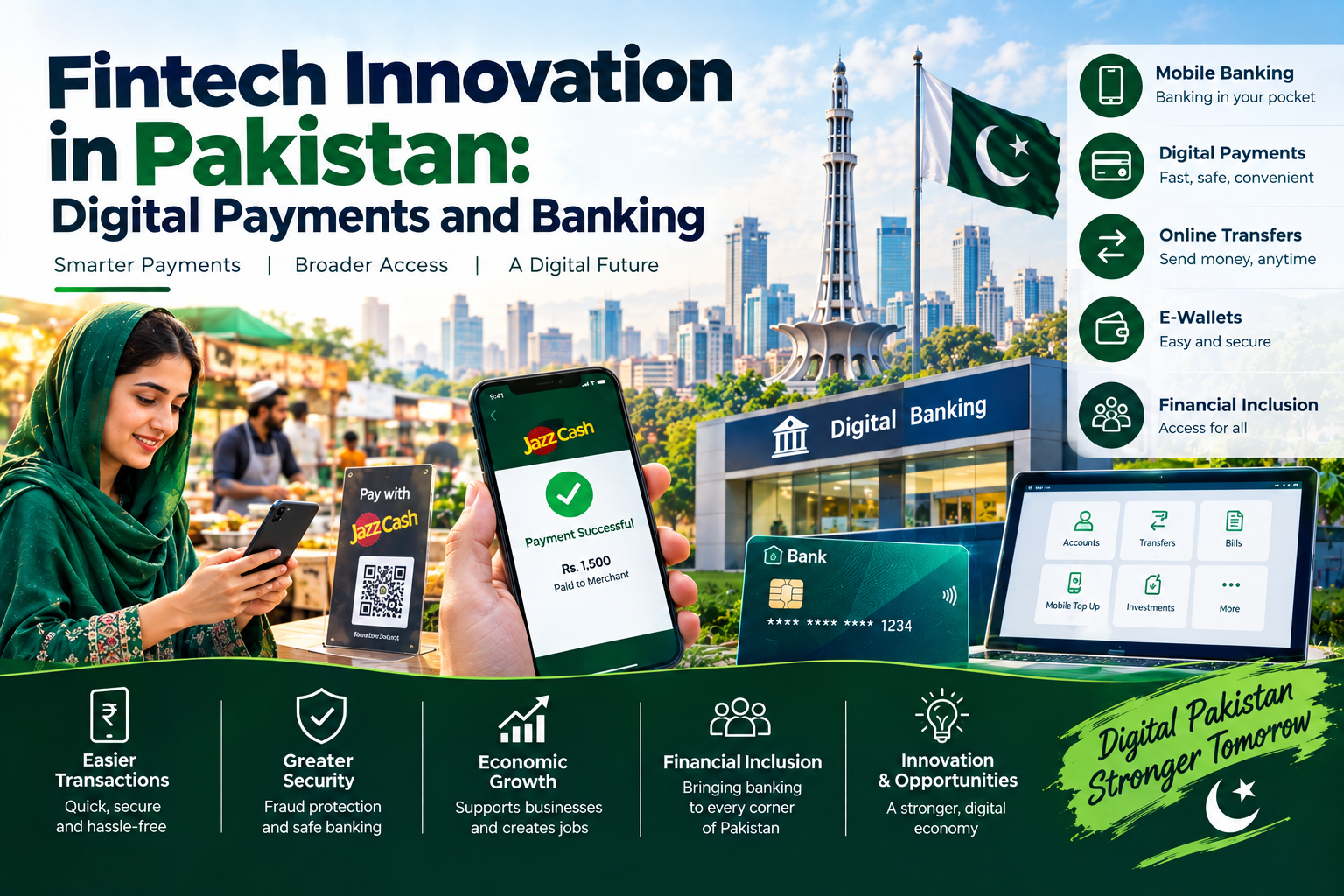
Financial technology, commonly known as fintech, is becoming an important part of Pakistan's digital economy. The rapid growth of smartphones, internet connectivity, mobile applications, digital wallets, online banking, and electronic payments is changing how people and businesses manage money.
Fintech innovation refers to the use of technology to provide financial products and services in faster, more accessible, and often more convenient ways. It includes digital payments, mobile banking, online transfers, digital wallets, financial management applications, insurance technology, payment platforms, and other technology-based financial services.
Pakistan has a large population and a growing digital market, creating opportunities for fintech companies to develop solutions for consumers, businesses, freelancers, and other users. Digital financial services can also support small businesses by providing additional payment methods and easier ways to manage transactions.
At the same time, fintech development requires strong attention to cybersecurity, privacy, consumer protection, digital literacy, and reliable infrastructure.
What Is Fintech?
Fintech is a combination of the words "financial" and "technology." It describes the use of technology to improve or create financial services.
Traditional banking often requires customers to visit a physical branch for certain services. Fintech can allow users to complete many activities through mobile applications, websites, or digital platforms.
Examples include:
Mobile banking
Digital wallets
Online payments
QR payments
Electronic money transfers
Digital financial management
Online lending platforms
Insurance technology
Payment gateways
Business accounting tools
The goal is generally to make financial services more accessible, efficient, convenient, and technology-driven.
Why Fintech Matters in Pakistan
Fintech innovation is important because financial services are connected to almost every part of the economy.
People receive salaries, pay bills, purchase products, transfer money, save funds, and manage businesses through financial systems.
Digital technology can simplify many of these activities.
For businesses, electronic payments can make transactions easier to record and manage.
For consumers, mobile financial services can reduce the need to visit physical branches for routine activities.
Fintech can also create opportunities for technology entrepreneurs and skilled professionals.
Digital Payments in Pakistan
Digital payments are one of the most visible areas of fintech innovation.
Customers can use mobile applications, online banking, digital wallets, cards, and QR-based systems to make payments.
Instead of relying entirely on physical cash, consumers can use electronic methods for certain purchases and transfers.
Businesses can also offer multiple payment options to customers.
Digital payment systems can provide transaction records, which can be useful for financial management and accounting.
As more people become familiar with digital payments, these systems can become an increasingly important part of everyday commerce.
Mobile Banking
Mobile banking allows customers to access banking services through smartphones.
Depending on the bank and service, users may be able to:
Check account information
Transfer money
Pay bills
Review transactions
Manage certain banking services
Make online payments
Mobile banking can save time because customers may not need to visit a branch for routine activities.
It also allows financial services to be available outside traditional banking hours.
Digital Wallets
Digital wallets allow users to store and manage funds electronically.
They can be used for payments, transfers, bill payments, and other financial activities depending on the service.
Digital wallets can be useful for people who prefer mobile-based transactions.
For small businesses, digital wallets can also provide an additional way to receive payments.
The security of digital wallets is important, so users should protect account credentials and enable available security features.
QR Code Payments
QR codes have become a useful technology for digital payments.
A business can display a QR code that customers scan using a compatible banking or payment application.
The customer can then initiate a digital payment.
QR payments can be useful for small businesses because they can provide an electronic payment option without requiring complex physical payment equipment in some situations.
Restaurants, shops, service providers, and other businesses can use digital payment technologies to improve customer convenience.
Fintech and Small Businesses
Small businesses can benefit from fintech in several ways.
Digital payment systems allow businesses to receive electronic payments.
Accounting applications can help businesses record income and expenses.
Online banking can simplify business transfers.
Digital financial tools can also help entrepreneurs monitor cash flow.
Better financial records can help business owners understand their operations and make more informed decisions.
For small businesses moving from cash-based systems toward digital systems, fintech can support gradual modernization.
Fintech and Freelancers
Freelancing is an important part of Pakistan's digital economy.
Freelancers often work with clients from different cities and countries.
Digital financial services can help freelancers manage payments, invoices, transfers, and business records.
Online financial tools can make it easier for independent professionals to separate personal and professional finances.
Reliable payment infrastructure is particularly important for freelancers who depend on international clients.
Fintech for Online Businesses
E-commerce businesses depend heavily on financial technology.
Customers need ways to pay for products.
Businesses need systems for receiving and recording payments.
Online stores may use payment gateways that connect customers, merchants, and financial institutions.
Digital refunds and transaction records can also be managed through technology.
The development of e-commerce and fintech therefore supports each other.
Digital Financial Inclusion
Financial inclusion means increasing access to useful and affordable financial services.
Fintech can potentially help people who have limited access to traditional banking facilities.
Mobile-based services can make certain financial activities accessible without requiring frequent visits to physical branches.
Digital payments can also make it easier for small businesses and individuals to participate in electronic commerce.
However, financial inclusion depends on more than technology. Users also need affordable connectivity, suitable devices, digital skills, trust, and appropriate consumer protection.
Fintech and Women
Digital financial services can provide useful opportunities for women entrepreneurs and workers.
Women operating online businesses can receive payments through digital systems.
Freelancers can use electronic financial services to manage income.
Digital banking can provide convenient access to financial information and transactions.
Financial education is also important because technology alone does not guarantee effective financial management.
Women who develop both digital and financial skills can use fintech tools more effectively for personal and business activities.
Fintech and Youth
Young people are among the active users of digital financial services.
Students and young professionals often use mobile applications, online shopping platforms, digital wallets, and electronic transfers.
This familiarity with technology can create opportunities for young entrepreneurs to develop fintech-related businesses.
Young professionals can also pursue careers in software development, cybersecurity, data analysis, financial technology, product management, and digital marketing.
Artificial Intelligence in Fintech
Artificial intelligence can support several areas of financial technology.
AI systems can analyze large amounts of information and identify patterns.
Financial institutions and technology companies can potentially use AI for customer support, fraud detection, risk analysis, personalized services, and operational automation.
Chatbots can help answer common customer questions.
Data analysis can support financial decision-making.
However, AI-based financial systems need careful oversight because inaccurate or biased automated decisions can affect customers.
Blockchain and Financial Technology
Blockchain is another technology associated with fintech.
Blockchain uses distributed digital records to store and verify transactions.
It has applications beyond cryptocurrencies and can be explored for areas such as record management, digital identity, and transaction systems.
However, blockchain technology is complex, and its practical use depends on the specific problem being addressed.
Technology adoption should therefore focus on whether a system provides genuine value rather than simply following a trend.
Digital Banking and Customer Experience
Fintech has increased expectations for convenient banking.
Customers often want services that are fast, accessible, and easy to use.
Mobile applications can provide interfaces through which customers manage financial activities.
Banks and fintech companies therefore need to focus on usability, reliability, security, and customer support.
A technically advanced service may still struggle if customers find it difficult to understand or use.
Cybersecurity in Fintech
Security is one of the most important issues in digital finance.
Financial accounts can contain sensitive information and funds.
Users should follow basic security practices such as:
Using strong and unique passwords
Enabling multi-factor authentication
Avoiding suspicious links
Never sharing verification codes
Keeping mobile applications updated
Using official applications
Checking transaction details carefully
Banks and fintech companies also need strong cybersecurity systems to protect customers.
Fraud and Digital Awareness
As digital payments grow, users need to understand common financial scams.
Fraudulent messages may attempt to convince people to reveal passwords, account information, or verification codes.
Some scams may use fake websites, calls, messages, or social media accounts.
Digital financial education can help users identify suspicious activity.
People should verify unexpected financial requests through official channels rather than relying on information contained in suspicious messages.
Privacy and Financial Data
Fintech services often process sensitive information.
This may include transaction histories, contact information, account details, and other personal data.
Responsible data management is therefore essential.
Financial technology companies should use appropriate security and privacy practices.
Users should also understand what information they provide to digital services.
Trust is an important part of financial technology adoption.
Fintech and E-Commerce
Fintech and e-commerce are closely connected.
Online stores need secure and convenient payment systems.
Customers need confidence that payments will be processed correctly.
Digital payment technologies can support online shopping by making transactions easier.
As e-commerce grows, demand for reliable payment infrastructure also increases.
Fintech companies can therefore contribute to the broader digital commerce ecosystem.
Digital Lending and Financial Services
Technology can also change how financial services are delivered.
Digital platforms may simplify application processes and provide online financial services.
Data analysis can help financial institutions assess applications and manage risks.
However, lending involves significant financial responsibilities.
Consumers need clear information about costs, terms, repayment obligations, and risks.
Responsible financial technology should focus on transparency and appropriate consumer protection.
Insurance Technology
Insurance technology, often called insurtech, uses digital tools to improve insurance services.
Online platforms can help customers compare information, submit applications, manage policies, or communicate with providers.
Digital systems can also help insurance companies manage records and claims.
Technology can potentially make certain insurance processes faster and more accessible.
Digital Accounting
Financial technology is also helping businesses manage accounting.
Cloud-based accounting software can allow businesses to record sales, expenses, invoices, and other financial information.
Small businesses can use digital accounting tools to understand their cash flow.
Automated calculations can reduce some manual work.
However, businesses still need proper financial controls and, where appropriate, professional accounting support.
Fintech and Rural Communities
Fintech can also create opportunities for rural communities.
Mobile-based financial services can potentially provide access to digital transactions without requiring a nearby traditional bank branch for every activity.
Farmers and rural businesses can use digital payment systems to interact with suppliers and buyers.
However, rural fintech adoption depends on mobile connectivity, affordable devices, digital literacy, and trust.
Challenges Facing Fintech in Pakistan
The fintech sector faces several challenges.
Cybersecurity is one of the most important.
Digital literacy is another issue because users need to understand how financial applications work and how to stay safe.
Internet connectivity and device affordability can also affect access.
Regulatory requirements and compliance can influence how fintech companies develop their products.
Building consumer trust is equally important.
Fintech businesses must demonstrate reliability, transparency, security, and responsible handling of customer information.
The Role of Regulation
Financial services require appropriate oversight because they involve people's money and sensitive information.
Regulation can help establish standards for financial institutions and technology companies.
Clear rules can also provide greater confidence to businesses, investors, and customers.
At the same time, innovation requires space for new ideas.
A balanced regulatory environment can help encourage technological development while protecting consumers and maintaining financial stability.
Education and Fintech Skills
The growth of fintech creates demand for people with different skills.
These may include:
Software development
Data science
Cybersecurity
Financial analysis
Product management
Digital marketing
Risk management
Customer service
Universities and professional training institutions can help students develop these skills.
Combining financial knowledge with technology skills can be particularly useful for fintech careers.
The Future of Fintech in Pakistan
The future of fintech in Pakistan is likely to involve greater use of mobile payments, digital banking, artificial intelligence, data analytics, digital commerce, and automated financial services.
Businesses may increasingly rely on digital systems for payments and accounting.
Consumers may have more options for managing financial activities through mobile devices.
Technology may also support financial inclusion by creating easier access to selected services.
However, future growth will depend on trust, security, infrastructure, digital literacy, appropriate regulation, and responsible innovation.
Conclusion
Fintech innovation is changing Pakistan's financial landscape by introducing new ways to make payments, manage money, conduct banking activities, operate businesses, and access financial services.
Mobile banking, digital wallets, QR payments, online transfers, payment gateways, digital accounting, and other technologies are becoming increasingly relevant to consumers and businesses.
Fintech can also create opportunities for startups, freelancers, women entrepreneurs, young professionals, and small businesses.
However, digital finance must be supported by strong cybersecurity, privacy protection, consumer awareness, reliable infrastructure, and responsible regulation.
Pakistan's growing digital economy provides opportunities for continued fintech development. With the right combination of technology, financial education, security, and innovation, digital financial services can become an increasingly important part of everyday economic activity.
FAQs
1. What is fintech in Pakistan?
Fintech means using technology to provide or improve financial services such as digital payments, mobile banking, online transfers, and financial management.
2. What are examples of fintech services?
Examples include mobile banking, digital wallets, QR payments, payment gateways, online transfers, digital accounting, and other technology-based financial services.
3. How does fintech help small businesses?
Fintech can help small businesses accept digital payments, manage transactions, maintain financial records, and access online financial services.
4. Is digital payment safe?
Digital payments can be secure when users and service providers follow appropriate security practices. Users should protect passwords and verification codes and avoid suspicious links.
5. What is the future of fintech in Pakistan?
The future may include greater use of digital banking, mobile payments, artificial intelligence, data analytics, e-commerce payments, and other technology-based financial services.