Introduction
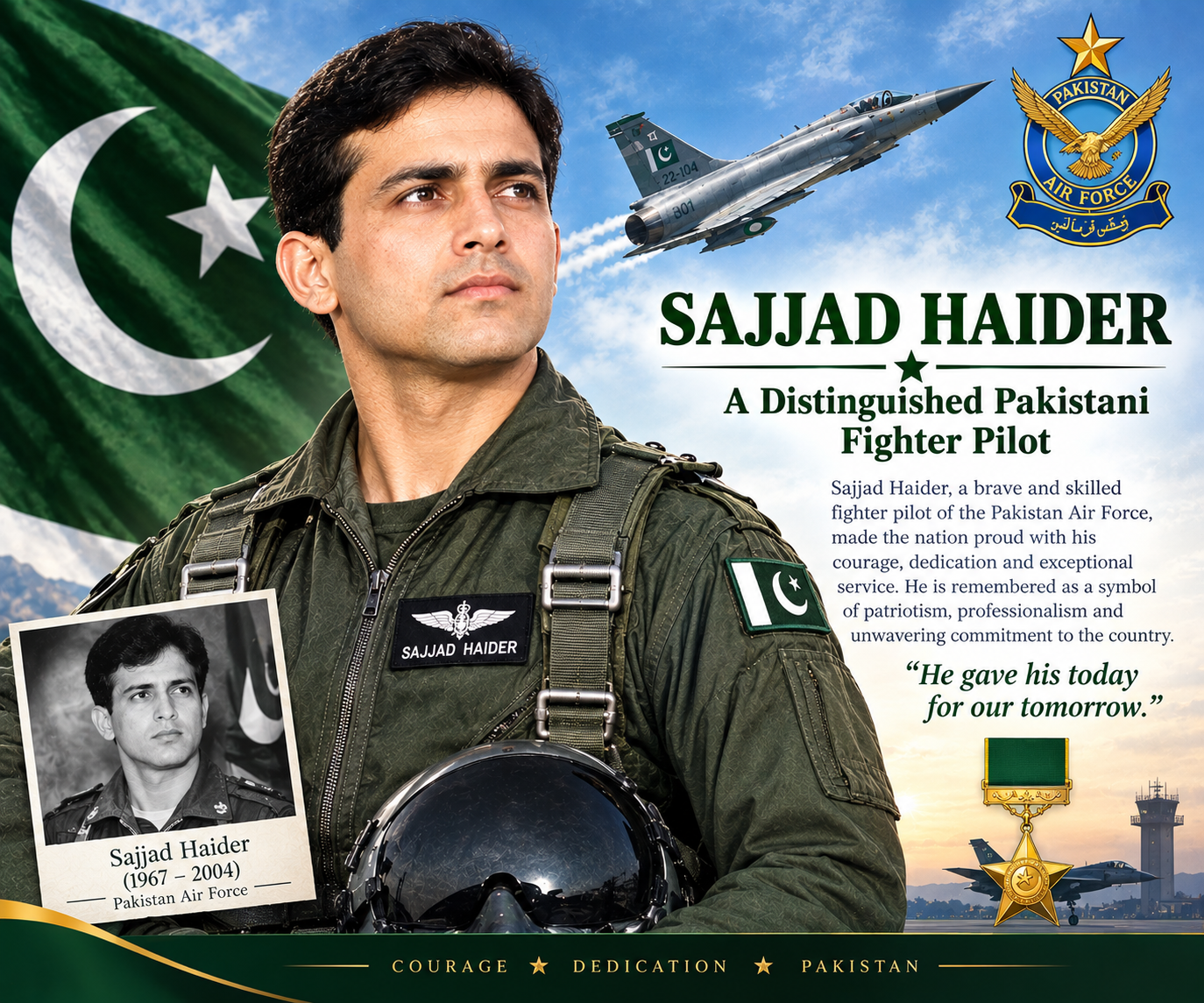
Sayed Sajad Haider, also written as Sajjad Haider, was a distinguished Pakistani fighter pilot and senior officer of the Pakistan Air Force (PAF). He became especially well known for his role during the 1965 Indo-Pak war, when he commanded No. 19 Squadron and led an important strike against the Pathankot air base. He later served in senior positions and remained an influential figure in discussions about Pakistan's military aviation history.
Sajad Haider was born on 26 December 1932 in Sargodha, then part of British India. He joined the air force in the early years of Pakistan and eventually rose to the rank of Air Commodore. His military career lasted around 28 years and included experience as a pilot, instructor, squadron commander, and senior officer.
He became popularly associated with the nickname “Nosy Haider” and was also described as the “Saviour of Lahore” in accounts of his career. His wartime experiences, particularly his leadership during 1965, became an important part of his public legacy. He later wrote about his experiences in the book Flight of the Falcon: Demolishing Myths of the Indo-Pak Wars 1965 and 1971.
His life is significant not only because of his service as a fighter pilot but also because of his contribution to professional military aviation, leadership, writing, and public discussion of Pakistan's air-force history.
Early Life of Sajad Haider
Sajad Haider was born on 26 December 1932 in Sargodha. His early life was spent during a period of major political changes in the Indian subcontinent. As a young boy, he witnessed the final years of British rule and later the creation of Pakistan in 1947.
According to biographical material about him, much of his childhood was spent in Balochistan, where his family lived in a multicultural environment. He later recalled growing up among people from different communities and cultures. These early experiences became an important part of the personal story he shared in his later writings.
His early years also developed his interest in national service. The official biographical account of his life says that, as a teenager, he became inspired by Quaid-i-Azam Muhammad Ali Jinnah after seeing him in Quetta. This experience contributed to his ambition to become a defender of Pakistan.
This ambition eventually led him toward aviation. The young Sajad Haider wanted a career that combined discipline, technology, leadership, and service. The Pakistan Air Force offered precisely such an opportunity.
Education and Preparation
Education was an important part of Sajad Haider's development. His recorded education included St. Francis' Grammar School, Forman Christian College, RPAF College, PAF Staff College, and several later professional and defense institutions. He also studied at institutions outside Pakistan, including training in the United States and Germany.
His educational journey shows that becoming a professional military pilot involves much more than learning to control an aircraft.
A military aviator needs knowledge of aircraft systems, navigation, communications, tactics, leadership, and decision-making. As officers move into senior ranks, they also require education in management, strategic planning, and defense studies.
Sajad Haider's career reflected this broad approach to professional development. He continued receiving specialized training throughout his career and eventually completed advanced studies, including an MSc from Quaid-i-Azam University.
His educational background became one of the foundations of his long military career.
Joining the Pakistan Air Force
Sajad Haider entered the air force during the formative years of Pakistan's military aviation. By 1953, he had graduated from the RPAF College and was commissioned into the Royal Pakistan Air Force, which later became the Pakistan Air Force.
After commissioning, he completed fighter-conversion training and began building experience as a military aviator.
His early career coincided with a period when Pakistan was developing and modernizing its air force. The institution required pilots who could operate increasingly advanced aircraft and help establish professional standards for the future.
Haider became part of this generation of pilots. Over time, he moved from basic flying duties to more specialized roles and developed a reputation for aviation skill and leadership.
Early Flying Experience
Sajad Haider's aviation career developed through practical experience and specialized training.
He completed a Fighter Conversion Course on the Tempest at Mauripur and reportedly finished second in his class behind another well-known PAF pilot, Sarfraz Rafiqui. He later trained on the F-86 Sabre in the United States, an important aircraft in Pakistan's air-force history.
These experiences gave him exposure to different aircraft and professional flying environments.
He also became associated with the PAF Falcons, the air force's aerobatic team. The team gained international attention for a formation flying performance involving 16 F-86 Sabres in 1958.
Participation in aerobatic flying requires precision, concentration, timing, and close cooperation between pilots. Such experience can contribute to the development of a pilot's confidence and technical discipline.
Service in the Early Years of Pakistan
Before becoming famous for his role in the 1965 war, Sajad Haider was already gaining experience in military operations.
Biographical accounts say that he took part in aerial operations during the Waziristan conflict in the 1950s. He also served with early jet units of the Royal Pakistan Air Force and developed his knowledge of modern fighter operations.
This period was important because the Pakistan Air Force was moving from older piston-engine aircraft toward jet aviation.
The change required new skills and a strong technical understanding. Pilots had to adapt to higher speeds, new aircraft systems, and different operational methods.
Haider's career developed during this technological transition, giving him experience that later became useful when he took on command responsibilities.
Leadership of No. 19 Squadron
One of the most important positions in Sajad Haider's career was his command of No. 19 Squadron PAF.
Squadron command is a major responsibility. A squadron includes pilots, ground staff, technicians, and other personnel, all working together to maintain operational readiness.
The squadron commander is responsible for leadership, planning, training, discipline, and mission preparation.
Haider became particularly famous because of his leadership of No. 19 Squadron during the 1965 war.
His role was not limited to flying an aircraft himself. He was also responsible for planning and leading other pilots.
The 1965 War
The 1965 Indo-Pak war became the defining chapter of Sajad Haider's military career.
During the conflict, the Pakistan Air Force conducted air operations against Indian targets. Haider's No. 19 Squadron was assigned important strike missions.
One of the best-known events occurred on 6 September 1965, when Haider led the squadron during the attack on Pathankot air base in India. His official biographical website describes this as one of the major operations associated with his career.
The operation became a major part of Pakistani accounts of the 1965 air war.
Haider's leadership during the strike contributed significantly to his reputation as a fighter pilot and squadron commander.
The Pathankot Strike
The Pathankot operation is one of the most frequently discussed events in Sajad Haider's career.
According to biographical accounts associated with Haider, he led a formation of aircraft toward Pathankot air base. The mission targeted military aircraft and other equipment at the base.
Accounts of the operation differ in their descriptions of exact damage and individual combat results, so specific figures should be treated as claims from particular historical accounts rather than as uncontested facts.
Haider's own memoir later discussed the events of 1965 and 1971 in detail. His book was presented as a personal account of his experiences and his interpretation of the wars.
Regardless of differences between historical accounts, the Pathankot strike remains strongly associated with Sajad Haider's name.
His Role as a Commander
The significance of Sajad Haider's role in 1965 was partly related to leadership.
Leading a fighter formation requires careful planning. Pilots must understand the mission, maintain formation, communicate with other aircraft, and respond to changing conditions.
The commander must also understand the capabilities of the aircraft and the skills of the pilots.
Haider's experience before 1965 helped prepare him for this responsibility.
His previous training, operational service, and experience with fighter aircraft gave him a professional foundation for squadron command.
This makes his story useful for understanding that successful military aviation depends on leadership and teamwork as well as individual flying skill.
Fighter Aircraft and Technology
Sajad Haider was closely associated with the F-86 Sabre, a jet fighter that played an important role in the Pakistan Air Force during the 1950s and 1960s.
The F-86 was a high-performance jet aircraft that required specialized pilot training.
Operating a fighter aircraft involves understanding speed, altitude, navigation, communications, aircraft performance, and operational procedures.
For pilots like Haider, technical knowledge was essential.
His training in the United States on the F-86 gave him additional experience with the aircraft and helped him become part of Pakistan's growing jet-fighter capability.
The PAF Falcons
Another interesting part of Haider's career was his association with the PAF Falcons aerobatic team.
Aerobatic flying is a highly precise form of aviation in which pilots perform coordinated maneuvers. It demands concentration, discipline, coordination, and extensive practice.
The PAF Falcons became known internationally during the 1950s. The team performed a famous 16-aircraft formation loop using F-86 Sabres in 1958, an event recorded in accounts of Haider's career.
This aspect of his career demonstrates that military aviation includes many forms of flying, from combat operations to highly coordinated demonstration flying.
Service During 1971
Sajad Haider also served during the 1971 war.
The 1971 conflict was another major and difficult period in Pakistan's history. The political and military circumstances were very different from 1965, and the country's armed forces faced significant challenges.
Haider's experience and seniority allowed him to contribute during this period.
Later, his memoir Flight of the Falcon discussed both the 1965 and 1971 wars. The book is described as an account of the experiences, difficulties, and controversies he encountered during his approximately 28 years in the Pakistan Air Force.
His writings therefore provide a personal perspective on the military history of those years.
A Long Military Career
Sajad Haider served in the Pakistan Air Force for approximately 28 years and eventually reached the rank of Air Commodore.
A long military career requires continuous learning and adaptation.
A pilot who becomes a senior officer takes on responsibilities that go far beyond flying. These can include administration, leadership, training, strategic planning, and institutional development.
Haider's career followed this path.
His transition from young pilot to senior commander illustrates how professional experience can grow over time.
Awards and Recognition
Sajad Haider received a number of honors during his career. His biographical record lists the Sitara-e-Jurat, Tamgha-e-Diffa, and other awards associated with his military service.
Military decorations are awarded for different forms of service and achievement. In Haider's case, they became part of the public record of his contribution to Pakistan's air force.
His recognition was also connected to his leadership during the 1965 war.
Over the decades, he became one of the more widely recognized names among Pakistan's former fighter pilots.
Nickname “Nosy Haider”
Sajad Haider was popularly known as “Nosy Haider.” His official biography explains that the nickname was given to him by fellow pilot Alauddin “Butch” Ahmed.
Nicknames often become part of military aviation culture because pilots spend years working closely together.
In Haider's case, the nickname became strongly connected with his public identity.
It also appears in accounts of his life, including material discussing his memoir and later career.
“Saviour of Lahore”
Sajad Haider was also referred to in some accounts as the “Saviour of Lahore.” This title is connected with his role during the 1965 war and the importance attributed to air operations in defending Lahore.
Such titles are part of the way military figures are remembered in public narratives.
They should be understood as part of historical and commemorative language rather than as formal military ranks.
Haider himself became increasingly associated with the stories of the 1965 air war as the decades passed.
Writing About His Experiences
After his military career, Sajad Haider remained active in public discussion and writing.
He authored Flight of the Falcon: Demolishing Myths of the Indo-Pak Wars 1965 and 1971, a book based on his experiences and perspectives. His official biography describes it as a personal account covering major events and challenges from his years in the Pakistan Air Force.
Writing gave him an opportunity to record his own understanding of events.
Personal memoirs are valuable historical sources because they preserve the experiences of people who directly participated in major events. At the same time, memoirs represent the author's own perspective, so historians may compare them with other sources.
Haider's book became an important part of his later public legacy.
Life After the Air Force
After retiring from active military service, Sajad Haider remained engaged in public life.
He became known as an author, columnist, businessman, defense commentator, and philanthropist, according to biographical accounts.
This phase of his life demonstrated that retirement from the military did not mean the end of his professional contribution.
His experience as a pilot and senior officer gave him knowledge that could be applied to writing, analysis, and public discussion.
His later work also helped preserve memories of an earlier generation of Pakistani air-force personnel.
Importance to Pakistan's Aviation History
Sajad Haider's significance comes from several parts of his career.
He was among the early generation of Pakistani jet pilots, served with the PAF Falcons, commanded a fighter squadron, participated in major wars, and reached senior rank.
His story therefore covers several stages of Pakistan's aviation development.
He experienced the transition from early post-independence aviation to more advanced jet operations.
He also witnessed major changes in Pakistan's political and military environment.
For students studying Pakistan's history, his career offers a way to understand the development of military aviation during the country's early decades.
Lessons from His Professional Life
Sajad Haider's life offers several useful lessons for students.
The first is the importance of education. His career included extensive academic and professional training.
The second is discipline. Military aviation requires strict procedures and careful preparation.
The third is leadership. As a squadron commander, he had responsibility for people as well as aircraft.
The fourth is continuous learning. Haider continued receiving professional education throughout his career.
The fifth is documentation. By writing about his experiences, he contributed to the preservation of historical memories.
These lessons are useful beyond aviation.
Students can apply the principles of preparation, learning, teamwork, responsibility, and communication to their own careers.
Importance of Teamwork
One of the central lessons from fighter aviation is that no pilot works entirely alone.
A squadron depends on pilots, engineers, mechanics, controllers, intelligence personnel, administrators, and many other specialists.
A successful mission therefore depends on coordination.
Sajad Haider's role as a squadron commander made this especially important. He had to work with many people and coordinate their responsibilities.
This aspect of his career helps students understand why teamwork is essential in professional environments.
Technology and Science
Sajad Haider's career also demonstrates the importance of science and technology in aviation.
Fighter aircraft depend on engineering, aerodynamics, propulsion, navigation, communications, and other technologies.
Pilots must understand enough about these systems to operate their aircraft safely and effectively.
For students interested in aviation, studying physics, mathematics, computer science, and engineering can provide useful foundations.
Haider's career developed during a period of rapid technological change in military aviation, making his professional life closely connected with that transformation.
Role Model for Aspiring Pilots
Sajad Haider's career can be informative for students who dream of becoming pilots.
His journey shows that a successful aviation career involves many stages.
A student first needs a strong educational foundation. After that comes specialized training, practical experience, professional discipline, and continued learning.
For military pilots, the path also includes leadership development.
Haider's career demonstrates how an individual can move through these stages over several decades.
His story can therefore encourage students to think about aviation as a serious professional field rather than simply as a glamorous career.
His Contribution to the PAF Legacy
The Pakistan Air Force has developed a strong tradition of remembering its pilots and commanders.
Sajad Haider became part of that tradition because of his service during important periods in the country's history.
His career connected several generations of PAF development, from early jet aviation to later military leadership.
The continuing interest in his life shows the historical value of the people who helped shape the institution.
Recent commemorative material has continued to discuss Haider's role in the 1965 war, showing that his name remains part of public discussion about Pakistan's aviation history.
His Death in 2025
Sajad Haider died on 3 January 2025 in Islamabad at the age of 92. According to a family memorial announcement, he was buried on 4 January 2025 and received a services funeral by the Pakistan Air Force.
His death marked the end of a long life connected with Pakistan's military aviation.
Tributes following his death remembered his wartime service, leadership, writing, and long association with the Pakistan Air Force.
His life had extended from the early years of Pakistan's independence into the modern era.
Remembering Sajad Haider
Sajad Haider's legacy continues through historical accounts, his writings, PAF commemorations, and the memories of people who knew his work.
His official family website preserves biographical material, photographs, military information, and references related to his career.
His story is particularly relevant to the history of Pakistan's air force because it covers both operational flying and senior leadership.
He is remembered as a pilot who served during two major wars and as an officer who spent decades developing his professional knowledge.
Sajad Haider and Young Pakistanis
Young people can learn from Sajad Haider's life in several ways.
His career shows that ambitious goals require preparation.
His education demonstrates the importance of continuous learning.
His flying career shows the value of technical knowledge and discipline.
His leadership responsibilities show that professional success also involves responsibility toward others.
His later writing demonstrates the importance of recording experiences and preserving history.
These lessons can help students understand that a successful career develops gradually through education, practice, and dedication.
Conclusion
Sajad Haider was a distinguished Pakistani fighter pilot and senior Pakistan Air Force officer whose career became an important part of Pakistan's aviation history.
Born in 1932, he entered the air force during the early years of Pakistan and developed extensive experience as a military aviator. He trained on important aircraft, became associated with the PAF Falcons, commanded No. 19 Squadron, and played a notable role in the 1965 war, particularly during the Pathankot operation.
He later served during the 1971 conflict and eventually rose to the rank of Air Commodore. After retiring from military service, he continued contributing through writing, public discussion, and other professional activities.
His book, Flight of the Falcon, provided his personal account of the wars and his long career in the PAF.
Sajad Haider died in Islamabad on 3 January 2025, leaving behind a career that spanned several important decades of Pakistani history.
For students, his life offers lessons about education, discipline, leadership, teamwork, technical knowledge, and continuous learning. His story remains an important chapter in the history of the Pakistan Air Force and Pakistani military aviation.
FAQs
1. Who was Sajad Haider?
Sajad Haider was a Pakistani fighter pilot and senior Pakistan Air Force officer who later rose to the rank of Air Commodore.
2. Why is Sajad Haider famous?
He is especially known for commanding No. 19 Squadron during the 1965 war and leading the well-known Pathankot air operation.
3. Which aircraft was Sajad Haider associated with?
He trained and served on aircraft including the Tempest and F-86 Sabre, and he was also associated with the PAF Falcons.
4. Did Sajad Haider write a book?
Yes. He wrote Flight of the Falcon: Demolishing Myths of the Indo-Pak Wars 1965 and 1971, describing his experiences and perspectives on the wars.
5. When did Sajad Haider die?
Sajad Haider died on 3 January 2025 in Islamabad at the age of 92.