Introduction
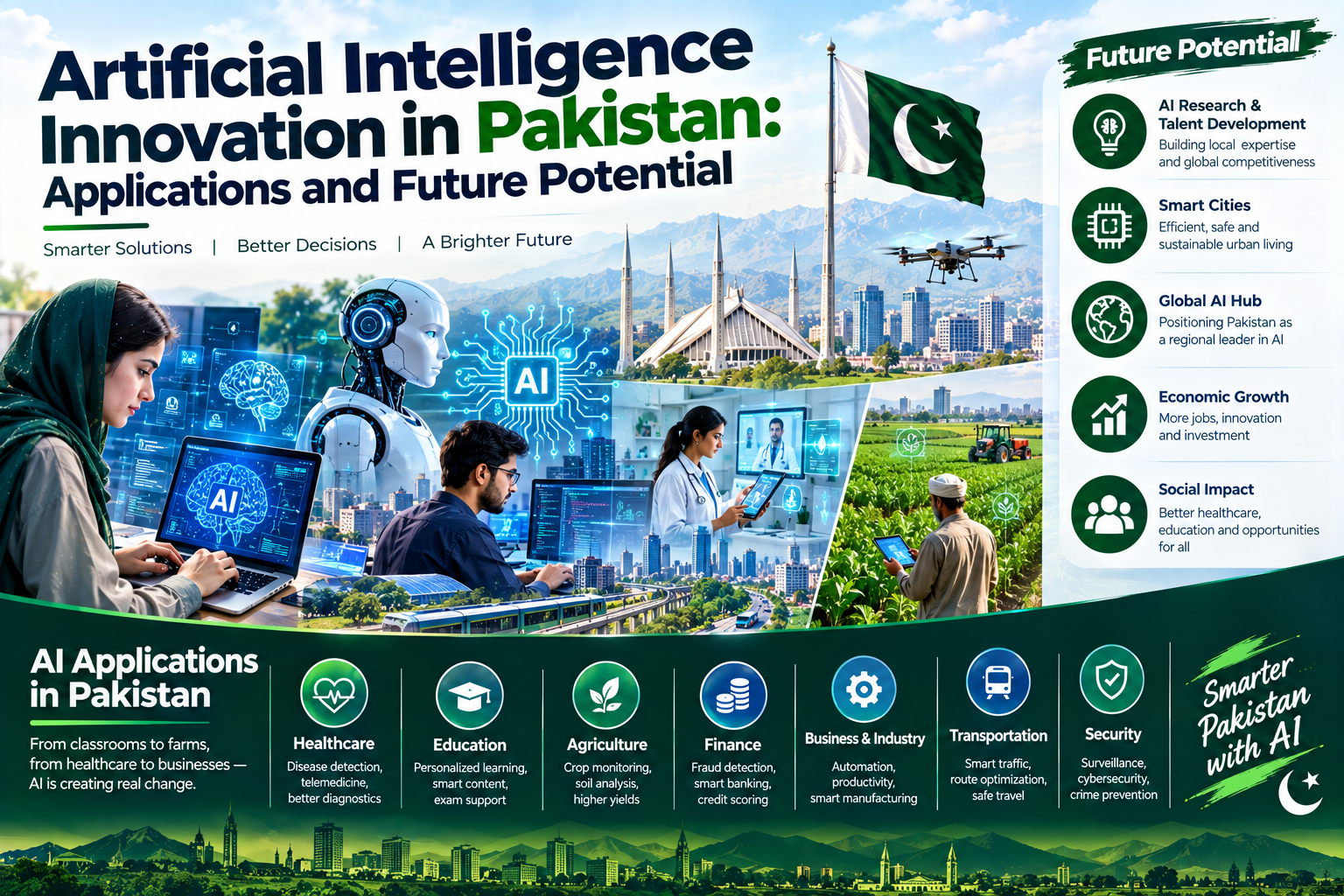
Artificial Intelligence, commonly known as AI, is one of the most important technological developments of the modern world. It is changing the way people work, communicate, learn, conduct business, analyze information, and solve problems. In Pakistan, artificial intelligence innovation is also creating new opportunities for businesses, students, researchers, startups, government organizations, and technology professionals.
AI refers to computer systems that can perform tasks that normally require certain forms of human intelligence. These tasks can include recognizing patterns, understanding language, analyzing information, making predictions, and supporting decision-making.
Pakistan has a large young population and a growing technology sector, which creates opportunities for AI development. Universities are introducing computing and data-related programs, technology companies are exploring AI-based solutions, and startups are developing digital products for local and international markets.
AI can potentially contribute to many areas of Pakistan's economy, including healthcare, education, agriculture, banking, e-commerce, manufacturing, transportation, customer service, and cybersecurity.
At the same time, AI development requires responsible planning. Data privacy, cybersecurity, education, employment changes, digital inequality, and ethical use are important considerations.
What Is Artificial Intelligence?
Artificial intelligence is a field of computer science focused on creating systems that can perform tasks associated with intelligent behavior.
AI systems can process information and identify patterns. Depending on their design, they may work with text, images, audio, numbers, or other types of data.
Some common AI technologies include:
Machine learning
Natural language processing
Computer vision
Speech recognition
Recommendation systems
Predictive analytics
Generative AI
Robotics
These technologies have different applications and can be used separately or together.
Growth of AI in Pakistan
Pakistan's technology ecosystem has been developing rapidly, creating an environment where AI can become increasingly important.
Software companies, freelancers, startups, universities, and technology professionals are exploring AI applications.
Young people are also showing interest in programming, data science, machine learning, and other technology fields.
The availability of online learning resources means students can study AI concepts from international and local educational platforms.
However, building a strong AI ecosystem requires more than learning software tools. It also requires mathematics, statistics, programming, research, computing infrastructure, high-quality data, and practical experience.
AI and Pakistani Startups
Startups can use AI to solve specific business problems.
A startup might develop an AI-powered platform for customer support, education, agriculture, financial services, logistics, healthcare, or marketing.
AI can help startups automate certain repetitive processes and analyze large amounts of information.
For Pakistani entrepreneurs, AI can also create opportunities to build services for international customers.
A strong startup ecosystem can encourage experimentation and the development of new technology-based businesses.
AI in Healthcare
Healthcare is one of the areas where AI can provide useful support.
AI systems can analyze certain types of medical information and assist healthcare professionals with research, data analysis, medical imaging, and administrative processes.
For example, computer vision technologies can be used to analyze medical images in appropriate systems.
AI can also help researchers process large datasets and identify patterns.
However, medical AI requires careful testing and professional supervision. AI should not automatically be treated as a replacement for doctors or other healthcare professionals.
Patient privacy is also extremely important when using medical data.
AI in Education
Education is another important area for AI innovation in Pakistan.
AI-based educational tools can provide explanations, practice exercises, personalized learning activities, language support, and study assistance.
Teachers can also use technology to organize certain educational tasks.
AI may help identify areas where students need additional practice.
However, students should use AI as a learning support rather than simply depending on it to complete their academic work.
Education should continue to focus on understanding, critical thinking, creativity, and independent learning.
Personalized Education Through AI
Students have different learning styles and different levels of understanding.
AI systems can potentially analyze learning activities and provide customized exercises.
For example, a student who struggles with a particular mathematics topic may receive additional practice on that topic.
Another student who understands the basics quickly may move to more advanced exercises.
Personalized learning can therefore make digital education more flexible.
AI in Agriculture
Agriculture is an important sector of Pakistan's economy, and AI can potentially support farmers and agricultural organizations.
AI systems can analyze information related to crops, weather, soil, irrigation, and farming conditions.
Computer vision can also be used in certain agricultural applications to identify patterns in crop images.
AI-based systems may support decisions related to irrigation, crop monitoring, and agricultural planning.
However, technology must be adapted to local farming conditions and should remain affordable for farmers.
Smart Farming
Smart farming combines digital technology with agriculture.
It may involve:
Sensors
Drones
Satellite information
AI
Weather data
Automated irrigation
Digital monitoring
AI can analyze information collected by these technologies.
This can help farmers make more informed decisions when appropriate.
For Pakistan, smart agriculture may provide opportunities to improve resource management and agricultural productivity.
AI in Banking and Fintech
The financial sector is another area where AI can be useful.
Banks and financial technology companies can use AI for tasks such as:
Fraud detection
Customer support
Risk analysis
Transaction monitoring
Personalized services
Data analysis
AI systems can identify unusual transaction patterns and help financial institutions investigate potential problems.
The use of AI in finance requires strong security and privacy practices because financial information is sensitive.
AI in E-Commerce
Online shopping platforms can use AI to improve customer experiences.
AI can analyze customer behavior and provide product recommendations.
It can also support search functions, customer service, inventory management, and demand forecasting.
Pakistani e-commerce businesses can use these technologies to improve online shopping experiences and manage business operations.
AI and Customer Service
Chatbots and virtual assistants are becoming increasingly common in digital services.
Businesses can use AI-powered systems to answer frequently asked questions, guide customers through services, and provide basic information.
This can help businesses handle repetitive customer inquiries.
However, customers should also have access to human support when a problem requires human judgment or detailed assistance.
AI in Manufacturing
Manufacturing companies can use AI for quality control, predictive maintenance, production planning, and process optimization.
Machines can generate large amounts of data. AI systems can analyze this data to identify patterns that may help businesses understand equipment performance.
AI-supported quality control can also assist in identifying certain production problems.
For Pakistani industries, these technologies may provide opportunities to improve efficiency and competitiveness.
AI in Textile Industry
Pakistan has a major textile and apparel sector, making AI relevant to textile manufacturing.
AI can potentially support:
Quality inspection
Demand forecasting
Inventory management
Production planning
Supply chain analysis
Design support
Computer vision systems can assist with identifying certain manufacturing defects.
Better data analysis can also help companies plan production according to market demand.
AI in Transportation
Transportation is another area where AI can provide support.
AI can analyze traffic patterns, route information, and transportation data.
It can potentially help organizations improve route planning and logistics management.
Delivery companies can use data analysis to organize routes more efficiently.
Future transportation systems may combine AI with electric vehicles, GPS technology, sensors, and smart infrastructure.
AI in Logistics
Logistics companies need to manage deliveries, warehouses, routes, and inventory.
AI can analyze large amounts of logistics data and help organizations make operational decisions.
For example, predictive systems can estimate demand and help companies plan inventory.
Route optimization can also help delivery businesses manage transportation resources.
AI and Cybersecurity
As Pakistan becomes more digital, cybersecurity becomes increasingly important.
AI can assist cybersecurity teams by analyzing large amounts of network information and identifying unusual patterns.
AI-based systems may help detect potential threats more quickly.
However, AI can also be used by attackers for certain malicious activities. This means cybersecurity professionals need to continue developing new defenses.
The responsible use of AI is therefore important for Pakistan's digital security.
AI in Government Services
Government organizations manage large amounts of information and provide many services to citizens.
AI could potentially support administrative tasks, data analysis, document processing, and service management.
Digital systems can help organizations organize information and improve certain processes.
However, government use of AI should include transparency, privacy protections, security, and appropriate human oversight.
AI and Language Technology
Pakistan is linguistically diverse. People use Urdu, English, Punjabi, Sindhi, Pashto, Balochi, Saraiki, and other languages.
Natural language processing can help computers understand and generate human language.
Developing better language technologies for Pakistani languages could create opportunities in education, accessibility, customer service, translation, and digital communication.
Local language AI can make technology more useful for people who are not comfortable using English.
AI for Urdu
Urdu language technology is an important area of potential research.
AI can be used for tasks such as text analysis, speech recognition, translation, summarization, and language learning.
Developing high-quality Urdu AI systems requires large and reliable datasets and strong linguistic research.
Universities and technology companies can contribute to this field.
AI and Freelancing in Pakistan
Pakistan has a large community of freelancers working with international clients.
AI is changing many digital professions, including writing, graphic design, programming, data analysis, and marketing.
Instead of viewing AI only as a replacement technology, freelancers can learn how to use AI tools to improve productivity and develop new services.
For example, a freelancer may combine AI-assisted research with human editing, creative thinking, technical expertise, and client communication.
Human skills remain important because clients often require judgment, originality, communication, and problem-solving.
AI Skills for Pakistani Students
Students interested in AI can begin by developing strong foundations.
Important areas include:
Mathematics
Statistics
Programming
Data structures
Algorithms
Data analysis
Machine learning
Problem-solving
English communication
Python is commonly used in many AI and data science applications.
Students do not need to learn everything at once. Building skills step by step can create a strong foundation.
AI Education in Universities
Universities have an important role in developing Pakistan's AI workforce.
Academic programs can provide students with theoretical knowledge and practical experience.
Research projects can help students understand how AI is applied to real-world problems.
Universities can also collaborate with technology companies and research organizations.
Such collaboration can help connect academic knowledge with industry requirements.
AI Research in Pakistan
Research is necessary for long-term AI development.
Pakistan can explore research areas such as:
Natural language processing
Computer vision
Agriculture AI
Healthcare AI
Educational technology
Robotics
Data science
Cybersecurity
Smart cities
Local research can help solve problems that are particularly relevant to Pakistani society.
AI and Robotics
Robotics combines AI with machines that can interact with the physical world.
Robots can be used in manufacturing, research, healthcare, agriculture, warehouses, and other environments.
Pakistan can benefit from research and training in robotics because it combines several important fields, including engineering, programming, electronics, and AI.
Robotics education can also encourage students to develop practical problem-solving skills.
Generative AI in Pakistan
Generative AI can create new text, images, audio, software code, and other types of content based on user instructions.
It has created new possibilities for education, business, communication, software development, and creative work.
Pakistani students and businesses can use generative AI as a productivity tool.
However, users need to verify AI-generated information because AI systems can produce incorrect or incomplete answers.
Human review remains important.
AI and Small Businesses
AI is not limited to large corporations.
Small businesses can use AI for:
Customer communication
Marketing ideas
Data organization
Product descriptions
Basic analytics
Business planning
Administrative tasks
Affordable AI tools can help small businesses access technologies that were previously difficult to obtain.
However, businesses should choose tools according to their actual needs rather than using AI simply because it is popular.
Challenges of AI Innovation in Pakistan
AI provides many opportunities, but Pakistan faces several challenges.
Limited Computing Infrastructure
Advanced AI research can require significant computing resources.
Lack of Skilled Professionals
AI needs people with expertise in mathematics, programming, statistics, and data science.
Data Availability
High-quality datasets are essential for many AI applications.
Data Privacy
Organizations need to protect personal and sensitive information.
Cybersecurity
AI systems themselves need protection from misuse and attacks.
Education Gaps
Students need access to quality training and practical learning opportunities.
Digital Inequality
Not everyone has equal access to computers, internet services, or advanced technology.
Responsible AI Development
AI should be developed and used responsibly.
Important principles include:
Privacy
Security
Transparency
Human oversight
Accuracy
Fairness
Accountability
Organizations should understand the limitations of AI systems before using them for important decisions.
AI should support human decision-making in areas where professional judgment remains necessary.
AI and Employment
AI is changing the nature of many jobs.
Some repetitive tasks may become automated, while new jobs and responsibilities may emerge.
This makes skills development increasingly important.
Workers can benefit from learning digital skills, data analysis, AI tools, communication, creativity, and problem-solving.
The goal should be to help people adapt to technological change.
AI and Entrepreneurship
AI can create opportunities for new businesses.
Entrepreneurs can identify problems in Pakistani markets and develop AI-supported solutions.
Potential areas include agriculture, healthcare, education, finance, logistics, retail, and language technology.
A successful AI business should solve a real problem and provide reliable value rather than simply using AI as a marketing term.
The Future of AI in Pakistan
The future of AI in Pakistan will depend on education, infrastructure, research, investment, entrepreneurship, and responsible policies.
AI may become increasingly integrated into businesses, schools, hospitals, banks, farms, factories, and digital services.
Local-language AI may also become more important as technology becomes accessible to a wider population.
Pakistan can strengthen its AI ecosystem by investing in students, researchers, universities, startups, digital infrastructure, and professional training.
How Pakistan Can Support AI Innovation
Several steps can support AI development.
First, students should have access to quality technology education.
Second, universities can strengthen AI research and industry collaboration.
Third, startups can receive opportunities to test and develop new solutions.
Fourth, organizations can invest in digital infrastructure.
Fifth, data privacy and cybersecurity should remain important parts of AI development.
Finally, businesses and institutions should focus on practical applications that solve real problems.
Conclusion
Artificial intelligence innovation in Pakistan is creating opportunities across education, healthcare, agriculture, finance, manufacturing, e-commerce, transportation, cybersecurity, and entrepreneurship.
Pakistan has a large young population and a growing technology community, providing a strong foundation for developing AI skills and businesses. Students can learn programming, mathematics, statistics, data science, and machine learning to prepare for future opportunities.
At the same time, AI development requires responsible use. Privacy, cybersecurity, data quality, digital inequality, employment changes, and human oversight must be considered.
AI should not simply be viewed as a technology that replaces people. It can also be a tool that helps people analyze information, solve problems, develop new products, and improve productivity.
The future of artificial intelligence in Pakistan will depend on how effectively the country combines technology with education, research, entrepreneurship, infrastructure, and responsible decision-making. With the right approach, AI can become an important part of Pakistan's innovation ecosystem and digital future.
1. What is artificial intelligence in Pakistan?
Artificial intelligence in Pakistan refers to the development and use of AI technologies for areas such as education, healthcare, agriculture, finance, business, and technology.
2. How can AI help Pakistan's agriculture sector?
AI can analyze agricultural data, weather information, crop images, soil information, and irrigation conditions to support farming decisions.
3. Can Pakistani students build careers in AI?
Yes. Students can develop careers in AI by learning mathematics, statistics, programming, data science, machine learning, and related technical skills.
4. What are the challenges of AI development in Pakistan?
Major challenges include limited computing infrastructure, shortage of specialized skills, data availability, privacy, cybersecurity, and unequal access to technology.
5. What is the future of AI in Pakistan?
AI may become increasingly important in education, healthcare, agriculture, banking, manufacturing, transportation, cybersecurity, startups, and digital services.