Introduction
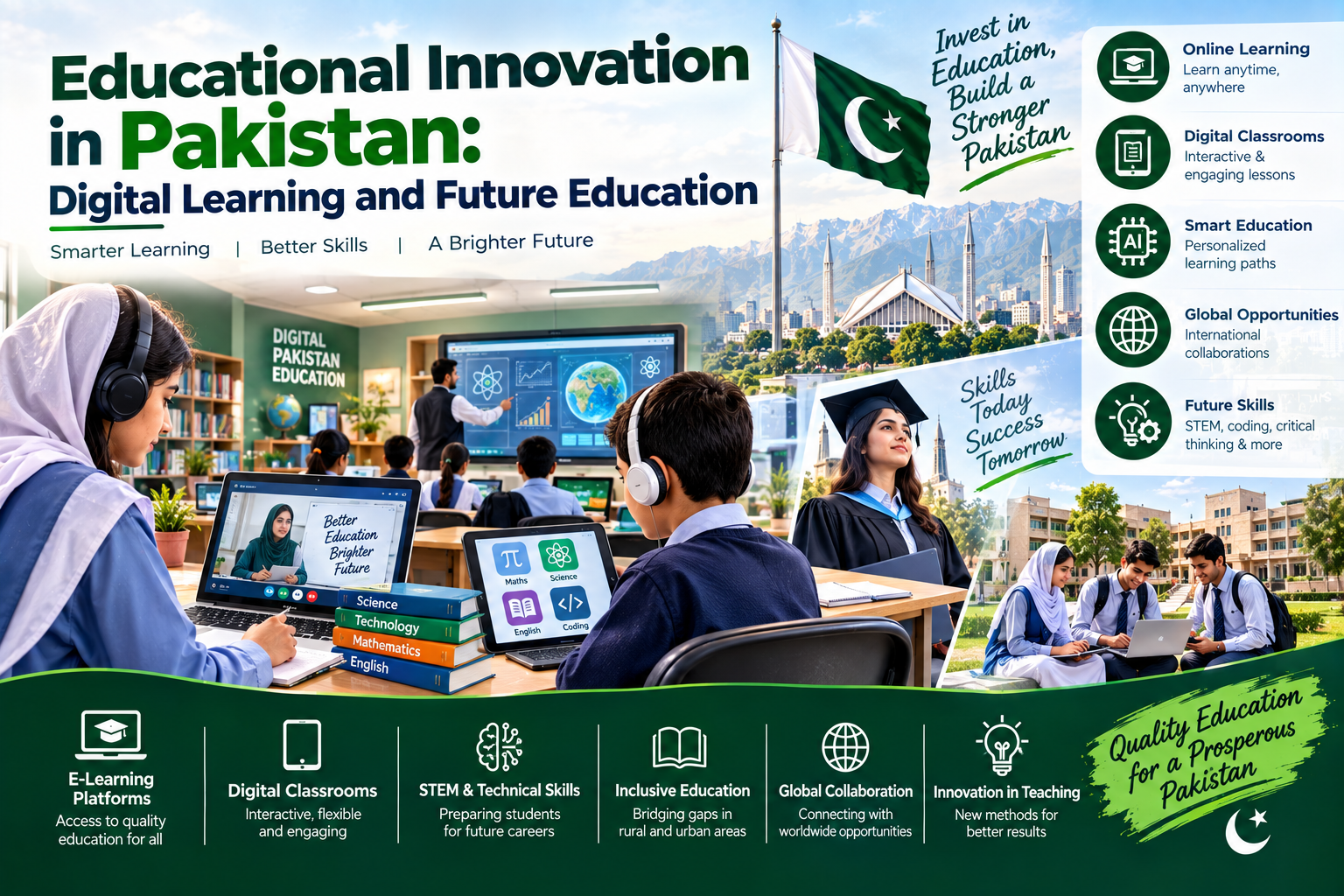
Education is one of the most important foundations of a country's development. A strong education system helps people develop knowledge, skills, confidence, creativity, and the ability to contribute to society. In Pakistan, the education sector is gradually changing as technology and new teaching methods become more common. Educational innovation in Pakistan is creating new opportunities for students, teachers, schools, colleges, universities, and educational organizations.
For many years, traditional classroom teaching was the main method of education. Students attended schools and colleges, listened to lectures, used textbooks, completed assignments, and took examinations. These methods remain important, but modern technology has introduced additional ways of learning.
Digital classrooms, online courses, educational applications, video lectures, learning management systems, virtual libraries, interactive content, artificial intelligence, and online assessments are examples of educational innovation. These tools can support traditional education and provide students with additional learning opportunities.
Educational innovation is especially important for Pakistan because the country has a large and diverse population. Students live in major cities as well as small towns and rural communities. Technology can help create additional learning opportunities for students who may not have access to the same educational resources as students in larger cities.
However, technology alone cannot solve every educational problem. Successful educational innovation requires trained teachers, reliable infrastructure, affordable internet, suitable digital content, and policies that focus on quality and accessibility.
What Is Educational Innovation?
Educational innovation means introducing new ideas, technologies, teaching methods, and learning systems to improve education.
Innovation does not necessarily mean replacing traditional classrooms. Instead, it can improve the way teachers teach and students learn.
Educational innovation can include:
Digital classrooms
Online learning platforms
Educational mobile applications
Video lectures
Virtual libraries
Online examinations
Digital assignments
Interactive learning materials
Artificial intelligence tools
Learning management systems
Online teacher training
Educational games and simulations
The purpose is to make learning more accessible, engaging, organized, and effective.
The Growth of Digital Learning in Pakistan
Digital learning has become an increasingly important part of education in Pakistan. Smartphones, computers, tablets, internet services, and online platforms have made educational resources easier to access.
A student can use a smartphone or computer to watch an educational lecture, read digital notes, practice questions, research a topic, or communicate with a teacher.
Digital learning can also allow students to study outside normal classroom hours. This can be helpful for students who want to revise difficult topics or learn at their own pace.
The growth of digital learning has also encouraged teachers and educational institutions to explore new methods of delivering lessons.
Online Education in Pakistan
Online education allows students to learn through the internet. Depending on the platform, students may attend live classes, watch recorded lectures, download study materials, submit assignments, and participate in discussions.
Online education can provide flexibility because students can access learning materials from different locations.
It can be particularly useful for students who cannot regularly travel to educational institutions or who want additional resources alongside their formal education.
However, online learning also requires discipline. Students need to manage their time, attend lessons, complete assignments, and avoid distractions.
Digital Classrooms
Digital classrooms combine traditional teaching with technology.
Instead of relying only on a blackboard and textbook, teachers can use computers, projectors, digital presentations, educational videos, diagrams, and interactive materials.
For subjects such as science, mathematics, computer science, and geography, visual explanations can make difficult concepts easier to understand.
A teacher can show a diagram, animation, simulation, or video to support a lesson.
Digital classrooms can therefore provide teachers with more ways to explain concepts.
Educational Mobile Applications
Mobile applications have become an important part of digital learning.
Students can use educational apps to practice mathematics, learn languages, study science, revise vocabulary, take quizzes, and organize their study routines.
Some applications provide interactive exercises and immediate feedback.
This can make practice more convenient because students can study using a smartphone without always needing a computer.
However, students should select educational applications carefully and use reliable resources.
Video-Based Learning
Video learning is another major innovation in education.
A teacher can explain a topic through a recorded lecture, while students can watch it at a convenient time.
One advantage of recorded lessons is that students can pause, replay, and review difficult parts.
For example, if a student does not understand a mathematics formula during the first viewing, the student can replay the explanation and practice the formula again.
Video learning can therefore support students who need more time to understand a concept.
Virtual Libraries
Traditional libraries remain valuable, but digital libraries provide another way to access educational resources.
A virtual library can contain digital books, research papers, articles, reference materials, lecture notes, and other educational resources.
Students can search for information without physically visiting a library.
This can be especially useful for university students and researchers who need access to large amounts of information.
Digital libraries can also help educational institutions organize resources more efficiently.
Learning Management Systems
Learning Management Systems, commonly called LMS platforms, allow educational institutions to organize digital learning.
A learning management system can be used to:
Share lecture materials
Upload assignments
Collect student work
Conduct quizzes
Provide announcements
Track learning activities
Organize courses
LMS platforms can help teachers and students keep educational activities organized.
They can also reduce dependence on paper-based communication.
Artificial Intelligence in Education
Artificial intelligence is becoming an important technology in education.
AI-based tools can support students with explanations, practice questions, language learning, brainstorming, and personalized learning activities.
Teachers may also use AI-supported tools for certain administrative and educational tasks.
However, AI should be used responsibly. Students should not depend on AI to complete all their academic work without understanding the subject themselves.
Education is about developing knowledge and skills, not simply obtaining answers.
Teachers also remain important because they provide human guidance, encouragement, context, and professional judgment.
Personalized Learning
Every student learns differently. Some students understand a topic quickly, while others need more examples and practice.
Digital learning technologies can support personalized learning by allowing students to choose materials according to their learning needs.
For example, a student who struggles with mathematics can spend more time practicing mathematical problems, while another student may move more quickly to advanced topics.
Personalized learning can give students greater control over their learning process.
Educational Technology for Students in Rural Areas
One of the major opportunities for educational innovation in Pakistan is supporting students in rural areas.
Students in remote communities may have fewer educational institutions, specialized teachers, laboratories, libraries, and learning resources.
Where internet and electricity infrastructure are available, digital learning can provide access to additional educational materials.
A student in a smaller town may be able to watch a lecture created by an experienced teacher from another city.
This does not completely replace local teachers, but it can supplement their work.
The Digital Divide in Pakistan
Educational innovation also faces an important challenge: the digital divide.
Not every student has equal access to:
Reliable internet
Smartphones
Computers
Tablets
Electricity
Digital learning platforms
Students from families with limited resources may face difficulties accessing online education.
Therefore, digital education policies should consider affordability and accessibility.
If digital education is introduced without addressing these differences, some students may benefit more than others.
Internet Access and Education
Reliable internet is important for online learning.
Students need a stable connection to attend live classes, watch videos, download materials, and submit assignments.
Poor connectivity can make digital learning difficult.
Educational institutions and policymakers can therefore play an important role in improving digital infrastructure.
Affordable internet access can help more students benefit from online education.
The Role of Teachers in Educational Innovation
Technology does not eliminate the importance of teachers.
Teachers remain responsible for explaining concepts, guiding students, answering questions, evaluating learning, encouraging participation, and supporting students.
Technology should be considered a tool that teachers can use rather than a replacement for teachers.
Teacher training is therefore one of the most important parts of educational innovation.
Teachers need opportunities to learn how to use digital platforms, educational software, online assessment systems, and other technologies effectively.
Teacher Training Through Technology
Digital technology can also improve teacher training.
Teachers can participate in online workshops, professional development courses, webinars, and training programs.
This can make professional learning more accessible.
A teacher in a smaller city can potentially attend an online training session conducted by an educational institution located elsewhere.
Continuous teacher development can improve the quality of digital education.
Digital Assessment
Technology can also change the way students are assessed.
Online quizzes, digital assignments, automated practice tests, and learning platforms can provide different forms of assessment.
Digital assessments can provide quick feedback in some situations.
However, online assessment also has challenges related to academic honesty, technical problems, internet connectivity, and fair evaluation.
Educational institutions need appropriate systems and policies to ensure that digital assessments remain reliable.
Interactive Learning
Traditional lectures can sometimes be passive if students only listen to information.
Interactive learning encourages students to participate.
Digital tools can provide:
Online quizzes
Educational games
Simulations
Interactive diagrams
Virtual experiments
Discussion forums
Practice exercises
These tools can encourage students to actively engage with educational content.
Gamification in Education
Gamification means using game-like elements in learning.
Students may receive points, badges, levels, challenges, or immediate feedback while completing educational activities.
The purpose is not simply to turn education into a game. Instead, game-like features can sometimes make repetitive practice more engaging.
For example, language-learning applications often use progress systems to encourage regular practice.
Digital Education and English Learning
English is important for education, science, technology, business, and international communication.
Digital platforms can provide students in Pakistan with additional opportunities to improve English vocabulary, grammar, pronunciation, reading, and listening.
Students can access language lessons, practice exercises, educational videos, and digital dictionaries.
This can be particularly useful for students who want additional practice beyond classroom lessons.
Educational Innovation in Higher Education
Universities in Pakistan are also adopting digital technologies.
Online learning platforms, digital libraries, research databases, virtual classes, online admissions, and digital communication systems can improve university services.
Students can access research materials without always depending on physical resources.
Universities can also use technology to connect students with researchers and educators around the world.
Online Skills Development
Educational innovation is not limited to traditional academic subjects.
Digital platforms can help young people learn practical skills such as:
Programming
Graphic design
Digital marketing
Writing
Data analysis
Entrepreneurship
Web development
Communication skills
These skills can support students as they prepare for further education and future employment.
Educational Startups in Pakistan
Educational startups can contribute to innovation by developing platforms and services for students and teachers.
A startup may focus on online tutoring, test preparation, language learning, digital classrooms, educational content, or professional skills.
Entrepreneurs can identify educational problems and develop technology-based solutions.
However, educational startups should focus on quality, accessibility, data privacy, and genuine learning outcomes.
Technology and Exam Preparation
Students often use digital tools for exam preparation.
Online practice questions, recorded lectures, digital notes, quizzes, and educational videos can provide additional preparation resources.
Students can use technology to revise difficult topics and practice repeatedly.
However, students should avoid relying on shortcuts. Real learning requires understanding concepts and practicing independently.
Digital Safety for Students
As education becomes more digital, students need to understand online safety.
Students should learn about:
Strong passwords
Privacy
Phishing
Safe browsing
Reliable sources
Cybersecurity
Responsible use of social media
Schools and colleges can include digital safety education in their programs.
This is important because students may spend significant time online for both education and communication.
Challenges of Educational Innovation in Pakistan
Educational innovation has many benefits, but several challenges need attention.
Infrastructure
Schools need electricity, internet connectivity, computers, projectors, and other equipment.
Cost
Devices and internet services can be expensive for some families.
Teacher Training
Teachers need appropriate training to use educational technologies effectively.
Digital Literacy
Students and teachers need basic digital skills.
Quality of Online Content
Not all online educational materials are accurate or suitable.
Academic Honesty
Online examinations and assignments can create challenges related to cheating and plagiarism.
Screen Time
Students need a balanced learning routine that includes physical activity, rest, and offline learning.
The Importance of Equal Educational Opportunities
Innovation should help reduce educational inequalities rather than increase them.
Students from different economic backgrounds should have reasonable opportunities to benefit from educational technology.
Schools, governments, educational organizations, and technology companies can work toward affordable digital resources.
Providing devices, internet access, digital libraries, and teacher training can help expand educational opportunities.
The Future of Education in Pakistan
The future of education in Pakistan is likely to involve a combination of traditional and digital learning.
Classrooms will continue to be important because students benefit from direct interaction with teachers and classmates.
At the same time, digital platforms can provide additional resources.
Artificial intelligence, virtual learning environments, digital libraries, interactive content, and online courses may become increasingly common.
The most successful educational systems are likely to use technology thoughtfully rather than simply adopting technology because it is new.
How Educational Innovation Can Support Pakistan's Development
Education and economic development are closely connected.
A population with strong knowledge and skills can contribute to technology, business, science, healthcare, engineering, agriculture, and many other sectors.
Educational innovation can help students gain both academic knowledge and practical digital skills.
This can prepare young people for a changing employment environment.
Technology-based education can also create opportunities for students to learn skills that can be used in remote work, freelancing, entrepreneurship, and digital businesses.
The Role of Parents
Parents can also support educational innovation.
They can encourage students to use technology for productive learning rather than only entertainment.
Parents can help children create balanced routines that include study, rest, physical activity, and responsible technology use.
They can also encourage children to verify information and ask teachers when they are unsure about something.
The Role of Students
Students are at the center of educational innovation.
They can benefit most when they actively participate in learning.
Students should use digital tools to:
Understand concepts
Practice skills
Research reliable information
Revise lessons
Ask questions
Develop new abilities
Technology should be a learning tool rather than simply a shortcut for completing assignments.
Conclusion
Educational innovation in Pakistan is creating new opportunities for students, teachers, schools, colleges, and universities. Digital classrooms, online learning, educational applications, video lectures, virtual libraries, artificial intelligence, interactive learning, and learning management systems are changing the way education can be delivered.
These innovations can make learning more flexible and provide access to resources beyond the traditional classroom. They can also support students in rural areas and provide additional opportunities for skill development.
At the same time, Pakistan must address challenges such as the digital divide, internet access, affordability, teacher training, digital literacy, online safety, and the quality of educational content.
The future of education should not be about technology replacing teachers. Instead, it should be about combining technology with good teaching, human guidance, practical learning, and equal opportunities.
With responsible planning and investment, educational innovation can help Pakistan develop a more accessible, modern, and skill-oriented education system. The ultimate goal should remain clear: helping students learn better and preparing them for the opportunities and challenges of the future.
FAQs
1. What is educational innovation in Pakistan?
Educational innovation in Pakistan means using new technologies, teaching methods, digital platforms, and learning systems to improve education.
2. How is digital learning changing education in Pakistan?
Digital learning allows students to access online lectures, educational applications, digital books, quizzes, courses, and other learning resources from different locations.
3. What role does AI play in education?
AI can support personalized learning, explanations, practice activities, educational content, and certain administrative tasks when used responsibly.
4. What are the main challenges of digital education in Pakistan?
Major challenges include limited internet access, device costs, infrastructure, teacher training, digital literacy, and differences in access to technology.
5. What is the future of educational innovation in Pakistan?
The future is likely to combine traditional classroom education with digital learning, online resources, artificial intelligence, interactive tools, and technology-based skills development.