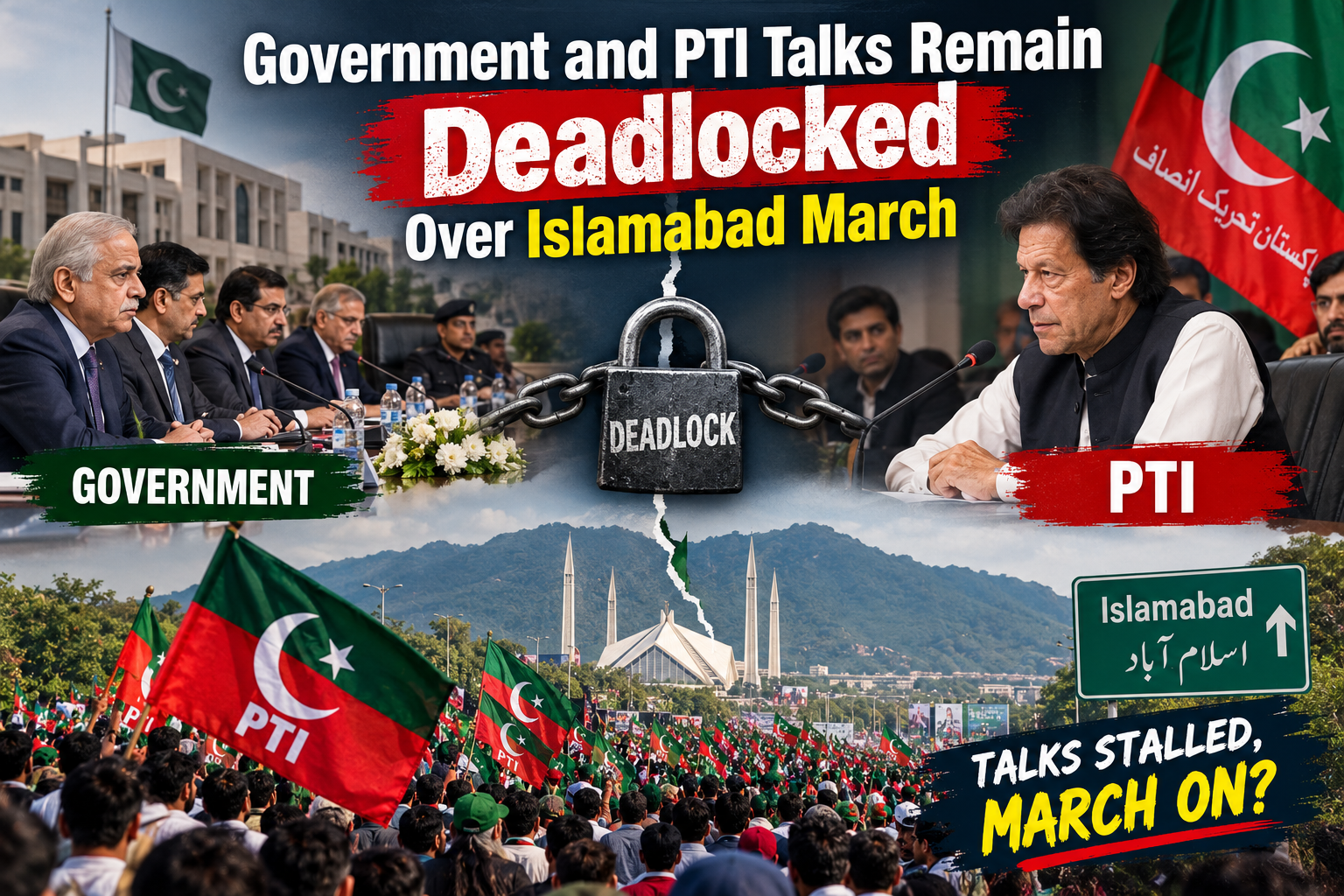
Pakistan’s political situation remains tense as negotiations between the federal government and Pakistan Tehreek-e-Insaf (PTI) have failed to produce a clear breakthrough over the party’s planned march toward Islamabad. The disagreement has brought political dialogue, public order, security arrangements and the future of government-opposition relations into sharp focus.
The talks were viewed as an opportunity to reduce tensions before the planned demonstration. However, major differences remain between the two sides. PTI continues to press its political demands and wants meaningful progress before changing its protest plans, while the government has emphasized security, stability and the need to prevent disruption in the capital.
The continuing disagreement demonstrates the difficulties Pakistan faces when political parties attempt to resolve major disputes during periods of heightened public tension.
Background of the Government-PTI Dispute
Relations between PTI and the federal government have remained strained for a considerable period. Political disagreements have included questions surrounding elections, constitutional matters, legal cases, the imprisonment of PTI founder Imran Khan and the treatment of the party’s political leadership and workers.
The latest dispute has centered on PTI’s planned Islamabad march. The party has presented the protest as a way of pressing its political demands, while the government has raised concerns about the possible effects of a large demonstration in the federal capital.
The decision to hold negotiations was therefore important. Rather than allowing disagreements to develop exclusively through public statements and street protests, representatives from both sides were given an opportunity to communicate directly.
Talks Begin Amid Rising Tensions
Government and PTI representatives held negotiations as pressure increased over the planned march. The talks created hopes that both sides might find a mutually acceptable solution.
Political negotiations can be complicated when the parties have fundamentally different expectations. PTI wants its demands addressed, while the government wants the protest situation brought under control and public activities protected from disruption.
Although the discussions provided an important communication channel, they did not immediately resolve the central disagreement.
The lack of a breakthrough has kept uncertainty high.
Why the Talks Are Important
Political dialogue is particularly important in a democratic country because disagreements between political parties are inevitable. What matters is how those disagreements are managed.
If political leaders can negotiate peacefully, they can reduce the possibility of confrontation and provide greater stability for citizens.
The current government-PTI talks are therefore important beyond the immediate question of the Islamabad march. Their outcome could influence future relations between the government and opposition and determine whether political disagreements are handled primarily through negotiations or through street protests.
PTI’s Position
PTI has maintained that it has legitimate political demands that need to be addressed.
The party has continued to emphasize political rights and the importance of allowing its supporters to participate in peaceful demonstrations. Its leadership has also sought progress on issues involving Imran Khan and other political matters.
For PTI supporters, the march represents an opportunity to express their political concerns and demonstrate support for the party leadership.
The party has also stressed the importance of keeping the protest peaceful.
Government’s Position
The federal government has taken a different approach.
Officials have emphasized the need to protect public order and prevent Islamabad from becoming severely disrupted by a large political gathering.
The capital contains Parliament, government ministries, diplomatic missions and other important institutions. Authorities therefore have particular security concerns whenever a major protest is expected.
The government has also indicated that political dialogue remains possible, but it does not want the protest to create instability or interfere with essential public activity.
The Role of Security
Security has become one of the most important elements of the current situation.
Authorities have increased preparations around Islamabad, including measures intended to control movement and protect sensitive locations.
While security measures can be necessary, they can also affect ordinary citizens. Road closures and diversions can create problems for students, employees, patients, businesses and transport operators.
This is why political protests require careful planning.
A peaceful demonstration should ideally allow citizens to exercise political rights without creating unnecessary difficulties for people who are not participating.
Impact on Islamabad Residents
People living in Islamabad and nearby Rawalpindi are among those most directly affected by the political uncertainty.
Major roads may face restrictions, traffic can become slower and commuters may need to use alternative routes. Businesses can also experience reduced activity when customers find it difficult to travel.
For families, even short-term road restrictions can create practical problems.
Students may have difficulty reaching educational institutions, employees can face delays getting to work and patients may experience challenges when traveling to hospitals.
These concerns make political negotiations particularly important.
Economic Impact
Political uncertainty can also affect economic activity.
Businesses need predictable transportation networks and stable conditions to operate efficiently. When roads are blocked or large areas become difficult to access, deliveries can be delayed and commercial activity can slow down.
Transport companies can face higher operating costs when vehicles are forced to take longer routes.
Small businesses may be particularly vulnerable because they often depend on daily customer traffic.
For an economy already dealing with numerous challenges, prolonged political uncertainty can make business planning more difficult.
Importance of Peaceful Protest
Peaceful political protest is an important part of democratic participation.
Citizens should be able to express political opinions, support political parties and communicate their concerns through lawful means.
At the same time, peaceful protest requires responsibility.
Political organizers have a responsibility to encourage supporters to avoid violence and damage to property. Authorities also have a responsibility to manage demonstrations in a way that respects lawful political activity while protecting public safety.
A balance between these responsibilities can help prevent political disagreements from becoming larger crises.
Previous Political Confrontations
Pakistan has experienced several major political protests and demonstrations in recent years.
These events have sometimes resulted in prolonged road blockages, clashes, arrests and disruptions to everyday life.
Because of this history, both the government and opposition face pressure to prevent the latest dispute from escalating.
The memory of previous confrontations also explains why security officials are taking the current situation seriously.
The Importance of Imran Khan
Imran Khan remains a central figure in PTI’s political campaign.
Although he is not currently leading the party's activities from outside prison, his political influence remains significant among PTI supporters.
Many of the party’s demands and public campaigns continue to be connected to his political situation.
This makes negotiations more complicated because PTI’s leadership wants progress on issues involving its founder, while government officials must consider legal and institutional processes.
Federal and Provincial Relations
The dispute also highlights tensions between Pakistan’s federal government and provincial leadership.
Khyber Pakhtunkhwa, where PTI has significant political influence, has been particularly important in the current situation.
When federal and provincial governments are controlled by different political groups, disagreements can become more complicated.
Cooperation between federal and provincial authorities is especially important in matters involving security, transportation and public administration.
What Could Happen Next?
Several possibilities remain open.
The government and PTI could continue negotiations and eventually reach an arrangement that reduces tensions. Another possibility is that the protest continues while discussions remain open.
There is also a possibility that negotiations could become more difficult if neither side is willing to compromise.
The next steps taken by political leaders will therefore be closely watched.
A negotiated solution would likely reduce uncertainty and allow normal activities to continue more easily.
Why Dialogue Is Better Than Confrontation
Political confrontation can create costs for everyone.
When political parties rely entirely on street pressure, the possibility of clashes and disruption increases. Negotiations, on the other hand, allow representatives to discuss demands without placing large numbers of people directly in conflict.
Dialogue does not mean that either side must abandon its political position.
Instead, negotiations can provide a mechanism for finding practical solutions.
Pakistan’s political history shows that disagreements cannot always be solved immediately. However, continued communication can help prevent disagreements from becoming uncontrollable.
Role of Political Leadership
Political leaders have an important responsibility during periods of national tension.
Their public statements can either reduce tensions or increase them.
Responsible political communication can encourage supporters to remain peaceful and avoid confrontation.
Leaders from both sides therefore have an opportunity to demonstrate that political differences can be managed through constitutional and democratic processes.
This is particularly important for young people watching the political environment and developing their understanding of democracy.
Public Expectations
Ordinary Pakistanis generally want political stability and the ability to continue their daily lives without unnecessary disruption.
People want to travel safely, work, attend school and run businesses.
At the same time, many citizens also care deeply about political representation and constitutional rights.
The challenge for political leaders is to protect both priorities.
A peaceful political process can help achieve this balance.
Pakistan’s Democratic Future
The current government-PTI dispute is another test of Pakistan’s democratic institutions.
Political systems become stronger when disagreements are managed through established legal and constitutional mechanisms.
Parliament, courts, political parties, election institutions and civil society all have roles to play in maintaining democratic stability.
The present crisis therefore has significance beyond the immediate march.
How the government and opposition respond could influence political culture in the future.
Conclusion
Government and PTI talks remain deadlocked as Pakistan faces continued political uncertainty over the planned Islamabad march.
The disagreement reflects deeper political differences between the ruling side and PTI, including disputes over political rights, Imran Khan’s situation and broader constitutional concerns.
At the same time, the government has emphasized public safety, security and the need to protect Islamabad from major disruption.
The most constructive path forward remains dialogue. Continued negotiations could provide both sides with an opportunity to reduce tensions and find practical solutions.
For ordinary Pakistanis, the ideal outcome is a peaceful political process in which constitutional rights are respected and daily life is protected.
Pakistan’s political future will depend not only on the positions taken by individual parties but also on the ability of political leaders to communicate, negotiate and accept democratic differences without allowing them to turn into prolonged confrontation.
FAQs
1. Why are the government and PTI holding talks?
The talks are aimed at addressing disagreements surrounding PTI’s planned Islamabad march and broader political demands.
2. Has an agreement been reached?
No final agreement has been reached, and major differences between the two sides remain.
3. Why is the government concerned about the march?
The government has raised concerns about security, traffic, public order and possible disruption in Islamabad.
4. What does PTI want from the negotiations?
PTI wants progress on its political demands and issues concerning its leadership and founder Imran Khan.
5. Why is political dialogue important for Pakistan?
Dialogue can help political parties resolve disagreements peacefully, reduce confrontation and protect the country from unnecessary political and economic disruption.