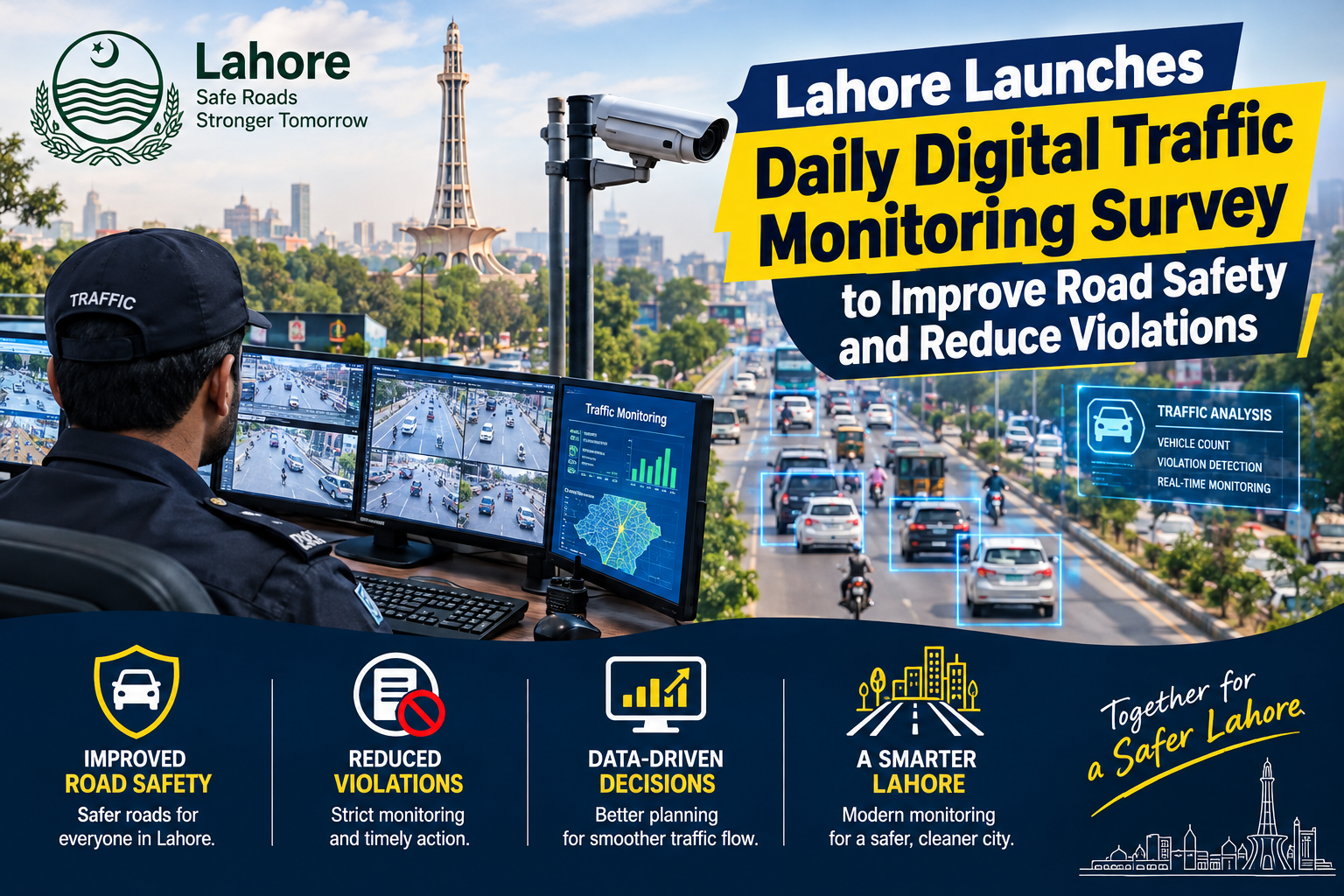
The survey represents a data-driven approach to traffic management in Pakistan’s second-largest city. Instead of relying exclusively on individual enforcement incidents, authorities aim to collect regular information about how motorists use roads, follow lane markings, wear helmets, use seat belts and comply with driving licence requirements.
According to the initial findings, 56,292 vehicles and motorcycles passed through the Canal Bridge near Mall Road during a one-hour monitoring period. The survey recorded 28,760 motorcycles and 27,532 other vehicles. It also identified lane violations, examined helmet use and reported instances of motorists travelling without valid driving licences.
Chief Traffic Officer Lahore Syed Abdul Raheem Shirazi said digital information was being collected daily at the level of individual intersections and sectors. The initiative aims to assess actual traffic conditions, improve journeys and support efforts to reduce road accidents.
The development is significant for commuters, transport operators, students, workers and businesses that depend on Lahore’s busy road network. It also highlights the growing role of digital data in managing urban traffic and encouraging safer driving practices.
What the One-Hour Traffic Survey Revealed
The initial survey provides a snapshot of traffic behaviour at a busy Lahore location. The findings offer useful information about vehicle movement and compliance with road safety rules during the monitored period.
The reported results included the following observations:
Total traffic: 56,292 vehicles and motorcycles crossed the monitored location within one hour.
Motorcycles: 28,760 motorcycles were recorded.
Other vehicles: 27,532 other vehicles were counted.
Lane discipline: 1,473 lane violations were reported on Mall Road, representing approximately 2.93% of the surveyed traffic.
Helmet use: Approximately 99% of motorcyclists were reported to be wearing helmets.
Seat belts: Ten vehicles were observed travelling without seat belts during the survey.
Driving licences: The survey reported that 5% of car drivers and 7% of motorcyclists were travelling without licences.
These figures should be understood in the context of the specific location and one-hour monitoring period. They do not necessarily represent every road in Lahore or traffic behaviour throughout the entire day.
Nevertheless, the results illustrate how targeted surveys can help authorities identify areas that may require further attention.
For example, information about lane violations may help officials determine whether road markings are sufficiently visible, whether motorists need clearer guidance or whether enforcement should be adjusted at particular intersections.
Similarly, information about helmet and seat-belt use can help authorities assess compliance with basic safety requirements.
The value of the survey will become clearer as additional data is collected and officials compare results across different locations and periods.
Why Lahore Needs Better Traffic Monitoring
Lahore is a major centre for education, commerce, healthcare, government administration and transport. Its roads serve a large number of residents as well as people travelling from surrounding towns and districts.
As urban activity increases, traffic management becomes more complicated. Roads must accommodate motorcycles, private cars, buses, commercial vehicles, delivery services and emergency vehicles, often within limited space.
Congestion can develop when traffic flows merge, intersections become crowded or motorists fail to follow lane markings. Poorly coordinated road use can also increase the risk of collisions and delays.
Traditional traffic management relies on traffic wardens, road signs, public awareness campaigns and enforcement measures. These remain important, but digital data can provide an additional way to understand what is happening on the roads.
A daily monitoring survey can help authorities identify recurring problems instead of responding only after complaints or incidents occur. Information gathered at different intersections can reveal where particular violations are concentrated and where further assessment may be useful.
For example, one intersection may experience frequent lane violations during peak commuting hours, while another may have problems involving vehicles entering from side roads. A single citywide response may not address both problems equally well.
Location-specific information can therefore support more targeted planning.
The new survey is intended to strengthen this process by collecting data regularly and using the findings to inform traffic management decisions.
How Digital Traffic Surveys Work
A digital traffic survey involves collecting, recording and analysing information about road use. Depending on the system and the survey design, information may be gathered through direct observation, digital recording tools or other authorised monitoring methods.
The objective is to turn observations into organised information that can be compared over time.
For instance, officials may record how many vehicles pass through an intersection, how many follow lane markings and how many comply with helmet or seat-belt requirements. These observations can then be summarised to identify patterns.
A survey conducted at the same location on different days may reveal whether violations remain consistent or change according to traffic conditions. Comparing locations may also help officials identify where additional attention is needed.
However, good data collection requires consistent methods. Officials must define what counts as a violation, use appropriate observation periods and avoid treating a short sample as a complete picture of the city.
The initial Lahore survey offers a starting point, but additional observations will be important for understanding longer-term patterns.
Digital monitoring is most useful when the information collected leads to practical improvements. Those improvements might include clearer road markings, better traffic signals, targeted public awareness or appropriately focused enforcement.
Without analysis and follow-up, collecting figures alone would have limited value.
Lane Discipline Emerges as an Important Issue
Lane discipline is one of the main areas highlighted by the Lahore survey. The report recorded 1,473 lane violations during the one-hour monitoring period on Mall Road, accounting for approximately 2.93% of the traffic surveyed.
Lane markings help guide vehicles into organised paths, particularly on busy roads with several lanes or turning movements. When motorists ignore these markings, traffic can become less predictable.
Abrupt lane changes may force other drivers to brake suddenly or alter their direction. At intersections, vehicles that occupy the wrong lane can block traffic intended to move in another direction.
These problems can affect motorcycles as well as cars and larger vehicles. Maintaining predictable movement helps all road users understand what other motorists are likely to do.
However, the reported number of lane violations does not, by itself, establish why they occurred. Possible factors could include driver behaviour, road layout, unclear markings or confusion at particular points. These possibilities would need to be examined through additional observations.
Authorities could use the survey findings to identify specific locations for closer assessment. Where necessary, they might consider improving road markings, reviewing lane arrangements or providing clearer directions.
Public awareness also matters. Motorists should understand that lane markings are not merely decorative features; they help organise traffic and reduce uncertainty.
A combination of clear road design, education and consistent enforcement can support safer and more orderly movement.
Helmet Use and Motorcycle Safety in Lahore
Motorcycles are a major part of everyday transportation in Lahore. They are widely used by students, employees, small business owners and delivery workers because they can be practical for navigating busy streets.
The survey reported that approximately 99% of motorcyclists observed at the monitored location were wearing helmets.
This is an encouraging finding for that particular sample, although it should not be interpreted as proof that helmet use is equally high across every part of Lahore.
Helmets are an important safety measure because they help protect the head during a collision. Wearing a helmet that fits properly and is securely fastened is an essential part of responsible motorcycle use.
Passengers also need appropriate protection. A motorcycle journey may be short, but the risk of a road incident does not disappear simply because the destination is nearby.
Traffic education campaigns can reinforce these messages by explaining how helmets should be worn and why riders and passengers should use them consistently.
The survey may also help authorities identify locations where helmet compliance is lower and where additional public awareness or enforcement could be beneficial.
It is important, however, to distinguish between helmet compliance and overall road safety. Wearing a helmet is one essential precaution, but safe riding also depends on appropriate speed, attention to traffic signals, lane discipline and consideration for other road users.
The survey provides one useful measure of behaviour, while further information would be needed to assess road safety more broadly.
Seat-Belt Compliance and the Safety of Car Occupants
The survey also examined seat-belt use and reported that ten vehicles were observed travelling without seat belts during the one-hour monitoring period.
Seat belts are among the most important basic safety measures for people travelling in cars. They help restrain occupants during sudden braking or a collision and reduce the risk of serious injury.
Drivers should make sure that their own seat belts are fastened before beginning a journey. Passengers should also use appropriate restraints, including suitable child restraints where required.
A relatively small number of observations at one location cannot establish the overall level of seat-belt compliance throughout Lahore. The findings should be considered a snapshot rather than a complete citywide assessment.
Further surveys across different roads, times and traffic conditions could provide a clearer picture.
Public awareness can support enforcement by explaining the purpose of seat belts rather than presenting them only as a legal requirement. When motorists understand how basic safety precautions protect them and their passengers, they may be more likely to make these practices part of their routine.
Driving Without a Licence Remains a Concern
The Lahore survey reported that 5% of car drivers and 7% of motorcyclists observed in the monitored area were travelling without licences.
Driving licences are important because they form part of the system used to establish that motorists meet the applicable requirements for driving on public roads.
Learning to drive involves more than controlling a vehicle. Drivers need to understand traffic signs, road markings, right-of-way rules and the responsibilities they have towards pedestrians and other motorists.
Unlicensed driving can raise concerns about whether a person has completed the required process and understands the relevant road rules. However, the survey figures alone do not establish the experience or abilities of any particular driver.
Authorities can address the issue through appropriate checks, public information and accessible information about licensing requirements.
Young people and first-time drivers should learn the rules before taking to public roads. Families can also help by encouraging responsible behaviour and ensuring that new drivers follow the applicable licensing requirements.
The survey may help authorities understand where additional attention is needed, but broader conclusions will require data collected across a wider range of locations.
How Digital Data Could Improve Traffic Management
The main purpose of collecting traffic information is to improve decisions. A digital survey becomes valuable when its findings help officials understand problems and choose appropriate responses.
One potential benefit is more targeted deployment of traffic personnel. If repeated surveys show that a particular intersection experiences frequent lane violations or congestion, officials can investigate the causes and determine whether additional supervision would help.
Another potential benefit is improved road planning. Data can help authorities identify locations where markings, signs, traffic signals or turning arrangements may need closer examination.
Traffic information can also help with public awareness. Campaigns can focus on common violations rather than relying on general messages that may not address the most frequent local problems.
Comparisons over time could provide another useful measure. If a particular intervention is introduced, later surveys may help show whether observed behaviour has changed. Such comparisons must account for differences in traffic volume, observation periods and other conditions.
It is important not to assume that a change in recorded violations automatically proves that a policy caused the change. Careful analysis is needed to separate meaningful improvements from normal variation.
The daily monitoring initiative could provide a useful foundation for this work if the information is collected consistently and used transparently.
Can Digital Monitoring Reduce Road Accidents?
The initiative aims to improve road safety, reduce travel times and support efforts to prevent accidents.
Digital monitoring can contribute to these objectives by helping authorities identify risky behaviour and locations that deserve attention. However, a survey does not directly prevent accidents simply by recording violations.
For monitoring to produce meaningful results, the findings need to lead to suitable action. That might involve clearer signs, improved road layouts, public education or appropriate enforcement of existing rules.
Road safety also depends on motorists making responsible decisions. Drivers should obey traffic signals, maintain safe distances, avoid distractions and adjust their driving to road and weather conditions.
Motorcyclists should use helmets, while car occupants should fasten their seat belts. Pedestrians also need safe crossing facilities and clear information about how to use roads responsibly.
Authorities must consider the needs of all road users, including people with disabilities, older residents and children travelling near schools.
A comprehensive road-safety approach combines infrastructure, education, enforcement and reliable data. Digital surveys can help guide that work, but their effectiveness should be assessed through sustained improvements in safety outcomes.
What the Survey Means for Daily Commuters
For people travelling through Lahore every day, the most noticeable benefit of improved traffic management would be more predictable journeys.
Workers often need to reach offices at particular times, while students depend on reliable transport to attend classes. Businesses also rely on roads for deliveries, customer access and the movement of goods.
Congestion can make these activities more difficult. Delays may cause missed appointments, disrupt transport schedules and increase uncertainty about arrival times.
Better information about traffic conditions and recurring violations can help authorities identify where problems are concentrated. However, the one-hour survey does not itself establish that journey times have already improved.
Commuters can contribute to safer roads by following traffic rules, respecting lane markings and avoiding behaviour that creates unnecessary risks for others.
Motorists should also recognise that safe travel is a shared responsibility. One driver's decision can affect many people moving through the same intersection.
The long-term value of Lahore’s initiative will depend on whether regular monitoring leads to practical improvements that residents can experience in their daily journeys.
Challenges in Implementing Digital Traffic Monitoring
Although digital monitoring offers potential benefits, its effectiveness depends on several factors.
Data accuracy: Surveys must record observations consistently. Inaccurate or incomplete information can lead to mistaken conclusions about traffic behaviour.
Coverage: A survey at one intersection cannot represent every road in a large city. Authorities need information from different areas and traffic conditions.
Consistent definitions: Officials must apply clear criteria when identifying violations. This helps ensure that comparisons between locations and dates are meaningful.
Privacy and responsible data use: Digital monitoring should operate within applicable laws and appropriate safeguards. Authorities should be clear about what information is collected, how it is used and who is authorised to access it.
Follow-up action: Data collection must be connected to decisions. If recurring problems are identified, officials need a process for investigating them and assessing possible improvements.
Public understanding: Residents should be informed about the purpose of the initiative and how its findings will be used.
Addressing these challenges can help make digital traffic monitoring more reliable and useful. Transparency is especially important because public confidence depends on the belief that information is being collected and applied fairly.
What Happens Next?
The daily digital traffic survey is intended to give Lahore’s traffic authorities a clearer picture of road use and compliance with traffic regulations.
The next important step will be collecting additional observations from different intersections and sectors. A broader dataset could help authorities determine whether the initial findings reflect wider patterns or conditions specific to the monitored location.
Further monitoring may also help officials identify recurring violations and assess whether targeted measures improve compliance. Changes to road markings, traffic signals, public awareness campaigns and enforcement arrangements could be considered where the evidence supports them.
The initiative’s progress should be assessed using measurable outcomes, including changes in observed violations, road safety and travel times. Regular reporting would help residents understand what the data shows and whether the measures introduced are producing meaningful improvements.
It will also be important to explain the limitations of the survey. Results from one hour at one location should not be treated as a complete picture of traffic behaviour throughout Lahore.
Ultimately, the value of digital monitoring will depend on how effectively the collected information is translated into safer roads and better journeys.
Conclusion
Lahore’s launch of a daily digital traffic violation monitoring survey marks an important development in the use of data for urban traffic management.
The initial one-hour survey at the Canal Bridge near Mall Road recorded 56,292 vehicles and motorcycles. It reported lane violations, high helmet use among observed motorcyclists and a smaller number of vehicles travelling without seat belts. It also highlighted concerns about driving without a licence.
These findings offer an initial snapshot of traffic behaviour, but further surveys will be needed to understand conditions across the city.
Digital monitoring can help authorities identify recurring problems, improve traffic planning and focus attention on areas where road safety measures may be needed. Its effectiveness will depend on accurate data, appropriate follow-up and transparent evaluation.
For Lahore’s residents, the ultimate objective is straightforward: safer roads, fewer avoidable accidents and more reliable journeys. Consistent enforcement, responsible driving and better-informed traffic management can all contribute to that goal.
FAQs
1. What new initiative has Lahore launched on October 14, 2026?
Lahore has launched a daily digital traffic violation monitoring survey to assess compliance with traffic rules and identify opportunities to improve road safety.
2. How many vehicles were recorded in the initial survey?
The survey recorded 56,292 vehicles and motorcycles passing through the Canal Bridge near Mall Road during a one-hour period.
3. What were the main findings of the survey?
The survey recorded 1,473 lane violations, reported that approximately 99% of observed motorcyclists wore helmets and identified some motorists travelling without seat belts or driving licences.
4. Who announced the digital traffic monitoring initiative?
Chief Traffic Officer Lahore Syed Abdul Raheem Shirazi discussed the initiative and explained that digital data was being collected daily across intersections and sectors.
5. How could the survey improve road safety in Lahore?
The collected information could help authorities identify recurring violations, improve traffic management, focus enforcement and develop measures aimed at reducing accidents and delays.