Introduction
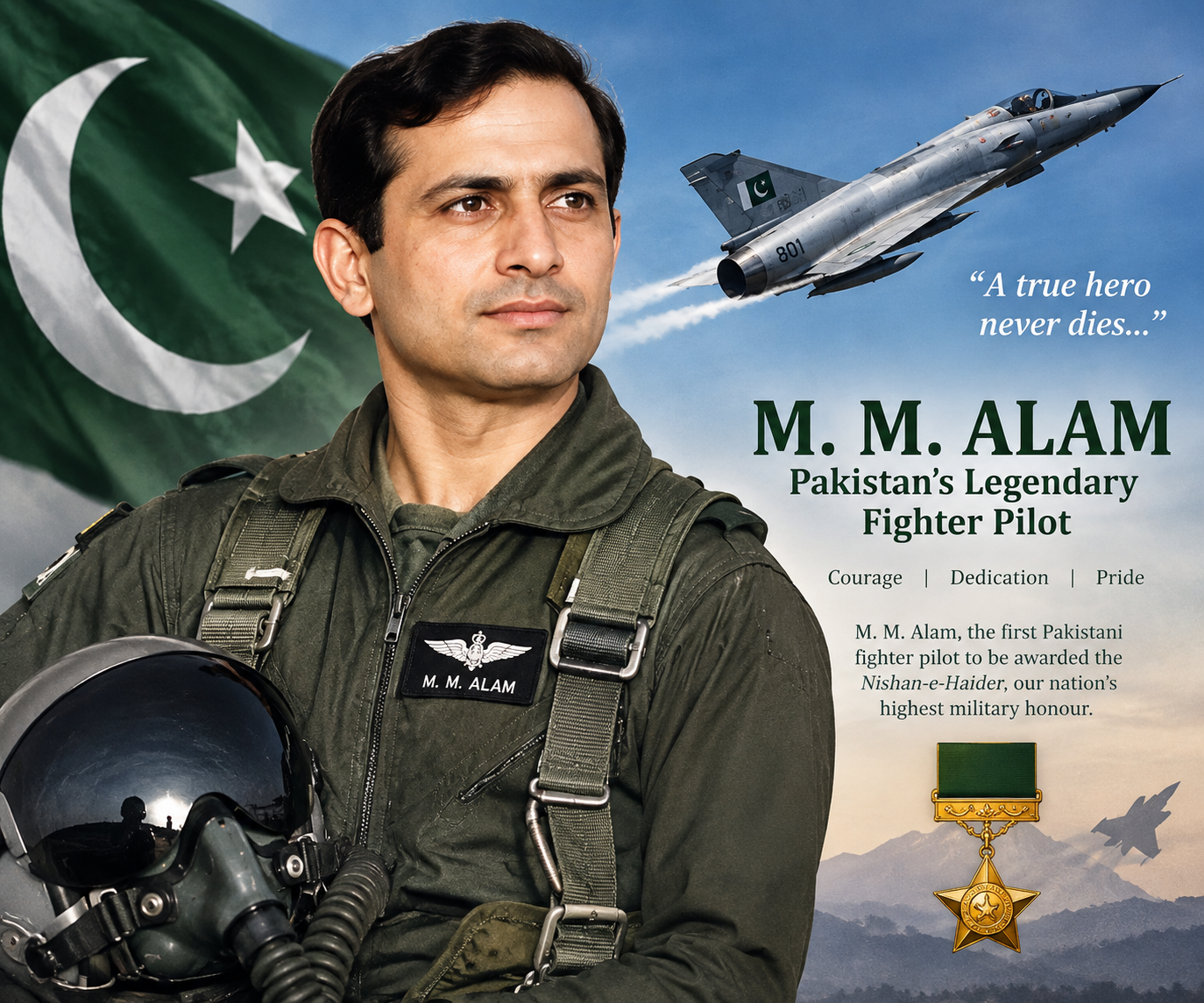
Muhammad Mahmood Alam, commonly known as M. M. Alam, is remembered as one of the most famous fighter pilots in the history of Pakistan. He served in the Pakistan Air Force (PAF) and became widely known for his courage, determination, flying skills, and dedication to his country. His name became especially famous during the 1965 Pakistan-India War, when he took part in aerial combat missions and became a symbol of bravery for many people in Pakistan.
M. M. Alam was born on 6 July 1935 in Calcutta, British India, and later moved to Pakistan after the creation of the country in 1947. At a young age, he developed an interest in aviation and military service. His passion for flying eventually led him to join the Pakistan Air Force, where he trained as a fighter pilot.
Throughout his career, M. M. Alam demonstrated professional discipline and a strong sense of responsibility. His achievements made him one of the most recognized names in the PAF. For many students and young Pakistanis, his life represents dedication, courage, and the importance of serving one's country with honesty and commitment.
Early Life of M. M. Alam
M. M. Alam was born into a family that valued education and discipline. He grew up during a period of major political and social changes in the Indian subcontinent. In 1947, the creation of Pakistan changed the lives of millions of people, including Alam and his family.
After Pakistan became an independent country, M. M. Alam developed a strong connection with his new homeland. Like many young people of his generation, he was interested in contributing to the development and protection of Pakistan. His interest in aviation gradually became an important part of his life.
At that time, becoming a fighter pilot was not an easy career. It required excellent physical fitness, mental discipline, technical knowledge, and the ability to make quick decisions. Alam worked hard to develop these skills and prepared himself for a career in the air force.
His early life helped build the qualities that later became important during his military career. His story shows that great achievements often begin with a simple ambition supported by hard work and determination.
Joining the Pakistan Air Force
M. M. Alam joined the Pakistan Air Force in 1952. His entry into the PAF marked the beginning of an important military career. As a young officer, he received professional training in aviation, aircraft operations, navigation, and aerial combat.
Training to become a fighter pilot is demanding. A pilot must understand aircraft systems, weather conditions, navigation techniques, communication procedures, and combat strategies. In addition, pilots must remain calm under pressure because aviation requires fast and accurate decisions.
M. M. Alam successfully developed these abilities and became a skilled fighter pilot. He continued to improve his knowledge and experience while serving in different roles within the Pakistan Air Force.
His career also reflected the growing importance of modern aviation in Pakistan's defense system. During the 1950s and 1960s, the PAF was expanding its capabilities and preparing its personnel for possible military challenges.
M. M. Alam as a Fighter Pilot
A fighter pilot's role is very different from that of a commercial airline pilot. Fighter pilots are trained to operate high-performance military aircraft in complex and sometimes dangerous situations. They must have strong technical understanding, excellent coordination, and the ability to respond rapidly.
M. M. Alam became known for his confidence and skill in operating fighter aircraft. His professional approach to flying earned him respect among fellow air force personnel.
During his career, he flew aircraft used by the Pakistan Air Force and gained experience in aerial combat operations. His expertise became especially important during the 1965 war.
M. M. Alam's career demonstrates that success in aviation depends on much more than simply controlling an aircraft. A fighter pilot must understand strategy, timing, teamwork, and situational awareness. Alam's achievements helped establish his reputation as an exceptional military aviator.
The 1965 Pakistan-India War
The most famous period of M. M. Alam's career came during the 1965 Pakistan-India War. The conflict included significant aerial combat between the Pakistan Air Force and the Indian Air Force.
During the war, M. M. Alam flew combat missions against opposing aircraft. His performance during these operations became a major part of his historical reputation.
One of the most widely remembered claims associated with M. M. Alam is that, during a major air battle on 7 September 1965, he shot down several Indian aircraft in a very short period. Pakistani accounts have traditionally celebrated this event as an extraordinary achievement and have associated it with the nickname "Little Dragon."
There has also been debate over the exact details and number of aircraft involved in the encounter. Different historical accounts and sources have presented different interpretations of the event. Nevertheless, there is broad agreement that M. M. Alam became one of the most prominent PAF pilots of the 1965 war.
The date 7 September later became associated with Pakistan Air Force Day, which commemorates the role of the PAF during the 1965 war.
The Famous Air Combat of 7 September
The air combat associated with M. M. Alam remains one of the most discussed episodes in Pakistan's military aviation history.
According to the long-standing Pakistani account, Alam engaged several opposing aircraft and achieved multiple aerial victories within a short period. The event was presented as evidence of his exceptional flying skills, concentration, and ability to perform under extreme pressure.
Aerial combat is highly demanding. Pilots must identify aircraft, understand their position, maintain control of their own aircraft, and make decisions in seconds. Even minor mistakes can have serious consequences.
For this reason, the achievement attributed to Alam became a source of pride within Pakistan. It was reported widely in Pakistani media and military narratives and contributed strongly to his status as a national aviation hero.
Historical discussions of the event sometimes focus on the exact number and timing of the victories. Some sources question specific details, while Pakistani official and popular accounts continue to recognize Alam as an outstanding combat pilot of the 1965 war.
Awards and Recognition
M. M. Alam received important recognition for his military service and wartime performance.
Among his honors was the Sitara-e-Jurat, one of Pakistan's significant military awards for bravery. Such recognition reflected the importance of his contribution during the 1965 conflict.
His achievements also made him famous beyond the military. His name became familiar to ordinary Pakistanis, students, and aviation enthusiasts.
Over the years, M. M. Alam became part of Pakistan's national military history. His photographs, stories, and achievements have appeared in books, documentaries, newspapers, and educational material.
His legacy was not limited to one award. It was also built through the lasting public memory of his service and his association with the early history of Pakistan's air defense.
M. M. Alam and Leadership
Although M. M. Alam is mainly remembered as a fighter pilot, his career also provides lessons about leadership.
Leadership in military aviation involves responsibility, discipline, teamwork, and the ability to remain composed during difficult situations. Fighter pilots cannot succeed through individual talent alone. They work within a larger system that includes ground crews, commanders, communication specialists, engineers, and other pilots.
Alam's career illustrates the value of preparation. Successful performance in an emergency or combat situation is usually the result of extensive training before the event occurs.
His example is often used to show young people that natural ability becomes more valuable when it is combined with education, practice, discipline, and responsibility.
M. M. Alam’s Contribution to Pakistan Air Force
M. M. Alam served Pakistan at an important time in the country's history. The Pakistan Air Force was developing its operational capabilities and building a strong professional identity.
Pilots such as Alam played an important role in establishing the reputation of the PAF during the 1960s. His wartime service became a part of the institution's heritage.
He was not only remembered for aerial combat but also for his years of service and professional experience. Senior military aviators often have a broader role that includes training, mentoring, leadership, and strategic responsibilities.
Alam's career helped inspire later generations of pilots who entered the Pakistan Air Force and pursued aviation as a profession.
His Connection with Young Pakistanis
M. M. Alam became an inspirational figure for many young Pakistanis. His story encouraged interest in aviation and military service.
For students, his life presents several useful lessons. First, difficult goals require consistent effort. Second, professional success requires discipline. Third, responsibility becomes especially important when a person is serving others or representing a larger institution.
Many young people dream about becoming pilots, but aviation requires serious study and training. Subjects such as mathematics, physics, technology, communication, and problem-solving can all contribute to success in aviation-related careers.
M. M. Alam's story therefore has value not only as military history but also as an example of professional dedication.
M. M. Alam’s Personality and Professionalism
Public discussions about M. M. Alam often emphasize his courage and professionalism. Military service requires individuals to follow procedures, respect teamwork, and remain committed to their duties.
The image of Alam as a dedicated officer became an important part of his public legacy. His life was closely associated with the PAF, and he remained connected to aviation for much of his professional career.
His story also demonstrates the importance of experience. Becoming an accomplished pilot is a long process involving education, technical practice, training flights, and operational experience.
The achievements associated with Alam's name were therefore not simply the result of one moment. They developed through years of preparation and military service.
His Later Career
After the 1965 war, M. M. Alam continued his service in the Pakistan Air Force. He held different responsibilities and remained an important figure within the institution.
Like other senior military officers, his later career involved more than direct aerial combat. Leadership positions require planning, administration, instruction, and support for younger personnel.
His experience as a decorated fighter pilot gave him valuable knowledge that could be passed on to later generations.
Alam eventually retired from active service, but his association with Pakistani aviation continued. His name remained well known among PAF personnel and the wider public.
M. M. Alam’s Retirement
Retirement from the air force did not remove M. M. Alam from Pakistan's public memory. Instead, his historical reputation continued to grow over time.
Retired military officers often become part of national historical discussions because their experiences provide insight into important events. Alam's experiences during the 1965 war made him especially significant in this regard.
He remained associated with aviation and continued to be recognized whenever Pakistani military history was discussed.
For many people, his name represented an important chapter in the development of Pakistan's air power.
Death of M. M. Alam
M. M. Alam died on 18 March 2013 in Karachi. His death was widely mourned in Pakistan.
Following his death, public tributes emphasized his contributions to the Pakistan Air Force and his place in the history of Pakistani military aviation.
His passing marked the end of the life of a pilot who had become one of the best-known figures in Pakistan's aviation history.
Even after his death, his story continues to be remembered in discussions about the 1965 war, the Pakistan Air Force, and the development of fighter aviation in Pakistan.
A Street Named After M. M. Alam
One of the most visible examples of his lasting public legacy is M. M. Alam Road in Lahore.
The road is named after him and has become a well-known location in the city. The use of his name for a major road reflects the level of public recognition associated with his military career.
For many residents and visitors, M. M. Alam Road is simply a familiar place in Lahore. However, its name also serves as a reminder of the fighter pilot behind it.
Naming public places after national figures is one way societies preserve historical memory and connect present generations with important people from the past.
M. M. Alam in Pakistan’s Military History
Pakistan's history includes many military figures who became known for their service during important national events. M. M. Alam occupies a distinctive position because his reputation is closely tied to aerial combat.
The 1965 war was one of the major conflicts in Pakistan's early history, and the air force played an important role in it. Alam became one of the most recognizable pilots associated with that period.
His historical importance comes from a combination of factors: his long PAF career, his participation in the 1965 war, the aerial victories attributed to him, and the recognition he received for his service.
While historians may discuss the details of individual combat claims differently, his broader place in Pakistani aviation history remains significant.
Lessons from M. M. Alam’s Life
The life of M. M. Alam provides several lessons for students and young people.
The first lesson is hard work. Aviation is a field that requires continuous training and learning.
The second lesson is discipline. A pilot must follow rules, procedures, and instructions carefully.
The third lesson is courage. Courage does not mean acting without thinking. It means remaining responsible and focused during difficult situations.
The fourth lesson is teamwork. Military aviation depends on cooperation between pilots, engineers, commanders, and support teams.
The fifth lesson is service. Alam's career was built around serving Pakistan through the Pakistan Air Force.
These lessons are useful beyond military life. Students can apply the same principles in education, business, science, technology, and many other careers.
Why M. M. Alam Is Still Famous
M. M. Alam remains famous in Pakistan for several reasons.
First, he was part of the generation that helped shape the Pakistan Air Force after independence.
Second, his role in the 1965 war gave him national recognition.
Third, the combat achievements associated with his name became an important part of Pakistan's military narrative.
Fourth, the public has continued to remember him through monuments, roads, educational references, media coverage, and military ceremonies.
His legacy has therefore continued long after his active service ended.
M. M. Alam as an Inspiration
For many people, M. M. Alam represents the idea that one individual can become an important part of a country's history through dedication and professional service.
His life is especially meaningful to students interested in aviation. Becoming a fighter pilot requires education, physical preparation, technical understanding, and years of training.
Young Pakistanis who dream of joining the PAF can look at historical figures such as Alam and understand the level of commitment required to build a successful aviation career.
His story also encourages a broader idea: every profession can contribute to the country when people perform their responsibilities honestly and professionally.
Conclusion
M. M. Alam is remembered as one of Pakistan's most famous fighter pilots and one of the best-known figures in the history of the Pakistan Air Force. From his early interest in aviation to his service during the 1965 war, his career was shaped by training, discipline, courage, and dedication.
His wartime achievements made him a national figure, while his later service strengthened his place in Pakistan's aviation history. Although historical discussions continue about some details of the aerial victories attributed to him, there is no doubt that M. M. Alam occupies an important place in the public memory of Pakistan's Air Force.
His death in 2013 did not end his legacy. His name continues to appear in discussions of Pakistani military history, and M. M. Alam Road in Lahore remains a familiar reminder of his contribution.
For students and young people, his life offers lessons in hard work, discipline, preparation, teamwork, and national service. M. M. Alam's story is therefore not only the story of a fighter pilot but also the story of a man whose professional dedication made him a lasting part of Pakistan's history.
FAQs
1. Who was M. M. Alam?
M. M. Alam was a famous Pakistani fighter pilot and officer of the Pakistan Air Force. He became widely recognized for his role in aerial combat during the 1965 Pakistan-India War.
2. When did M. M. Alam join the Pakistan Air Force?
M. M. Alam joined the Pakistan Air Force in 1952 and developed a distinguished career as a fighter pilot.
3. Why is M. M. Alam famous?
He is especially famous for his role in the 1965 war and for the aerial victories attributed to him during combat missions. He also received military recognition for his service.
4. Which military award did M. M. Alam receive?
M. M. Alam received the Sitara-e-Jurat in recognition of his military service and wartime performance.
5. When did M. M. Alam die?
M. M. Alam died on 18 March 2013 in Karachi, Pakistan. He continues to be remembered as an important figure in Pakistan’s aviation and military history.