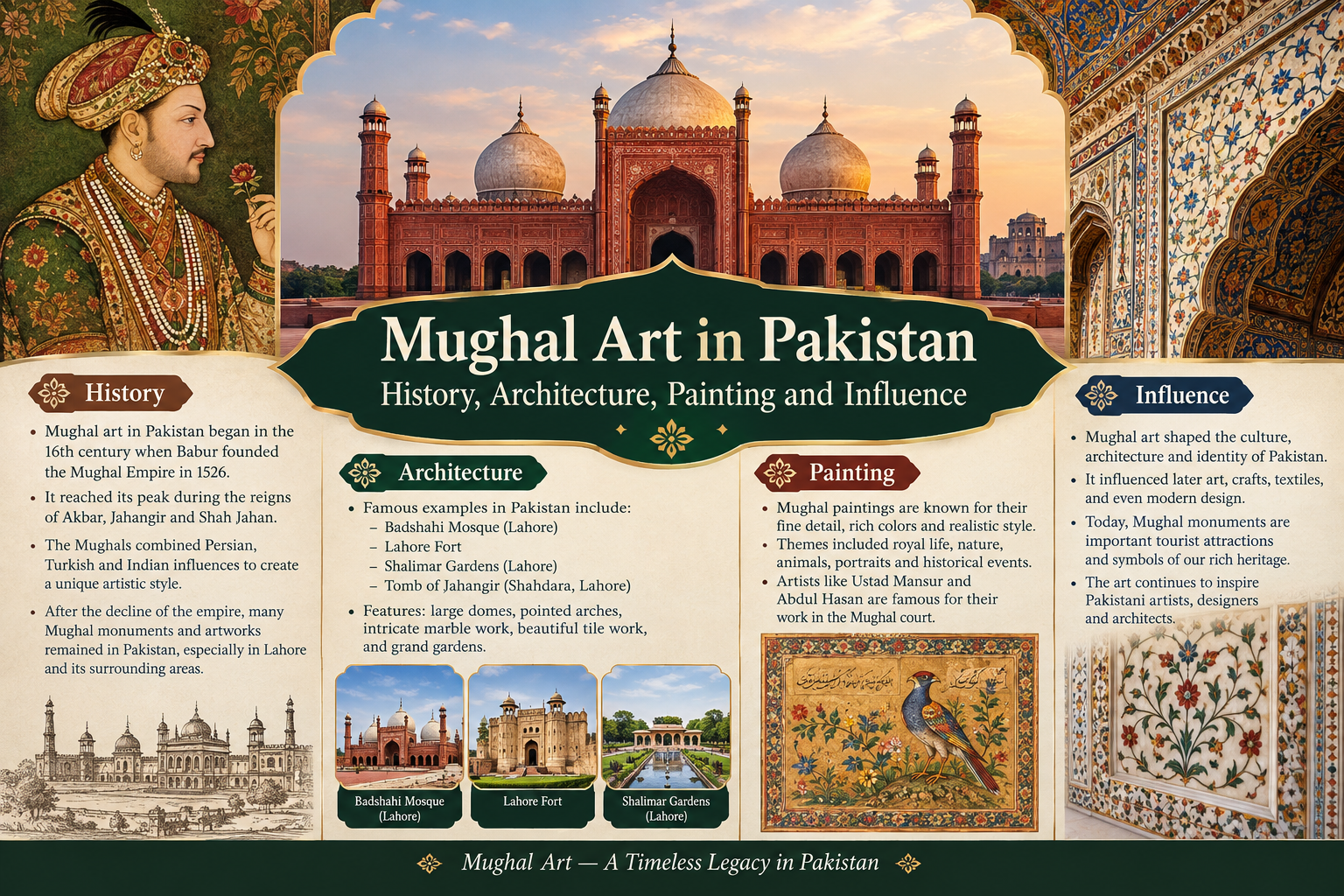
Mughal art is one of the most important artistic traditions connected with the history and cultural heritage of the region that is now Pakistan. The Mughal period left a lasting influence on architecture, painting, calligraphy, gardens, decorative arts, textiles and crafts. Many historic buildings in Pakistan still show the artistic ideas that developed or flourished during the Mughal era.
The Mughal Empire ruled large parts of South Asia for several centuries. During this period, artists, architects, calligraphers, craftsmen and designers worked under royal and regional patronage. Their work combined Central Asian, Persian, Indian and other South Asian artistic traditions.
Today, Mughal artistic heritage can be seen particularly in Punjab and other parts of Pakistan. Historic monuments such as the Lahore Fort, Badshahi Mosque, Shalimar Gardens and Wazir Khan Mosque demonstrate the importance of architecture, tile work, calligraphy and decorative design during and around the Mughal period.
Mughal art is important because it shows how different cultural traditions can come together to create distinctive forms of artistic expression.
What Is Mughal Art?
Mughal art refers to the artistic traditions that developed under Mughal rule and within the wider cultural environment associated with the Mughal Empire.
It includes:
Architecture
Miniature painting
Calligraphy
Tile work
Decorative arts
Garden design
Woodwork
Metalwork
Textiles
Jewelry
Manuscript illustration
Mughal art was not one single style. It changed over time as different rulers, artists and regional traditions influenced its development.
The Beginning of Mughal Artistic Tradition
The Mughal Empire was established in South Asia in the early sixteenth century by Babur.
Babur came from a Central Asian and Timurid cultural background. His artistic and architectural traditions were influenced by Persian and Central Asian culture.
As the Mughal Empire expanded, these traditions interacted with artistic practices already present in South Asia.
This interaction eventually produced a distinctive Mughal style.
Persian Influence on Mughal Art
Persian culture had a strong influence on Mughal artistic traditions.
Persian language was important in the Mughal court, and Persian literary and artistic traditions influenced painting, calligraphy, architecture and manuscript production.
Artists from Persian cultural centers also worked in Mughal courts.
Persian influence can be seen in:
Manuscript illustration
Calligraphy
Garden design
Architectural decoration
Poetry
Court painting
However, Mughal art was not simply Persian art reproduced in South Asia. It developed through interaction with Indian and other regional traditions.
Indian Influence on Mughal Art
South Asia already had a long history of architecture, painting, sculpture, decorative arts and craftsmanship before the Mughal period.
Local artists and craftspeople contributed their knowledge to Mughal projects.
This included skills in:
Stone carving
Marble work
Decorative painting
Textile production
Metalwork
Woodwork
Construction
Tile decoration
The combination of different traditions helped create the distinctive character of Mughal art.
Mughal Architecture in Pakistan
Architecture is perhaps the most visible form of Mughal artistic heritage in Pakistan.
Several historic monuments in Lahore and other cities demonstrate Mughal architectural principles.
Mughal architecture often combined large structures with carefully planned courtyards, gardens, decorative surfaces, domes, arches and minarets.
Buildings were designed not only for practical purposes but also to create visual harmony.
Lahore Fort
The Lahore Fort is one of Pakistan's most important historic monuments.
Lahore Fort
The fort contains buildings and decorative elements from different periods, including significant Mughal additions.
Its complex includes palaces, halls, courtyards, gateways and decorative structures.
Mughal rulers expanded and modified parts of the fort over time.
The fort demonstrates how architecture could combine political power, royal living spaces and artistic decoration.
Badshahi Mosque
The Badshahi Mosque is one of Lahore's most famous historic landmarks.
Badshahi Mosque
It was commissioned during the reign of Mughal emperor Aurangzeb and completed in the seventeenth century.
The mosque is known for its large courtyard, monumental scale, domes, minarets and red sandstone architecture.
Its design demonstrates the importance of proportion, symmetry and monumental architecture in the Mughal period.
Shalimar Gardens
The Shalimar Gardens in Lahore are another major example of Mughal artistic planning.
Shalimar Gardens
The gardens were commissioned by Shah Jahan.
They demonstrate the Mughal interest in combining architecture, water, plants and carefully planned spaces.
The garden includes terraces, water channels, fountains, pools and decorative structures.
The overall design reflects the importance of gardens in Mughal culture.
Wazir Khan Mosque
The Wazir Khan Mosque in Lahore is famous for its colorful tile decoration and calligraphy.
Wazir Khan Mosque
Although it was commissioned during the Mughal period, it is particularly notable for its extensive decorative tile work.
Its walls contain colorful patterns, floral designs, geometric forms and calligraphic decoration.
The mosque demonstrates how architectural surfaces could become works of art.
Mughal Miniature Painting
Mughal miniature painting is another important part of Mughal artistic history.
Miniature paintings were usually created on relatively small surfaces and were often connected with manuscripts and royal collections.
They could depict:
Court scenes
Historical events
Royal portraits
Hunting scenes
Animals
Plants
Landscapes
Battles
Literary stories
Artists paid close attention to details, including clothing, architecture, facial features and natural elements.
Development of Mughal Painting
Mughal painting developed significantly under the patronage of different rulers.
Humayun played an important role in bringing Persian artistic influences into the Mughal court after his return from exile.
Artists associated with Persian traditions were invited to work in the imperial environment.
Over time, Indian artists also became important contributors.
The resulting style combined Persian techniques with South Asian subjects and visual traditions.
Akbar and Mughal Art
Emperor Akbar was an important patron of art.
During his reign, manuscript illustration developed significantly.
Large artistic projects involved teams of painters and craftsmen.
Illustrated manuscripts could contain hundreds of images, with artists specializing in different aspects of production.
Some worked on drawing, others on coloring or detailed finishing.
This collaborative system helped develop the Mughal miniature tradition.
Jahangir and Naturalistic Art
Emperor Jahangir had a strong interest in painting, particularly naturalistic representations.
Paintings from his period often showed detailed portraits, animals and plants.
Artists developed techniques for representing natural forms with careful observation.
Birds, flowers and animals could be depicted with remarkable attention to detail.
This interest in nature became an important characteristic of Mughal painting.
Shah Jahan and Architectural Art
Shah Jahan is strongly associated with monumental architecture.
During his reign, Mughal architecture reached a highly refined level of decorative and structural design.
His period is associated with:
Marble decoration
Gardens
Symmetrical planning
Decorative stonework
Calligraphy
Elaborate buildings
The Shalimar Gardens and important additions to Lahore's historic architecture reflect the artistic interests of his period.
Aurangzeb and the Changing Artistic Environment
Aurangzeb's reign had a different artistic environment from some earlier Mughal periods.
Royal patronage of certain court arts changed, and artists increasingly worked outside the central court.
This contributed to the development of regional painting traditions.
Artists and artistic techniques spread to different centers, helping influence later South Asian painting styles.
Mughal Calligraphy
Calligraphy was an essential part of Mughal art.
Arabic and Persian writing appeared in architecture, manuscripts and decorative objects.
Calligraphers created inscriptions for mosques, palaces and other buildings.
The writing was carefully designed to fit architectural spaces.
Calligraphy was often combined with geometric and floral decoration.
Decorative Tile Work
Tile decoration is particularly important in the artistic heritage of Lahore.
Mughal and later buildings feature colorful tiles arranged in geometric and floral patterns.
These tiles could cover:
Walls
Arches
Domes
Courtyards
Gateways
The combination of different colors and patterns created highly decorative surfaces.
The tradition is sometimes associated with the broader South Asian development of kashi kari, or decorative tile work.
Floral Motifs in Mughal Art
Flowers appear frequently in Mughal art.
Floral designs can be seen in:
Paintings
Tiles
Carpets
Textiles
Stonework
Architecture
Manuscripts
Flowers were often arranged symmetrically or used as repeated decorative patterns.
Natural forms were transformed into artistic motifs that could be repeated across different surfaces.
Geometric Patterns
Geometry was another important part of Mughal design.
Artists and architects used repeated shapes, symmetrical arrangements and carefully calculated patterns.
Geometric designs can be found in:
Tile work
Screens
Floors
Walls
Ceilings
Architectural panels
Geometry helped create visual balance and order.
Mughal Gardens
Gardens were an important part of Mughal culture.
Mughal garden design often emphasized symmetry, water and carefully organized spaces.
The charbagh concept, involving a four-part garden arrangement, became especially important in Islamic garden traditions.
Water channels and pools could divide spaces and create visual reflections.
Gardens served both practical and aesthetic purposes.
They provided spaces for relaxation while also demonstrating planning and architectural skill.
Water in Mughal Design
Water was an important design element in Mughal gardens and architecture.
Fountains, channels and pools created movement and sound.
Water could also reflect buildings and decorative surfaces.
The careful arrangement of water helped connect different parts of a garden.
In the hot climate of much of South Asia, water also had practical environmental importance.
Mughal Decorative Arts
Mughal artistic traditions extended beyond major buildings.
Craftspeople produced decorative objects using different materials.
These included:
Metal
Wood
Stone
Textiles
Ceramics
Glass
Precious and semi-precious materials
Objects could feature floral patterns, calligraphy and geometric designs.
Mughal Influence on Textiles
Textiles were an important part of court culture.
Fine fabrics could be decorated with floral motifs and detailed patterns.
Mughal artistic preferences influenced textile designs across South Asia.
Floral patterns later became common in regional embroidery and fabric traditions.
Some modern Pakistani textile designs continue to use motifs associated with Mughal decorative art.
Mughal Influence on Pakistani Crafts
Mughal artistic traditions influenced many crafts that continued after the Mughal Empire.
These include:
Tile making
Embroidery
Carpets
Wood carving
Metalwork
Jewelry
Decorative painting
Craft traditions changed over time, but historical Mughal designs continued to influence later artists.
Mughal Art and Modern Pakistan
Mughal art remains visible in modern Pakistan.
Historic monuments attract visitors, researchers, students and tourists.
Artists and designers also use Mughal-inspired patterns in modern creative work.
Mughal floral motifs, arches, geometric designs and calligraphy can be found in contemporary:
Interior design
Fashion
Furniture
Graphic design
Jewelry
Architecture
Textile patterns
This shows that historical art can continue influencing modern creative industries.
Mughal Art in Pakistani Education
Mughal history and architecture are commonly discussed in studies of Pakistan's cultural heritage.
Students learn about historic monuments, architectural styles, miniature painting and the development of artistic traditions.
Educational visits to historic sites can help students understand the relationship between history and art.
Historic buildings can provide practical examples that are difficult to understand fully through textbooks alone.
Preservation of Mughal Heritage
Preserving Mughal artistic heritage is important because historic monuments are vulnerable to environmental damage, pollution, weather and human activity.
Conservation work may involve:
Structural maintenance
Cleaning
Restoration
Documentation
Protection of decorative surfaces
Archaeological research
Preservation requires specialist knowledge because inappropriate restoration can damage historic materials.
Tourism and Mughal Art
Mughal monuments are important attractions for cultural tourism in Pakistan.
Lahore in particular contains several major historic sites connected with Mughal history.
Visitors can experience architecture, gardens, tile work and calligraphy in their original environments.
Cultural tourism also creates opportunities for local guides, businesses, craftspeople and heritage organizations.
Mughal Art and Pakistani Identity
Mughal art is an important part of Pakistan's historical landscape.
It reflects centuries of interaction between Central Asian, Persian and South Asian traditions.
The monuments and artworks left behind provide evidence of the artistic skills and cultural exchanges that took place during the period.
At the same time, Mughal art should be understood as one part of Pakistan's much broader artistic history.
Pakistan also has important Gandharan, Buddhist, Indus Valley, Islamic, Sikh, regional and modern artistic traditions.
Mughal Art and the Walled City of Lahore
The historic Walled City of Lahore contains many buildings and spaces associated with different periods of Lahore's history.
Mughal architectural influence is especially visible in historic mosques, gateways and decorative structures.
The area demonstrates how architectural traditions developed over centuries rather than existing as isolated historical moments.
Mughal structures later became part of the broader urban history of Lahore.
Mughal Art and Modern Architecture
Modern architects sometimes use historical Mughal elements in contemporary buildings.
These may include:
Arches
Domes
Courtyards
Geometric patterns
Tile decoration
Islamic calligraphy
Garden layouts
Modern interpretations can create visual connections with historical architecture while using modern construction techniques.
Mughal Art in Pakistani Fashion
Mughal-inspired designs are also popular in Pakistani fashion.
Designers may use floral motifs, traditional patterns, decorative borders and historical architectural elements.
These influences can appear in:
Formal clothing
Embroidery
Jewelry
Accessories
Textile prints
The use of historical motifs demonstrates how art can move between architecture, clothing and design.
Mughal Art in Contemporary Painting
Contemporary Pakistani artists sometimes reference historical Mughal imagery.
They may reinterpret miniature painting, portraits, architecture and traditional patterns through modern artistic methods.
Some artists preserve the detailed style of miniature painting, while others use it as inspiration for experimental compositions.
This creates a dialogue between historical and contemporary art.
The Importance of Mughal Miniature Painting Today
Miniature painting continues to be practiced in Pakistan.
Artists and art institutions teach traditional techniques while encouraging contemporary experimentation.
Modern miniature artists may work with traditional materials and methods but address modern themes.
This demonstrates that miniature painting is not simply a historical technique.
It can continue to evolve as a contemporary art form.
Mughal Art and Museums
Museums play an important role in preserving and displaying Mughal artistic heritage.
Collections may include:
Manuscripts
Paintings
Decorative objects
Coins
Textiles
Ceramics
Historical photographs
Museums allow visitors to study objects that may otherwise be difficult to access.
They also provide educational resources for researchers and students.
Importance of Research
Research helps improve understanding of Mughal art.
Historians, archaeologists, architects, conservation experts and art historians study buildings and artworks to understand their materials, techniques and historical context.
Research can also help identify appropriate preservation methods.
Challenges in Preserving Mughal Art
Mughal monuments face several challenges.
Pollution can affect stone and decorative surfaces. Weather can damage exposed materials. Urban development can place pressure on historic areas.
Tourism must also be managed carefully so that large numbers of visitors do not cause unnecessary damage.
Proper conservation planning is therefore essential.
How Young People Can Learn About Mughal Art
Young people can learn about Mughal art in several ways.
They can:
Visit historical monuments
Read history and art books
Study miniature painting
Explore museum collections
Learn calligraphy
Practice traditional patterns
Watch educational documentaries
Study architectural drawings
Learning about historical art can help students understand how culture changes over time.
Mughal Art as a Source of Inspiration
Mughal art continues to inspire modern artists because of its detailed patterns, architectural beauty and rich visual language.
Artists can take inspiration from:
Floral designs
Geometric patterns
Calligraphy
Miniature painting
Gardens
Architectural forms
Historical manuscripts
Modern creativity can reinterpret these elements without simply copying historical works.
Future of Mughal-Inspired Art in Pakistan
Mughal-inspired art is likely to remain part of Pakistan's cultural and creative landscape.
Digital design, modern architecture, fashion and contemporary painting provide new ways to reinterpret historical motifs.
At the same time, historic monuments need continued preservation.
The future of Mughal artistic heritage therefore involves both conservation and creative adaptation.
Conclusion
Mughal art represents an important chapter in the artistic history of the region that is now Pakistan. Its influence can be seen in architecture, miniature painting, calligraphy, gardens, tile work, textiles and decorative crafts.
Historic places such as the Lahore Fort, Badshahi Mosque, Shalimar Gardens and Wazir Khan Mosque demonstrate the variety and sophistication of Mughal artistic traditions.
Mughal art developed through interaction between Central Asian, Persian, Indian and other South Asian influences. It was shaped by rulers, architects, painters, calligraphers and craftspeople who worked across different generations.
Today, Mughal artistic ideas continue to influence Pakistani fashion, architecture, painting, interior design and crafts. At the same time, historic monuments require careful preservation so that future generations can experience this heritage.
The lasting influence of Mughal art shows how historical creativity can continue to inspire new generations while remaining connected to the cultural history of Pakistan.
FAQs
1. What is Mughal art?
Mughal art refers to artistic traditions associated with the Mughal period, including architecture, miniature painting, calligraphy, gardens, textiles and decorative crafts.
2. Which Pakistani city is famous for Mughal art?
Lahore is particularly famous for its Mughal heritage, including the Lahore Fort, Badshahi Mosque, Shalimar Gardens and Wazir Khan Mosque.
3. What are common features of Mughal art?
Common features include floral motifs, geometric patterns, calligraphy, detailed miniature painting, symmetrical architecture and carefully planned gardens.
4. What is Mughal miniature painting?
Mughal miniature painting is a detailed form of small-scale painting that developed under Mughal patronage and often depicted court scenes, portraits, nature, historical events and literary subjects.
5. Why is Mughal art important in Pakistan?
Mughal art is important because it forms a major part of Pakistan's historical and cultural heritage and continues to influence architecture, painting, fashion, crafts and modern design.