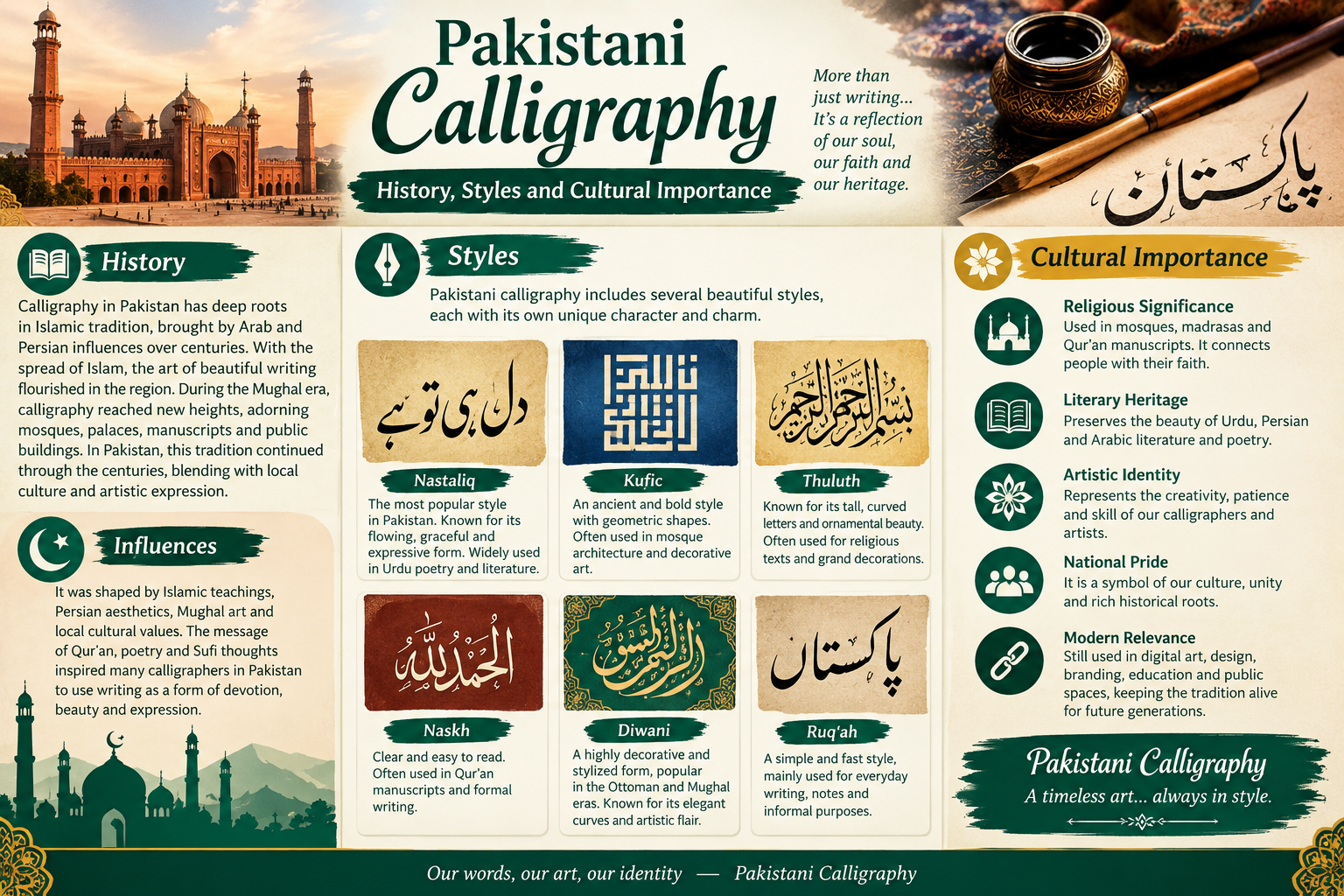
Pakistani calligraphy is one of the most respected and beautiful forms of artistic expression in the country's cultural heritage. It combines writing with visual art and has a strong connection with Islamic culture, Urdu literature, Persian traditions and the artistic history of South Asia. From elegant Quranic calligraphy to Urdu poetry and modern decorative designs, calligraphy can be found in mosques, homes, schools, galleries, books and public spaces across Pakistan.
Calligraphy is not simply about writing words beautifully. It involves careful control of letters, spacing, lines, shapes and composition. A skilled calligrapher can transform ordinary words into an artistic composition that communicates both language and beauty.
Pakistan has produced many talented calligraphers who have contributed to the development of modern Islamic and Urdu calligraphy. Traditional styles continue to be practiced while contemporary artists are experimenting with new materials, colors, layouts and digital techniques.
What Is Calligraphy?
Calligraphy is the artistic practice of creating beautiful written letters and words. The term generally refers to carefully designed handwriting in which the shape, size, spacing and arrangement of letters are important.
In Pakistan, calligraphy is particularly associated with Arabic, Urdu and Persian writing traditions.
A calligraphic composition may contain:
Quranic verses
Religious expressions
Urdu poetry
Persian poetry
Names
Proverbs
Inspirational sayings
Decorative words
Historical inscriptions
Calligraphy can be created using traditional pens and ink or through modern digital tools.
History of Calligraphy in Pakistan
The history of calligraphy in the region is much older than the creation of Pakistan in 1947. The areas that now form Pakistan were part of several historical civilizations, kingdoms and cultural traditions.
Islamic calligraphy developed strongly in the region following the spread of Islam. Arabic became important for religious writing, while Persian became an important literary and administrative language for centuries.
Urdu later became a major literary language and developed its own rich written tradition.
When Pakistan was established, these different traditions continued to influence its artistic culture.
Calligraphy therefore became an important part of Pakistan's national cultural identity.
Islamic Calligraphy in Pakistan
Islamic calligraphy is one of the most important forms of calligraphic art in Pakistan.
Arabic calligraphy is frequently used for Quranic verses, religious phrases and the names of important Islamic figures.
Mosques may feature calligraphy on:
Walls
Domes
Arches
Mihrabs
Tiles
Doors
Decorative panels
The writing is often combined with geometric patterns and architectural decoration.
Islamic calligraphy allows religious text to become part of the visual environment while maintaining its written meaning.
Quranic Calligraphy
Quranic calligraphy has a special place in Pakistani artistic traditions.
Artists carefully reproduce Quranic verses using established Arabic calligraphic styles. Because the text is sacred, calligraphers pay particular attention to accuracy and presentation.
Quranic calligraphy may appear on framed artwork, mosque walls, architectural surfaces and decorative objects.
Many people also display calligraphic Quranic verses in their homes as part of their religious and cultural environment.
Urdu Calligraphy
Urdu calligraphy is another major part of Pakistani artistic culture.
Urdu has a rich literary tradition, and its writing is closely connected with poetry.
Calligraphers can turn verses by famous Urdu poets into decorative compositions.
Urdu calligraphy can be found in:
Art exhibitions
Books
Posters
Cultural events
Educational institutions
Home decoration
Public artwork
The flowing nature of the Urdu script makes it especially suitable for artistic composition.
Nastaliq Script
Nastaliq is one of the most recognizable scripts associated with Urdu.
It is known for its elegant, flowing appearance and diagonal movement.
Traditional Urdu books and newspapers have historically used Nastaliq extensively.
Calligraphers working in Nastaliq need strong control over letter forms and spacing because the script has a complex visual structure.
The beauty of Nastaliq has helped make Urdu calligraphy an important part of Pakistani literary culture.
Naskh Script
Naskh is another important Arabic script.
It is generally easier to read than some highly decorative scripts and has been widely used for religious and literary texts.
Naskh has an important place in Islamic calligraphy and is commonly associated with the writing of Arabic texts.
Calligraphers may choose Naskh depending on the purpose, size and style of their composition.
Thuluth Script
Thuluth is known for its large and decorative letter forms.
It has historically been used in architectural decoration and important inscriptions.
In Pakistan, Thuluth-inspired calligraphy can be seen in religious and artistic contexts.
Its large letters make it suitable for walls, architectural spaces and decorative panels.
Diwani Script
Diwani is a highly decorative Arabic script associated historically with Ottoman calligraphic traditions.
Although it is not exclusively Pakistani, examples of Arabic calligraphic styles such as Diwani have influenced decorative calligraphy in the broader Islamic artistic world.
Modern Pakistani artists may experiment with different Arabic scripts to create contemporary compositions.
Calligraphy and Pakistani Architecture
Calligraphy has played an important role in Pakistani architecture.
Mosques, shrines and other religious buildings may incorporate calligraphic decoration into their design.
Calligraphy can appear alongside:
Tile work
Geometric patterns
Floral designs
Wood carving
Stonework
Metalwork
This combination creates a connection between writing and architecture.
Instead of being placed only on paper, calligraphy can become part of the structure itself.
Calligraphy in Mosques
Mosques are among the most visible places where calligraphy can be found.
Arabic verses and religious phrases may be incorporated into walls, domes, arches and other architectural areas.
The scale of the writing can range from small decorative details to large compositions visible across a major interior space.
Calligraphy can therefore contribute both artistic and spiritual dimensions to mosque architecture.
Calligraphy and Urdu Literature
Pakistan has a strong literary tradition, particularly in Urdu poetry.
Poets such as Allama Iqbal, Mirza Ghalib, Faiz Ahmed Faiz and many other literary figures have inspired calligraphers.
A poem can be transformed from ordinary printed text into a visual artwork.
Calligraphers may select a short verse and arrange its words in an artistic shape.
This creates an interesting connection between literature and visual art.
Calligraphy and Poetry
Poetry and calligraphy naturally complement one another.
Poetry communicates ideas through words, while calligraphy adds visual beauty to those words.
Urdu poetry is particularly suitable for calligraphic art because the Nastaliq script has a flowing appearance.
A calligraphic composition may emphasize certain words by changing their size, placement or visual relationship with surrounding letters.
The result can make a familiar poetic line look completely different from ordinary printed writing.
Materials Used in Traditional Calligraphy
Traditional calligraphy requires specialized tools.
Common materials include:
Reed pens
Ink
Paper
Ink containers
Rulers
Cutting tools
Handmade papers
The reed pen, often called a qalam, is particularly important in traditional Islamic calligraphy.
The tip of the pen is carefully cut to create the desired thickness and shape of the strokes.
The calligrapher's control of the pen determines the appearance of the letters.
The Role of the Qalam
The qalam is a traditional writing instrument used in Islamic calligraphy.
It is commonly made from a reed or similar material and prepared carefully by the calligrapher.
Different cuts and sizes can produce different line widths.
The angle at which the pen is held also affects the shape of letters.
Learning to prepare and use a qalam is therefore an important part of traditional calligraphy training.
Traditional Calligraphy Techniques
Traditional calligraphy requires patience and practice.
A beginner normally learns individual letter forms before moving toward complete words and compositions.
Important skills include:
Controlling the pen
Creating consistent strokes
Understanding letter proportions
Maintaining spacing
Connecting letters correctly
Arranging words
Creating balanced compositions
Calligraphers may spend years improving these skills.
Calligraphy as a Form of Discipline
Calligraphy requires concentration and careful attention to detail.
Unlike ordinary handwriting, artistic calligraphy cannot usually be produced quickly without practice.
The artist must think about each letter and how it fits within the larger composition.
This makes calligraphy both an artistic and disciplined practice.
Famous Pakistani Calligraphers
Pakistan has produced many respected calligraphers.
One of the best-known figures is Sadequain, whose work had a major influence on Pakistani calligraphic art.
Sadequain developed a distinctive approach to calligraphy and created large-scale works in which letters became expressive visual forms.
His work helped introduce calligraphy into modern fine art.
Other Pakistani calligraphers have also contributed to the development and teaching of traditional styles.
Sadequain and Modern Calligraphy
Sadequain is particularly important in the history of Pakistani modern art.
He treated calligraphy not merely as decorative writing but as an expressive art form.
His large calligraphic compositions demonstrated that traditional Arabic letters could be used within modern artistic structures.
His work helped increase the visibility of calligraphy in galleries and fine-art discussions.
Calligraphy in Pakistani Schools
Calligraphy can also be found in educational settings.
Students may practice handwriting, Urdu writing and decorative lettering as part of art activities.
Schools may display calligraphic artwork during cultural and religious events.
Learning calligraphy can help students develop patience, concentration and control over writing tools.
It can also introduce younger generations to traditional artistic heritage.
Calligraphy Competitions
Calligraphy competitions and exhibitions provide opportunities for artists and students to display their skills.
Competitions may focus on:
Arabic calligraphy
Urdu calligraphy
Quranic verses
Modern compositions
Traditional scripts
Such activities help encourage interest in calligraphy and provide a platform for emerging artists.
Calligraphy in Home Decoration
Calligraphic artwork is commonly used as home decoration in Pakistan.
Families may display framed Arabic or Urdu calligraphy in living rooms, bedrooms, entrances and other areas.
Religious calligraphy is particularly common.
Modern interior designers may combine traditional calligraphy with contemporary frames and minimalist surroundings.
This creates a connection between traditional art and modern home design.
Calligraphy on Tiles
Tile work and calligraphy have a long relationship in Islamic architecture.
Decorative tiles can carry Arabic writing and geometric patterns.
Pakistan has important architectural traditions involving colorful tile decoration.
Calligraphic tiles may be used in mosques, shrines and historic buildings.
The combination of lettering and tile design creates a strong visual effect.
Calligraphy and Truck Art
Pakistani truck art also uses decorative lettering.
Urdu poetry, sayings and short messages may be painted onto trucks.
Although truck lettering is different from formal Islamic calligraphy, both demonstrate the cultural importance of artistic writing in Pakistan.
Truck artists often combine words with flowers, geometric patterns and colorful borders.
This makes writing part of a larger visual composition.
Calligraphy in Public Spaces
Calligraphy can be used in public buildings, cultural centers and artistic installations.
Large-scale lettering can transform a wall into an artistic feature.
Public calligraphy can also promote Urdu literature, cultural heritage and traditional design.
Modern artists sometimes use large letters as abstract visual forms.
Modern Pakistani Calligraphy
Modern calligraphy is not limited to traditional black ink on white paper.
Contemporary artists may use:
Acrylic paint
Watercolors
Digital tools
Mixed media
Wood
Glass
Metal
Canvas
Fabric
Ceramic surfaces
Artists may also combine calligraphy with abstract art, geometric designs and modern color schemes.
This allows traditional writing styles to enter new artistic spaces.
Digital Calligraphy
Technology has changed the way calligraphy can be created.
Graphic design software allows artists to experiment with lettering, composition, colors and backgrounds.
Digital calligraphy can be used for:
Social media designs
Posters
Logos
Book covers
Websites
Invitations
Advertisements
Digital artwork
However, digital tools do not completely replace traditional skills.
Understanding letter structure and calligraphic principles remains important.
Calligraphy and Social Media
Social media platforms have provided new opportunities for Pakistani calligraphers.
Artists can share photographs and videos of their work with audiences around the world.
Short videos showing the creation of calligraphic compositions can also attract viewers interested in traditional art.
This digital exposure can help young artists build portfolios and connect with potential customers.
Calligraphy as a Career
Calligraphy can become a professional skill when combined with artistic ability and modern design knowledge.
Potential areas include:
Art commissions
Graphic design
Wedding stationery
Logo design
Wall decoration
Book design
Digital artwork
Teaching
Workshops
Cultural projects
Artists who understand both traditional calligraphy and modern digital design may have additional opportunities.
Learning Pakistani Calligraphy
Anyone interested in learning calligraphy can begin with basic exercises.
A beginner should first understand the script they want to practice.
For Urdu calligraphy, Nastaliq can be studied through structured practice. For Arabic calligraphy, students can choose an appropriate script such as Naskh.
The learning process can include:
Learning individual letters
Practicing basic strokes
Studying proportions
Practicing letter connections
Writing short words
Practicing complete sentences
Creating small compositions
Studying established calligraphers
Regular practice is more useful than trying to create complicated artwork immediately.
Importance of Practice
Calligraphy is a skill that improves through repetition.
A person may understand the theory of a script but still need significant practice to produce consistent letters.
Daily practice can help improve:
Pen control
Stroke quality
Letter spacing
Writing speed
Accuracy
Composition
Patience is one of the most important qualities for a developing calligrapher.
Preservation of Traditional Calligraphy
Traditional calligraphy is an important part of Pakistan's cultural heritage.
Preserving it requires both documentation and active practice.
Museums, schools, cultural institutions and artists can contribute by organizing exhibitions, workshops and educational programs.
Digital archives can also help preserve examples of historical calligraphy for future generations.
Challenges for Traditional Calligraphers
Traditional calligraphers face several challenges in the modern world.
Digital fonts have made professionally printed writing easy to produce. People can now create attractive lettering with software in a short time.
As a result, fewer people may choose to learn traditional pen-based calligraphy.
Another challenge is that traditional calligraphy requires time and patience, while modern communication often emphasizes speed.
Despite these challenges, handmade calligraphy continues to have artistic value because each piece contains the individual work of the artist.
The Relationship Between Tradition and Modernity
Pakistani calligraphy demonstrates that tradition and modernity can exist together.
Traditional scripts can be preserved while artists experiment with new materials and creative ideas.
A modern calligraphy artwork may use traditional Arabic letters but place them within an abstract composition.
Similarly, an Urdu calligrapher may use Nastaliq while experimenting with modern colors and digital presentation.
This balance allows the art form to remain relevant.
Cultural Importance of Pakistani Calligraphy
Calligraphy represents several important aspects of Pakistani culture.
It reflects:
Islamic artistic traditions
Urdu literature
Persian cultural influence
South Asian craftsmanship
Religious expression
Contemporary creativity
Because of this combination, calligraphy occupies an important position within Pakistan's broader artistic heritage.
Calligraphy and Cultural Identity
Writing systems are closely connected to language and culture.
For Pakistan, Urdu calligraphy provides a visual connection to the country's literary heritage.
Arabic calligraphy connects artistic practice with Islamic culture.
Regional languages and scripts can also be represented through decorative writing.
This makes calligraphy a way of preserving cultural identity through visual communication.
Future of Pakistani Calligraphy
The future of Pakistani calligraphy can involve both traditional and digital approaches.
Traditional artists can continue teaching established scripts, while younger designers can experiment with new technologies.
Digital platforms can provide opportunities to reach international audiences.
Art schools and cultural institutions can support workshops and exhibitions.
By combining traditional knowledge with modern creative tools, Pakistani calligraphy can continue to develop without losing its historical foundations.
Conclusion
Pakistani calligraphy is an important part of the country's artistic and cultural heritage. From Quranic verses and mosque decoration to Urdu poetry, home artwork and modern digital designs, calligraphy appears in many different forms.
Its history connects Pakistan with broader Islamic, Persian, South Asian and Urdu literary traditions. Traditional scripts such as Nastaliq, Naskh and Thuluth demonstrate the diversity of calligraphic styles.
At the same time, modern Pakistani artists continue to experiment with canvas, digital tools, mixed media and contemporary compositions.
Calligraphy is therefore not simply an old method of beautiful writing. It is a living art form that continues to connect language, culture, religion, literature and creativity.
Preserving traditional techniques while encouraging modern experimentation can help ensure that Pakistani calligraphy remains an important part of the country's artistic identity for future generations.
FAQs
1. What is Pakistani calligraphy?
Pakistani calligraphy is the artistic practice of creating beautiful Arabic, Urdu and other written compositions, often connected with Islamic art and Pakistani literary culture.
2. Which script is commonly associated with Urdu calligraphy?
Nastaliq is one of the most recognizable scripts associated with Urdu writing and calligraphy.
3. Who is a famous Pakistani calligrapher?
Sadequain is one of Pakistan's most well-known artists associated with modern calligraphic art.
4. Where can Pakistani calligraphy be seen?
Calligraphy can be seen in mosques, shrines, homes, schools, galleries, books, public spaces and digital artwork.
5. Is Pakistani calligraphy still relevant today?
Yes. Traditional calligraphy continues to be practiced, while modern artists are also using digital tools, contemporary materials and new artistic styles.