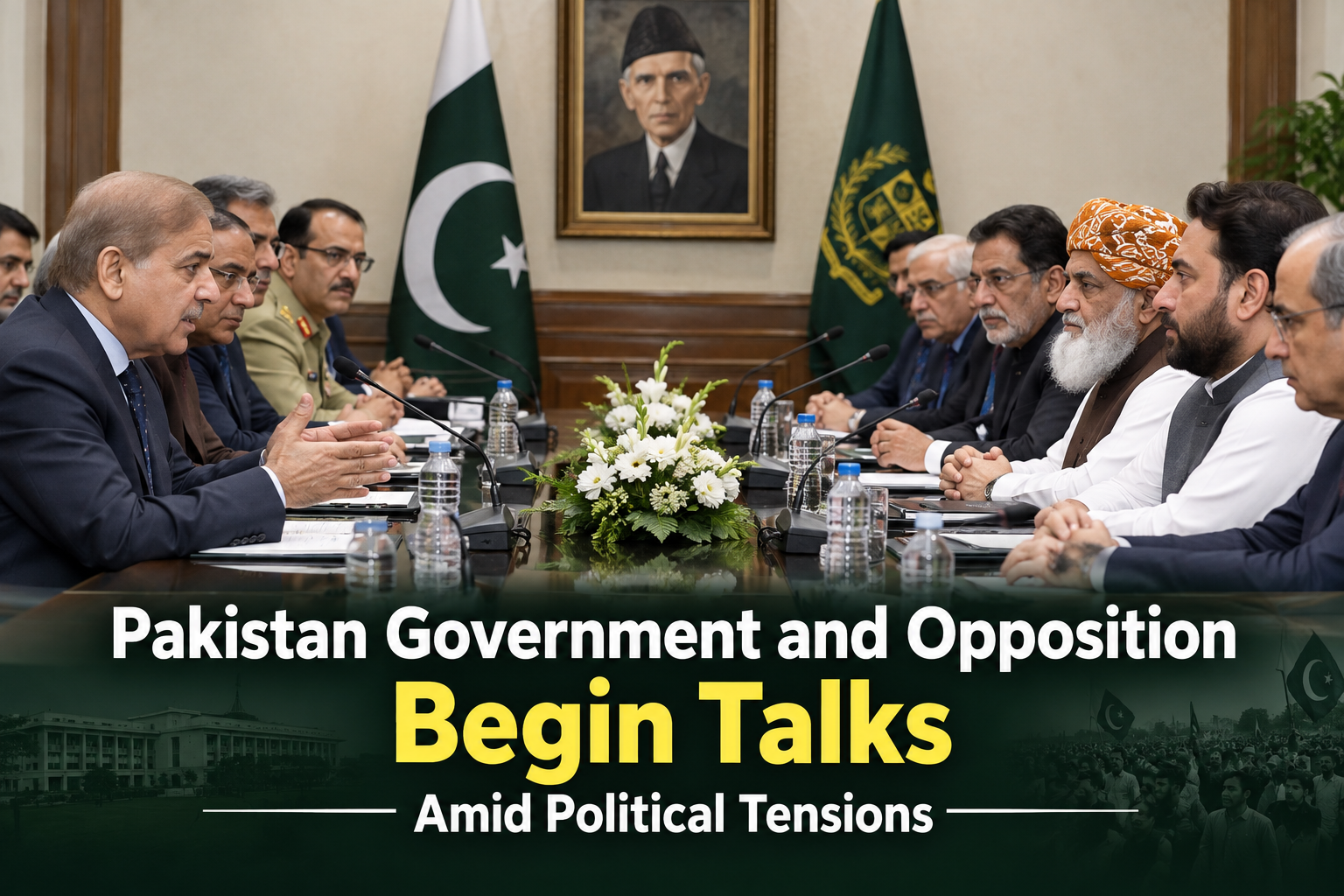
Pakistan’s political landscape witnessed an important development on October 2, 2026, as representatives of the federal government and the opposition Pakistan Tehreek-e-Insaf (PTI) formally sat together for negotiations. The talks took place at the chambers of National Assembly Speaker Ayaz Sadiq in Islamabad and came at a time when political tensions had increased over PTI’s announced protest march toward Islamabad on October 4.
The first round of negotiations concluded after approximately an hour, with both sides agreeing to continue discussions. The talks were intended to find a political way forward and reduce tensions surrounding the planned protest. However, the first meeting did not produce a final agreement, and several major differences remained between the government and opposition.
The development attracted considerable attention because political dialogue between the government and PTI had become increasingly difficult in recent years. The October 2 meeting therefore represented an attempt to address political disagreements through negotiations rather than allowing tensions to continue escalating.
Background of the Political Situation
The immediate reason behind the negotiations was PTI’s planned October 4 protest march. The party had announced the march as part of its political campaign and linked it to demands concerning the release of its founder, Imran Khan, along with broader political and constitutional issues.
The march had originally been scheduled for September 27 but was subsequently postponed to October 4. By the beginning of October, the planned demonstration had become a major point of disagreement between PTI and the federal government.
According to reports, PTI remained committed to its protest plans while the government wanted the proposed march cancelled. Government representatives had also raised concerns about the security situation in Khyber Pakhtunkhwa and the possible consequences of a large political gathering moving toward Islamabad.
The situation became more complicated because the federal government had publicly discussed possible constitutional and administrative measures concerning Khyber Pakhtunkhwa if tensions continued. This added another layer to the political dispute and increased the importance of dialogue between the two sides.
First Formal Round of Talks
The first formal round of talks was held on Friday, October 2. National Assembly Speaker Ayaz Sadiq hosted the meeting at his chambers in Islamabad.
Representatives from the ruling coalition and opposition participated in the discussions. The government side included Interior Minister Mohsin Naqvi and Prime Minister’s Adviser on Political Affairs Rana Sanaullah, while representatives associated with the Pakistan Peoples Party also participated. The opposition side included PTI Chairman Barrister Gohar Ali Khan and Senate Opposition Leader Allama Raja Nasir Abbas, along with other opposition figures.
The meeting was significant because it brought the two sides together at an official forum to discuss a crisis that had previously been dominated by public statements, warnings and political disagreements.
Although the first round did not produce a final settlement, both sides agreed to continue negotiations. A second round was scheduled for October 3.
Why the October 4 Protest Became Important
The planned October 4 march was central to the negotiations.
PTI had linked the protest to its political demands, particularly the release of its founder Imran Khan. The party had also raised concerns about what it describes as constitutional and political issues.
For the government, however, the proposed march created concerns about law and order, disruption of routine activities and security arrangements in the federal capital. Government officials had previously stated that they would not allow a situation in which roads and public life were seriously disrupted.
These differing positions meant that the October 4 date became an important deadline for negotiations.
If the two sides could reach an understanding, the political environment could become less tense. If they failed to reach an agreement, the proposed protest remained a major source of uncertainty.
Government’s Position
The federal government entered the negotiations with a number of concerns.
One of the central government demands was the cancellation of the October 4 protest. Government representatives argued that the current security environment, particularly in Khyber Pakhtunkhwa, made a large-scale political march toward Islamabad a serious concern.
Interior Minister Mohsin Naqvi was among the government representatives involved in the talks. Adviser Rana Sanaullah had previously stated that the government had been involved in discussions with PTI leaders behind the scenes before the formal negotiations began.
The government had also discussed the possibility of taking constitutional measures concerning Khyber Pakhtunkhwa if the situation deteriorated. Reports indicated that the possibility of governor’s rule or emergency measures had been discussed by government officials, although the October 2 negotiations represented an effort to pursue dialogue.
The government's approach therefore combined security concerns with an effort to resolve the immediate political dispute through negotiations.
Opposition’s Position
The opposition, particularly PTI, entered the talks with its own set of demands.
One of the most important issues raised by the opposition concerned Imran Khan. PTI leaders sought improved access to him and discussed matters related to his treatment and circumstances while in custody.
According to reports published after the first round, PTI also wanted Imran Khan to be shifted to a hospital. The opposition further raised other issues connected with political developments and arrests involving people associated with the party.
Senate Opposition Leader Allama Raja Nasir Abbas said that the protest call would remain in place until an agreement was reached. He also stressed the importance of negotiations as a means of resolving political disputes.
This position demonstrated that the opposition did not initially treat the negotiations as automatically replacing its protest plans. Instead, the continuation or cancellation of the protest was connected to the outcome of the talks.
Role of National Assembly Speaker Ayaz Sadiq
National Assembly Speaker Ayaz Sadiq played an important role by providing a parliamentary setting for the negotiations.
The choice of the National Assembly Speaker’s chambers was significant because parliament is traditionally a forum where political parties can engage with each other.
The talks also demonstrated the potential role of parliamentary institutions in addressing political disagreements. Rather than limiting discussions to public statements or media appearances, the two sides were brought into the same room to exchange positions directly.
The first round did not immediately solve the dispute, but the continuation of negotiations indicated that both sides were at least willing to keep the dialogue open.
Earlier Political Contacts
The October 2 meeting did not happen without prior contacts.
On October 1, Rana Sanaullah had said that the federal government and PTI were already engaged in what he described as “off-the-record talks” concerning the planned protest. He said consultations were taking place with senior PTI leadership.
The ruling coalition had also discussed the political and security situation before the formal meeting.
A meeting at the presidency involved President Asif Ali Zardari, Prime Minister Shehbaz Sharif, Interior Minister Mohsin Naqvi and other senior figures. According to reports, the political situation in Khyber Pakhtunkhwa and the proposed PTI protest were among the issues under discussion.
These developments showed that negotiations were preceded by internal consultations within the government and opposition.
Khyber Pakhtunkhwa and Security Concerns
Khyber Pakhtunkhwa remained an important part of the wider political dispute.
The province is governed by PTI and has faced significant security challenges. Government officials argued that the security situation should be taken into account when considering a major political march from the province toward Islamabad.
Rana Sanaullah had previously said that the federal government was considering various constitutional options concerning the province. He also stated that authorities had made preparations to prevent the proposed march from entering Islamabad.
The opposition, meanwhile, objected to the possibility of emergency or governor’s rule and warned against taking such steps.
This disagreement made the political dialogue more complicated because the negotiations were not only about the protest itself but also about relations between the federal government and the provincial administration.
Political Dialogue as a Possible Way Forward
Political negotiations can provide an alternative to prolonged confrontation.
Pakistan has experienced periods in which political disagreements between governments and opposition parties have resulted in protests, parliamentary disputes and tensions between federal and provincial authorities.
The October 2 negotiations provided an opportunity for the two sides to communicate directly.
For dialogue to succeed, both sides would need to identify areas where compromise might be possible. The government wanted the protest cancelled, while the opposition wanted progress on its political demands.
The continuation of talks on October 3 therefore became important because the first meeting mainly established communication rather than resolving the dispute.
PTI’s Earlier Decision to Negotiate
Before the October 2 meeting, PTI's political and core committees had held discussions regarding whether to participate in negotiations.
According to reports, the party ultimately agreed to enter talks with the federal government. Barrister Gohar Ali Khan played a central role in representing the party's position.
PTI's decision to negotiate demonstrated that despite maintaining its political demands, the party was willing to participate in a formal dialogue process.
The opposition also viewed negotiations as a possible method for addressing political disagreements without further escalation.
Government Coalition and PPP’s Role
The ruling coalition included representatives from parties beyond the Pakistan Muslim League-Nawaz (PML-N).
Pakistan Peoples Party representatives also participated in the discussions. Sherry Rehman and other PPP figures were involved in the government-side delegation.
The participation of coalition partners was important because the government’s position depended not only on the largest governing party but also on cooperation among its allies.
PPP leaders had also publicly discussed the importance of political dialogue and national stability.
Their participation meant that the negotiations represented a broader coalition position rather than a discussion involving only the PML-N and PTI.
The Issue of Imran Khan
Imran Khan remained one of the central subjects of the political dispute.
PTI considers his release an important political demand, while the legal status of his cases and imprisonment remains a matter involving Pakistan's judicial and legal processes.
During the negotiations, PTI leaders raised issues concerning his access, treatment and possible transfer to a hospital.
According to reports, PTI Chairman Barrister Gohar said Imran Khan had given opposition leaders authority to negotiate on his behalf.
This made his situation directly relevant to the negotiations.
At the same time, any questions concerning legal cases and custody involve judicial procedures that are separate from political negotiations.
Importance of Public Peace
Another important aspect of the talks was the potential effect of political protests on ordinary citizens.
Large demonstrations in Islamabad can affect roads, schools, offices, businesses, public transportation and other daily activities.
The government therefore emphasized security and public order, while the opposition emphasized its right to political activity and protest.
The challenge for both sides was to find a method through which political expression could take place while reducing disruption and security risks.
This is one reason negotiations became particularly important as the October 4 date approached.
No Final Agreement in the First Round
Despite the importance of the meeting, the first round did not produce a final agreement.
Reports indicated that the two sides exchanged positions but remained divided on key issues. The government wanted the October 4 protest cancelled, while PTI maintained its demands and linked the continuation of its protest call to the progress of negotiations.
Both sides nevertheless agreed to continue the dialogue.
The second round was scheduled to take place on October 3 at the National Assembly Speaker’s chambers.
This meant that the political situation remained fluid after the first meeting.
What the Second Round Could Address
The second round of talks was expected to focus on the main points of disagreement.
These included the future of the October 4 protest, the opposition's demands concerning Imran Khan, political tensions between the federal and provincial governments, and security concerns.
The two sides could also discuss possible steps that might build confidence.
For example, the government could consider measures requested by the opposition, while PTI could consider how its protest plans might be adjusted if meaningful progress were achieved.
The precise outcome, however, depended on the positions adopted by both sides during the negotiations.
Importance for Pakistan’s Political Environment
The October 2 talks were significant because they occurred during a period of considerable political tension.
Political stability can affect many areas of national life, including economic confidence, administration, investment, public services and governance.
When political parties remain in constant confrontation, parliamentary and governmental processes can become more difficult.
Dialogue does not automatically resolve political disputes, but it provides a mechanism for parties to communicate and potentially identify areas of agreement.
The October 2 meeting therefore represented an important attempt to reopen communication between the government and opposition.
Parliament as a Forum for Political Disputes
The involvement of the National Assembly Speaker also highlighted the role of parliament in political dialogue.
Parliament is designed to provide a platform where elected representatives can debate national issues.
Holding negotiations within the parliamentary environment allowed representatives of opposing political positions to meet under an institutional framework.
This can be particularly relevant during periods when political disagreements extend beyond normal parliamentary debate.
The talks demonstrated that parliamentary figures can sometimes facilitate communication even when political parties remain divided.
The Challenge of Building Trust
One of the biggest difficulties facing the negotiations was trust.
The government and PTI have frequently exchanged strong statements and accusations over political and constitutional matters.
As a result, reaching an agreement requires more than simply announcing negotiations. Both sides need confidence that commitments made during discussions will be respected.
The first round therefore served as an initial step rather than a complete solution.
Further meetings could help clarify whether both sides were prepared to make practical compromises.
Possible Effects on Islamabad
Islamabad remained the central location affected by the planned protest.
The federal capital is home to major government institutions, diplomatic missions, businesses and residential areas.
A large political march could therefore create significant logistical and security challenges.
The government had already discussed preparations to prevent the protest from entering Islamabad.
At the same time, PTI's continued protest call meant that the possibility of demonstrations remained an important issue.
Negotiations provided an opportunity to address these concerns before the planned date.
Broader Democratic Context
Political protests and negotiations are both parts of democratic political activity, although they involve different methods.
Opposition parties use demonstrations to express political demands and mobilize supporters. Governments, meanwhile, have responsibilities relating to public administration, security and the maintenance of public order.
The challenge is to balance these competing considerations within the constitutional and legal framework.
The October 2 talks reflected an attempt to resolve the immediate disagreement through political communication.
Their importance therefore extended beyond the specific protest because the outcome could influence relations between the government and opposition more broadly.
Looking Ahead
After the first round of negotiations, attention shifted toward the second round scheduled for October 3.
The central question was whether the government and opposition could bridge their differences before October 4.
Several issues remained unresolved.
The government wanted the protest cancelled, while PTI continued to demand progress on its political concerns. The opposition also raised matters involving Imran Khan, while the government continued to emphasize security and public order.
The next stage of negotiations would therefore be important in determining whether the two sides could reach a mutually acceptable understanding.
Conclusion
The October 2, 2026 government-opposition talks marked an important development in Pakistan’s political situation. Representatives of the federal government, ruling coalition and PTI-led opposition met at the National Assembly Speaker’s chambers in Islamabad to discuss the growing tensions surrounding PTI’s planned October 4 protest march.
The first round did not result in a final agreement, but both sides agreed to continue negotiations. The government emphasized the need to cancel the planned protest, while the opposition maintained its political demands and raised issues concerning Imran Khan and other matters.
The discussions also took place against the backdrop of security concerns in Khyber Pakhtunkhwa and disagreement over possible federal measures involving the province. Earlier statements from government officials had included discussion of emergency or governor’s rule, while the opposition opposed such possibilities.
The continuation of negotiations showed that dialogue remained an available channel for addressing the dispute. Whether the talks could produce a broader agreement depended on the willingness of both sides to continue discussions and address their differences.
For Pakistan, the development was important because political stability affects governance, economic activity and everyday life. The October 2 meeting therefore represented not merely another political meeting but an attempt to create a structured avenue for communication between the government and a major opposition party at a particularly tense moment.
The second round of negotiations on October 3 was expected to provide further clarity regarding the October 4 protest and the wider political dispute. At the time of the first round, however, no final settlement had been announced, and the political situation remained subject to further negotiations.
FAQs
1. When did Pakistan’s government and opposition begin talks?
The first formal round of talks was held on October 2, 2026, at the chambers of National Assembly Speaker Ayaz Sadiq in Islamabad.
2. Why were the government and opposition negotiating?
The talks were mainly aimed at addressing political tensions surrounding PTI’s planned October 4 protest march and other political demands.
3. What was the government’s main position?
The government wanted the proposed October 4 protest cancelled and emphasized concerns about security and public order.
4. What did PTI raise during the negotiations?
PTI raised political demands including issues concerning Imran Khan and maintained that its protest plans were connected to the outcome of negotiations.
5. Did the first round produce a final agreement?
No. The first round ended without a final settlement, but both sides agreed to continue talks on October 3.