Introduction
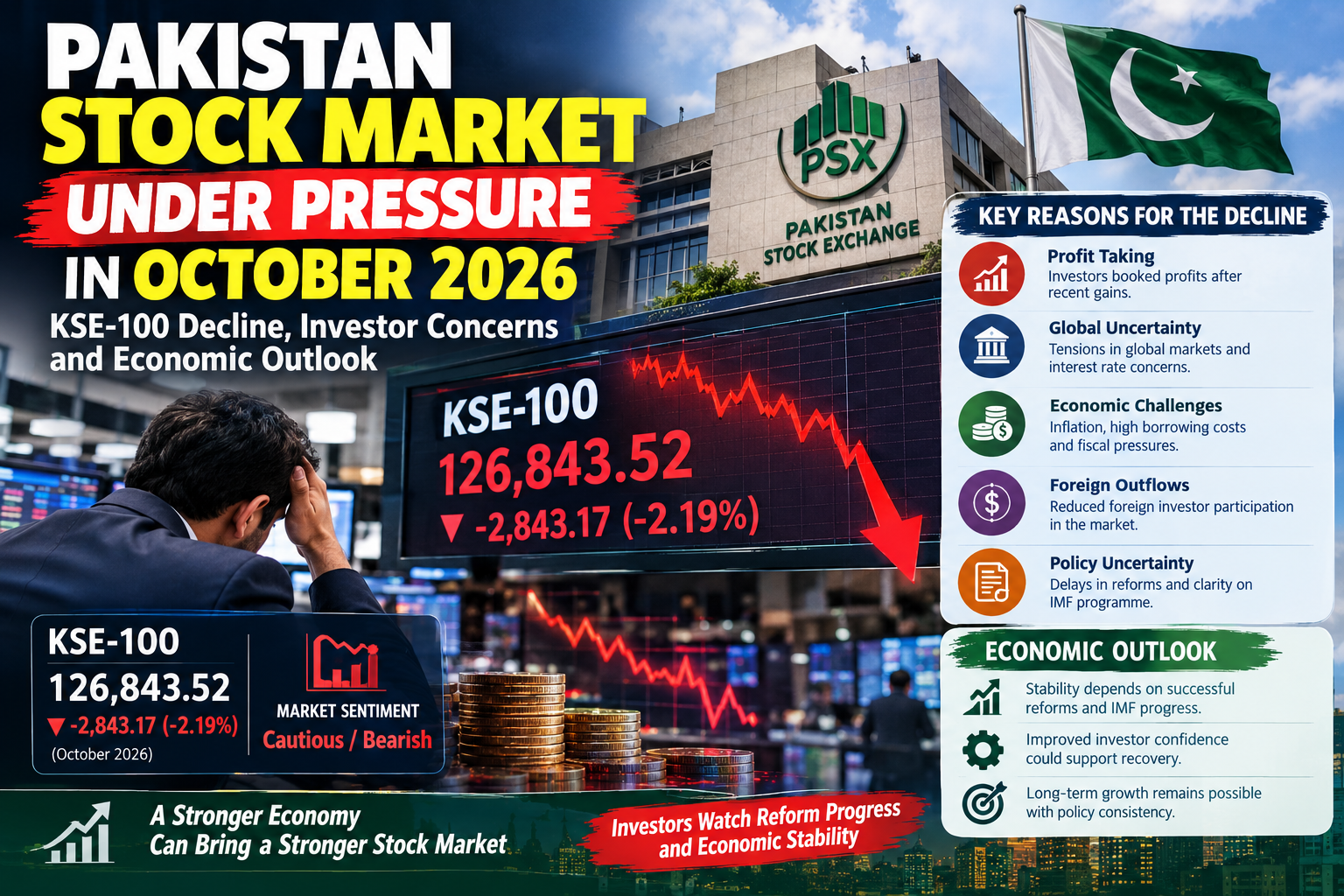
Pakistan’s stock market remained under pressure in October 2026 as investors responded to international oil prices, regional geopolitical uncertainty and concerns about the country’s economic outlook. The Pakistan Stock Exchange (PSX), one of the country’s key financial markets, experienced volatile trading as early gains gave way to selling pressure.
On Friday, October 9, 2026, the benchmark KSE-100 Index closed at approximately 167,089 points, falling 352.63 points, or 0.21 percent, during the session. The decline followed a sharper fall earlier in the week, highlighting the cautious mood among investors.
The market’s performance attracted attention because it came despite positive developments surrounding Pakistan’s discussions with the International Monetary Fund (IMF). Investors continued to weigh the potential benefits of external financial support against rising energy costs, economic uncertainty and regional tensions.
Stock market movements matter because they can influence investor confidence, business financing and the financial decisions of companies and individuals. However, daily changes in the market do not necessarily reflect the condition of the entire economy.
Understanding the recent pressure on Pakistan’s stock market requires examining the latest index performance, the factors influencing investor sentiment, the role of international oil prices and the possible outlook for the coming weeks.
1. Latest Update: KSE-100 Index Closes Lower
The Pakistan Stock Exchange ended Friday’s trading session on a negative note. The KSE-100 Index settled at approximately 167,089 points after losing 352.63 points, equivalent to a decline of 0.21 percent.
The index initially showed positive movement and climbed to an intraday high of approximately 168,134 points. However, the market struggled to maintain those gains and later moved lower, touching an intraday low of around 166,838 points.
The reversal demonstrated how quickly investor sentiment can change when buyers become cautious or selling activity increases.
Although the percentage decline on Friday was relatively small, the session followed a more significant fall on Thursday, when the index lost 1,138.50 points, or approximately 0.68 percent, to close at 167,441.91 points.
These consecutive declines highlighted the pressure facing the market during the week.
Investors were assessing several developments simultaneously, including international energy prices, geopolitical risks and expectations surrounding Pakistan’s economic policies.
A falling index does not mean that every listed company has experienced losses. Individual shares can move in different directions depending on their financial performance, industry conditions and investor expectations.
Nevertheless, the overall decline suggested that caution continued to influence trading at the Pakistan Stock Exchange.
2. Why Is Pakistan’s Stock Market Facing Pressure?
Several factors contributed to the market’s recent weakness. These include profit-taking, elevated international oil prices, regional uncertainty and concerns about economic conditions.
One important factor is investor confidence. When traders believe that risks are increasing, they may reduce their exposure to shares or take profits after earlier gains.
This selling activity can place downward pressure on the benchmark index, particularly when large companies experience declines.
International developments also influence Pakistan’s financial markets. Changes in oil prices, global interest rates and geopolitical conditions can affect expectations about inflation, business expenses and economic growth.
Domestic policy decisions matter as well. Investors closely follow government borrowing, monetary policy, taxation, external financing and reforms because these factors can influence company profits and the wider economy.
The stock market therefore reflects a combination of local and international expectations rather than one isolated event.
Recent trading suggests that investors remain cautious while assessing whether positive economic developments can outweigh the risks affecting the market.
3. Rising International Oil Prices Add to Investor Concerns
International oil prices are an important factor for Pakistan because the country depends significantly on imported energy.
When global crude oil prices rise, the cost of importing energy can increase. This may put pressure on the country’s import bill, foreign exchange requirements and domestic fuel prices.
Higher fuel costs can also affect businesses across several industries. Transportation companies may face increased operating expenses, while manufacturers and distributors can experience higher costs for moving raw materials and finished products.
Some businesses may pass these additional expenses on to consumers. This can contribute to inflationary pressure and influence household spending.
For investors, higher energy prices create questions about future profitability. Companies with substantial transportation or energy expenses may face additional pressure if they cannot fully recover those costs through higher selling prices.
The impact is not identical across every sector. Some energy-related businesses may benefit from particular price movements, while other industries may be negatively affected.
Investors therefore consider how changing oil prices could influence individual companies and the wider economy.
For Pakistan, sustained increases in international oil prices can create additional challenges at a time when economic stability and foreign exchange management remain important policy priorities.
4. Geopolitical Uncertainty Influences Market Sentiment
Regional and international political developments can affect financial markets by increasing uncertainty about trade, energy supplies and economic activity.
When tensions rise in important regions, investors may become concerned about disruptions to shipping routes, higher energy prices or changes in international financial conditions.
These concerns can influence decisions even before any direct economic disruption occurs. Financial markets often react to expectations about future events rather than waiting for their full consequences to become visible.
Pakistan’s stock market has also faced pressure amid broader regional uncertainty. Investors have been monitoring developments that could influence oil prices, international trade and the country’s economic outlook.
Uncertainty can make businesses more cautious about investment decisions. Companies may delay expansion plans if they are unsure about future demand, operating costs or financing conditions.
For investors, unpredictable conditions can make it more difficult to estimate company earnings and determine suitable share valuations.
However, geopolitical developments do not always produce the same market response. The effect depends on the nature of the event, its expected duration and the industries most directly affected.
As a result, investors continue to monitor international developments alongside domestic economic indicators.
5. IMF Agreement Provides Support, but Challenges Remain
Pakistan’s economic relationship with the International Monetary Fund remains an important consideration for investors.
In October 2026, Pakistan and the IMF reportedly reached a staff-level agreement following reviews under the country’s existing financing arrangements. The agreement involved approximately $1.2 billion in potential financing, subject to the required approval process.
Such developments can support confidence because external financing may help strengthen foreign exchange resources and support the country’s economic programme.
However, an IMF agreement does not automatically guarantee that the stock market will rise.
Investors also consider the conditions attached to financing, the pace of economic reforms, government revenue, inflation, interest rates and the overall business environment.
Markets may respond positively when an agreement reduces uncertainty. Yet other risks can offset that positive sentiment.
In the recent trading sessions, the market struggled to sustain its gains despite the encouraging financing development. This suggests that investors were also focused on oil prices, regional tensions and broader economic concerns.
The market response illustrates an important principle: positive news about one economic indicator may not be sufficient to overcome several other sources of uncertainty.
For sustained confidence, investors generally look for consistent progress across financial stability, economic growth, policy implementation and business performance.
6. Profit-Taking Contributes to Market Declines
Profit-taking occurs when investors sell shares to secure gains after prices have increased.
It is a normal part of financial market activity. Investors may decide to sell when they believe a share has reached a level at which they want to realise their profits, even if the company’s longer-term prospects remain unchanged.
Profit-taking can become more pronounced after a strong rally. As more investors sell, share prices may decline, especially when new buyers are unwilling to purchase at the same prices.
Pakistan’s stock market has experienced this type of pressure during recent volatile sessions.
A positive opening does not necessarily mean that an index will finish higher. If selling activity increases during the day, the market may lose its early gains.
This pattern was visible on Friday, when the KSE-100 Index initially advanced but later closed lower.
It is important to distinguish profit-taking from a fundamental deterioration in company performance. A share price can decline because investors are securing gains, because expectations have changed or because new risks have emerged.
Investors must therefore consider the reasons behind a price movement rather than interpreting every decline in the same way.
7. How Stock Market Pressure Affects Investors
A falling stock market can affect investors in different ways, depending on their portfolios, investment time frames and financial circumstances.
People who already own shares may see the market value of their investments decline. The size of the effect depends on which companies they hold and how those shares perform.
Short-term traders may be particularly sensitive to rapid price changes because their decisions often depend on market momentum.
Long-term investors may focus more on company earnings, financial strength, business models and future growth prospects. Even so, a prolonged market decline can affect their confidence and investment plans.
Market volatility can also make it harder for investors to decide when to buy or sell. Rapid changes may encourage emotional decisions, especially when people focus only on daily price movements.
Investors should understand that shares can rise or fall and that no investment return is guaranteed.
Before making financial decisions, individuals should consider their financial goals, their ability to accept losses and the risks associated with particular investments.
It is also important to avoid making decisions solely on social media rumours or unverified predictions about future index levels.
8. Impact on Companies Listed on the Pakistan Stock Exchange
The stock market provides companies with a platform through which investors can buy and sell shares in their businesses.
When investor confidence is strong, companies may find it easier to attract interest in their shares and, under suitable circumstances, raise capital to support expansion.
When markets remain under pressure, companies may face more difficult conditions for raising equity financing. Investors may demand stronger financial performance or lower valuations before committing funds.
However, the effect varies considerably between companies.
Businesses with stable earnings, manageable debt and reliable cash flows may be viewed differently from companies facing financial difficulties or uncertain demand.
Sector conditions also matter. Banks, energy companies, technology businesses, cement producers and consumer-focused firms can respond differently to changes in interest rates, fuel prices and economic growth.
A broad index decline therefore does not mean that every listed business is experiencing the same challenges.
Companies with strong fundamentals may continue to operate effectively during a period of market volatility. Others may face greater pressure if their costs increase or customers reduce spending.
For this reason, company-level financial performance remains important when evaluating the significance of a stock market decline.
9. The Relationship Between Inflation and Stock Market Performance
Inflation can influence stock market performance through several channels.
When prices rise rapidly, businesses may experience higher costs for raw materials, energy, wages and transportation. If companies cannot pass those costs on to customers, their profit margins may shrink.
Higher inflation can also affect household purchasing power. Consumers may spend more of their income on necessities and reduce spending on other goods and services.
This can influence the revenues of businesses that depend on discretionary consumer demand.
Monetary policy is another important connection. If inflation remains elevated, investors may expect interest rates to remain high or rise further. Higher borrowing costs can increase expenses for businesses and make some investments less attractive.
Conversely, easing inflation can support confidence if it allows financial conditions to become more predictable.
However, the relationship between inflation and stock prices is not automatic. Some companies may be able to increase their selling prices, while others may be more vulnerable to rising expenses.
Investors therefore assess inflation alongside interest rates, company earnings, currency movements and broader economic activity.
For Pakistan, the outlook for prices and monetary policy remains relevant to the performance of listed companies and the decisions of market participants.
10. Foreign Investment and Market Confidence
Foreign investors can play a role in the performance of Pakistan’s financial markets.
International investors evaluate opportunities across countries and compare expected returns with economic, political and currency-related risks.
When confidence improves, foreign investors may become more interested in a market. When uncertainty increases, they may reduce exposure or direct funds towards other opportunities.
Their decisions can be influenced by exchange-rate expectations, international interest rates, political developments, market liquidity and the financial performance of listed companies.
Foreign investment is only one part of the market, however. Domestic investors, financial institutions, companies and individual traders also influence share prices.
A market decline cannot automatically be attributed to foreign selling without reliable data showing the direction and scale of investment flows.
For Pakistan, stable economic policies and transparent financial information can help investors evaluate opportunities more confidently.
Predictable rules, effective regulation and reliable corporate reporting can also contribute to the development of a healthier investment environment.
Over time, stronger market institutions and improved economic stability may help broaden participation in the country’s capital markets.
11. What Should Investors Watch in the Coming Weeks?
Several indicators may influence the direction of the Pakistan Stock Exchange in the coming weeks.
International Oil Prices
Changes in crude oil prices may affect Pakistan’s import expenses, inflation expectations and the operating costs of listed companies.
IMF Programme Developments
Investors will monitor progress in the approval and implementation of Pakistan’s financing arrangements and related economic reforms.
Inflation and Interest Rates
New inflation data and monetary policy decisions can influence borrowing costs, consumer demand and the valuations investors place on shares.
Corporate Earnings
Company results can provide information about sales, costs, debt, profitability and future business expectations.
Political and Regional Developments
Changes in domestic political conditions or regional tensions may affect investor confidence and expectations about economic stability.
Trading Activity
Market turnover, price movements and the number of advancing and declining shares can help show whether market participation is strengthening or weakening.
No single indicator can reliably predict the market’s future direction. Investors generally assess several factors together to understand the broader picture.
The market may recover if uncertainty eases and confidence improves, but further volatility remains possible if economic or geopolitical risks intensify.
12. Why Market Volatility Matters to Pakistan’s Economy
The stock market is one part of Pakistan’s broader financial system. Its performance can influence investor confidence, company financing and public perceptions of economic conditions.
A strong market may reflect improving expectations about corporate earnings or economic stability. A falling market may indicate concern about risks, but it does not necessarily mean that economic activity is declining at the same rate.
The stock market and the real economy are connected, yet they are not identical.
For example, a company may continue producing goods and earning revenue even when its share price falls. Similarly, a rising stock market does not guarantee that every household will experience higher incomes or lower living costs.
Market performance also depends on expectations. Share prices may decline when investors believe future earnings will be weaker, even if current business activity remains stable.
For policymakers, maintaining confidence requires attention to the wider economic environment, including inflation, employment, public finances and investment conditions.
For businesses, predictable policies and access to financing can support long-term planning.
For investors, understanding the difference between short-term market movements and longer-term economic trends can help prevent decisions based entirely on headlines.
13. Possible Outlook for the Pakistan Stock Market
The outlook for Pakistan’s stock market will depend on how economic and international conditions develop.
If international oil prices ease, geopolitical uncertainty declines and confidence in economic policies improves, the market could receive support.
Progress on financing arrangements, stable monetary conditions and stronger corporate earnings could also help improve investor sentiment.
On the other hand, continued pressure from energy prices, uncertainty about interest rates or renewed regional tensions could keep the market volatile.
Investors will also be watching whether the KSE-100 Index can regain momentum after its recent declines.
However, short-term movements remain difficult to predict. A market can recover quickly after a decline, or selling pressure can continue if investors remain concerned about future risks.
No index level should be treated as a guaranteed target, and past market performance cannot ensure future returns.
The most useful approach is to follow verified market data, review economic developments and understand the risks associated with individual investments.
Conclusion
Pakistan’s stock market faced renewed pressure in October 2026 as the KSE-100 Index closed lower amid profit-taking, elevated international oil prices and geopolitical uncertainty.
The benchmark index settled at approximately 167,089 points on October 9, losing 352.63 points during the session. The decline followed a sharper fall earlier in the week and reflected the cautious mood among market participants.
Although Pakistan’s reported IMF staff-level agreement provided a potentially positive development, investors continued to weigh concerns about energy costs, inflation, financing conditions and regional developments.
The recent performance demonstrates that stock markets respond to a combination of economic indicators and expectations. A positive development in one area may not be enough to offset risks in other areas.
For Pakistan, sustained investor confidence will depend on progress towards economic stability, predictable policies, transparent corporate reporting and a business environment that supports long-term investment.
The coming weeks may bring further changes as investors assess new information. For readers and market participants, understanding the reasons behind market movements is more useful than relying on daily fluctuations alone.
Frequently Asked Questions (FAQs)
1. Why is Pakistan’s stock market under pressure in October 2026?
The market has faced pressure from profit-taking, elevated international oil prices, regional geopolitical uncertainty and concerns about economic conditions.
2. What was the KSE-100 Index closing level on October 9, 2026?
The KSE-100 Index closed at approximately 167,089 points after falling 352.63 points, or 0.21 percent.
3. How do international oil prices affect Pakistan’s stock market?
Higher oil prices can increase import expenses, transportation costs and inflationary pressure, potentially affecting business profitability and investor confidence.
4. Does the IMF agreement guarantee a stock market recovery?
No. An IMF agreement may support confidence, but the market also responds to interest rates, energy prices, company earnings and geopolitical developments.
5. Could the Pakistan Stock Exchange recover in the coming weeks?
A recovery is possible if confidence improves and economic risks ease, but further volatility may occur. Future market movements are uncertain and cannot be guaranteed.