Introduction
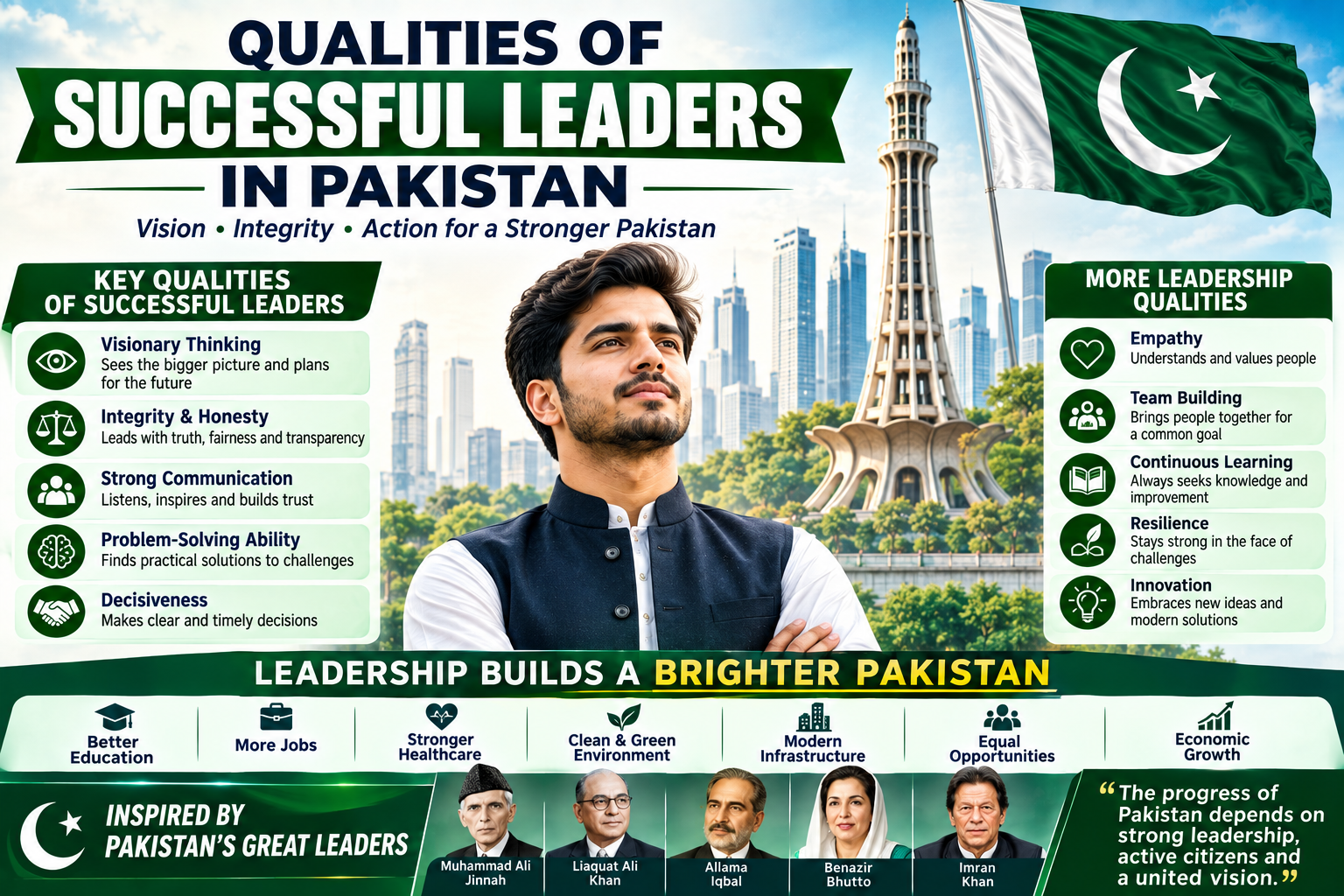
Successful leadership is one of the most important factors behind the progress of any country. Pakistan has a large population, a young workforce, talented professionals, natural resources, and growing opportunities in technology and entrepreneurship. To use this potential effectively, the country needs leaders who are capable, responsible, honest, and committed to long-term development.
A successful leader is not simply a person who has authority or occupies a powerful position. Leadership is about guiding people toward common goals, solving problems, making responsible decisions, and creating an environment where others can grow. In Pakistan, these qualities are important in politics, education, business, technology, community development, and many other fields.
Good leadership can strengthen institutions, improve public services, encourage innovation, and inspire young people to contribute to society. Understanding the qualities of successful leaders can therefore help Pakistan develop a stronger leadership culture.
1. Vision
One of the most important qualities of a successful leader is having a clear vision. A leader needs to understand where an organization, community, or country should go in the future.
A strong vision gives people a sense of direction. Instead of focusing only on immediate problems, visionary leaders think about long-term goals.
For Pakistan, leadership with a clear vision can help create long-term strategies for education, economic growth, technology, healthcare, infrastructure, and employment.
A good vision should also be realistic. Leaders need to understand available resources and develop practical plans for achieving their objectives.
2. Honesty and Integrity
Honesty is a fundamental quality of successful leadership. People are more likely to trust leaders who are truthful and consistent in their words and actions.
Integrity means doing the right thing even when it is difficult. Leaders with integrity do not make decisions simply for personal benefit. They understand that leadership comes with responsibility.
In Pakistan, promoting integrity in leadership can help strengthen public trust and encourage responsible behavior within institutions and organizations.
3. Accountability
Successful leaders accept responsibility for their decisions. They do not simply blame others when something goes wrong.
Accountability means being prepared to explain decisions, accept mistakes, and take corrective action when necessary.
Strong accountability can improve the performance of institutions because people understand that their actions have consequences.
Effective governance discussions in Pakistan frequently emphasize accountability, transparency, merit, and institutional effectiveness as important principles for improving public service.
4. Strong Communication Skills
Communication is essential for leadership. A leader may have excellent ideas, but those ideas cannot create results if they cannot be communicated clearly.
Successful leaders should be able to:
Explain ideas simply
Listen carefully
Give clear instructions
Respond respectfully
Understand different viewpoints
Communicate during difficult situations
Good communication creates understanding between leaders and the people they work with.
In Pakistan, strong communication can help leaders connect with citizens, employees, students, communities, and other stakeholders.
5. Decision-Making Ability
Leaders often have to make difficult decisions. Sometimes there is not enough information or there are several possible choices.
A successful leader studies the available information, considers different consequences, listens to experts, and then makes a responsible decision.
Good decision-making does not mean making every decision perfectly. It means being willing to learn from mistakes and improve future decisions.
For Pakistan, effective decision-making is particularly important when dealing with economic, educational, environmental, and social challenges.
6. Problem-Solving Skills
Every country and organization faces problems. Successful leaders focus on finding solutions instead of simply discussing difficulties.
Problem-solving requires:
Identifying the real problem
Understanding its causes
Considering possible solutions
Evaluating their advantages and disadvantages
Selecting a practical approach
Reviewing the results
Leaders who develop strong problem-solving skills can respond more effectively to changing circumstances.
7. Emotional Intelligence
Emotional intelligence means understanding one's own emotions and recognizing the feelings of others.
A leader with emotional intelligence can remain calm during difficult situations, communicate with people respectfully, and understand different perspectives.
This quality is particularly useful when managing teams or dealing with disagreements.
Leaders do not work alone. They depend on other people, so understanding people's concerns can help create stronger relationships.
8. Ability to Listen
Leadership is not only about speaking. Successful leaders also know how to listen.
Listening allows leaders to understand the problems, suggestions, and concerns of the people they serve.
A leader who listens carefully can discover issues that may not be visible from reports or statistics alone.
In Pakistan, listening to students, workers, farmers, entrepreneurs, teachers, professionals, and communities can help leaders develop policies that better reflect real needs.
9. Adaptability
The world is changing rapidly because of technology, economic developments, climate-related challenges, and changing social needs.
Successful leaders must be able to adapt.
Adaptability means being willing to learn new things, reconsider old approaches, and respond to changing circumstances.
Pakistan's leaders need to understand developments in areas such as artificial intelligence, digital services, renewable energy, modern agriculture, education technology, and global trade.
10. Courage
Leadership sometimes requires difficult decisions. A successful leader needs courage to address problems honestly and take responsible action.
Courage does not mean acting without thinking. Instead, it means being prepared to make difficult decisions after carefully considering the available evidence.
A courageous leader can also admit mistakes and make necessary changes.
11. Teamwork
Successful leadership is based on teamwork. No leader can achieve major goals alone.
A good leader recognizes the skills of different people and gives them appropriate responsibilities.
Teamwork encourages:
Cooperation
Creativity
Better decision-making
Shared responsibility
Improved productivity
For Pakistan, teamwork between government institutions, businesses, educational institutions, communities, and citizens can support national development.
12. Respect for Others
Respect is another important quality of leadership.
Successful leaders understand that people have different experiences, opinions, cultures, and backgrounds. They treat people fairly and listen to different perspectives.
Respectful leadership can reduce unnecessary conflict and encourage cooperation.
In a diverse country like Pakistan, respect and cooperation can contribute to greater social harmony.
13. Discipline
Discipline helps leaders remain focused on their goals. A disciplined leader manages time, follows plans, meets responsibilities, and remains consistent.
National development requires long-term effort. Therefore, leaders need discipline to continue working toward important objectives even when progress is slow.
Discipline can also influence others. When leaders demonstrate responsible behavior, team members are more likely to follow their example.
14. Commitment to Education
Successful leaders understand the importance of knowledge and continuous learning.
A leader should be willing to learn from experts, research, experience, and changing circumstances.
For Pakistan, education should be a major leadership priority because an educated and skilled population can contribute to economic and social development.
Leadership development itself can also begin in schools and colleges by encouraging critical thinking, teamwork, communication, and responsibility.
15. Support for Youth
Pakistan's young population represents a major opportunity. Successful leaders should recognize the importance of giving young people opportunities to learn, work, innovate, and participate.
Youth can contribute to:
Technology
Entrepreneurship
Education
Research
Business
Community development
Creative industries
Leaders who invest in young people are helping prepare the next generation of professionals and decision-makers.
16. Innovation and Creativity
Successful leaders do not always depend on traditional methods. They encourage new ideas and creative solutions.
Innovation can help Pakistan address challenges in agriculture, education, healthcare, transportation, technology, and business.
Leaders can support innovation by creating environments where people are encouraged to experiment, learn, and improve.
Young people can be particularly valuable in this area because they are often comfortable with emerging technologies and new ways of working.
17. Transparency
Transparency means making processes and decisions understandable and open where appropriate.
Transparent leadership can increase trust because people have greater clarity about how decisions are made and how resources are used.
For public institutions, transparency can also support accountability and improve confidence in governance.
18. Fairness and Merit
Successful leaders should make decisions fairly and recognize people based on ability, effort, qualifications, and performance.
Merit-based opportunities can motivate talented people to work harder and develop their skills.
Pakistan can benefit from leadership cultures that value competence and performance across education, business, public administration, and other sectors.
19. Patience
Important changes rarely happen overnight. Successful leaders understand that meaningful development requires time.
Patience helps leaders remain focused when results take longer than expected.
However, patience does not mean ignoring problems. It means continuing to work toward solutions while making improvements along the way.
20. Responsibility
Leadership comes with responsibility. People in leadership positions influence others through their decisions and behavior.
Responsible leaders consider how their decisions may affect employees, citizens, communities, and future generations.
In Pakistan, responsible leadership can help create a culture where people take ownership of their duties rather than avoiding responsibility.
21. Ability to Inspire Others
A successful leader can motivate people to work toward positive goals.
Inspiration does not necessarily come from powerful speeches. It can come from personal example, hard work, honesty, and dedication.
When people see leaders behaving responsibly, they may become more willing to contribute themselves.
22. Long-Term Thinking
One of the biggest differences between effective and ineffective leadership is the ability to think beyond the present.
Long-term thinking means considering how today's decisions will affect future generations.
For Pakistan, long-term planning is important in areas such as:
Education
Water management
Energy
Infrastructure
Technology
Economic development
Environmental protection
Long-term leadership can help create stability and sustainable progress.
23. Understanding Technology
Modern leadership increasingly requires technological awareness.
Leaders do not need to become professional programmers, but they should understand how technology is changing education, business, communication, employment, and public services.
Pakistan can benefit from leaders who understand digital transformation and support responsible technology adoption.
24. Ethical Leadership
Ethical leadership means making decisions according to principles such as honesty, fairness, responsibility, and respect.
Ethical leaders consider not only whether something is possible but also whether it is right.
This approach can strengthen organizations and institutions because people know that decisions are based on clear principles.
Challenges to Developing Successful Leaders in Pakistan
Developing strong leadership is not always easy. Some challenges include limited leadership training, unequal access to quality education, lack of mentorship, short-term thinking, and insufficient opportunities for young people.
These challenges can be addressed through:
Better education
Leadership training
Mentorship programs
Skill development
Youth participation
Professional development
Stronger institutions
Merit-based opportunities
Leadership should be developed continuously rather than treated as something people automatically possess.
The Role of Schools in Developing Future Leaders
Schools can introduce leadership skills at an early age.
Students can develop leadership through:
Group assignments
Debates
Presentations
Sports
Student projects
Volunteer activities
Science competitions
These activities teach cooperation, communication, confidence, and responsibility.
The Role of Universities
Universities can provide more advanced leadership opportunities. Students can participate in research, entrepreneurship, internships, student organizations, and community projects.
Universities can also connect students with professionals who can provide career guidance and mentorship.
This practical experience can help students understand how leadership works in professional environments.
The Role of Businesses
Business leaders also have an important role in Pakistan's development.
Responsible businesses can create jobs, support innovation, develop employees, and contribute to communities.
Good business leadership can help improve productivity while encouraging ethical and sustainable practices.
Conclusion
Successful leadership is essential for Pakistan's development. The country needs leaders who possess vision, integrity, accountability, communication skills, courage, adaptability, problem-solving ability, and respect for others.
Leadership is not only the responsibility of politicians or government officials. Teachers, entrepreneurs, students, professionals, community members, and business owners can all demonstrate leadership in their respective fields.
Pakistan can develop stronger leaders by improving education, promoting merit, expanding leadership training, supporting youth, encouraging innovation, and strengthening ethical values.
The leaders of tomorrow are being developed today. When young people receive knowledge, skills, guidance, and opportunities, they can become responsible leaders who contribute to a stronger and more prosperous Pakistan.
FAQs
1. What are the most important qualities of a successful leader?
Vision, integrity, accountability, communication, courage, adaptability, and problem-solving are important leadership qualities.
2. Why is leadership important for Pakistan?
Effective leadership can support better governance, economic growth, education, innovation, and social development.
3. How can young people develop leadership skills?
They can develop leadership through education, teamwork, volunteering, projects, communication, and practical experience.
4. What is ethical leadership?
Ethical leadership means making responsible and fair decisions based on honesty, integrity, and respect.
5. How can Pakistan develop better leaders?
Pakistan can promote leadership through quality education, mentorship, skill development, leadership programs, merit, and youth participation.