Introduction
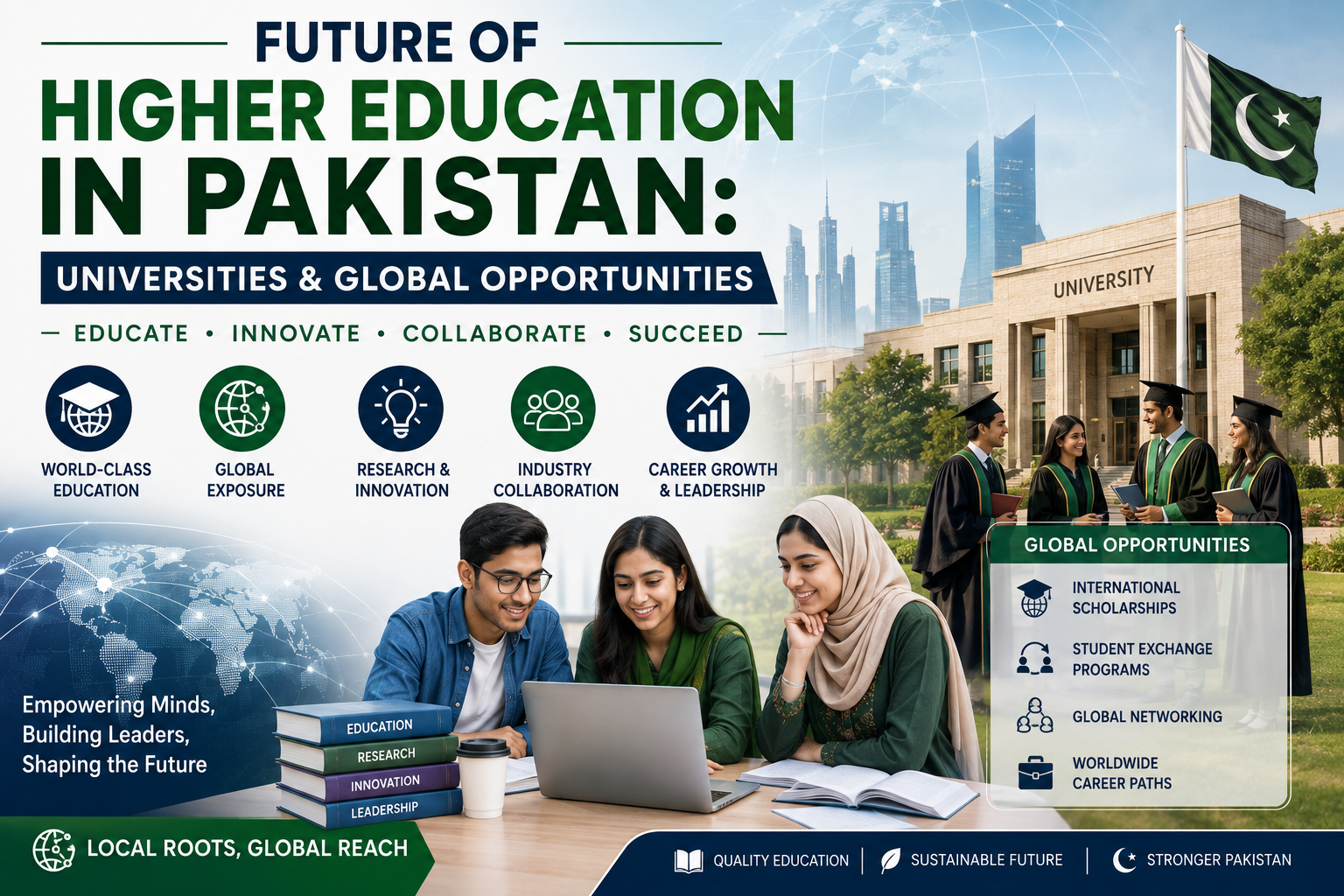
Higher education plays an important role in the development of any country. Universities and colleges do more than provide degrees. They help students develop knowledge, professional skills, research abilities, communication skills and the confidence needed to participate in a changing economy. For Pakistan, strengthening higher education is particularly important because the country has a large young population that needs quality education and meaningful career opportunities.
Pakistan's higher education sector has changed significantly over the years. Universities have expanded into new cities, online learning has become more common, and students now have greater access to international courses, scholarships and digital resources. At the same time, the country continues to face challenges related to education quality, research, affordability, employment and the connection between university degrees and market needs.
In 2026, higher education continues to be an important part of Pakistan's broader education reform agenda. The Higher Education Commission (HEC) has emphasized reforms aimed at strengthening the sector, improving quality and increasing the international visibility of Pakistani universities. This creates an opportunity to think about what higher education in Pakistan should look like in the future.
The future of Pakistani universities will not depend only on the number of institutions. It will depend on quality, innovation, research, technology, practical skills and global connections.
Current State of Higher Education in Pakistan
Pakistan has a large network of universities and degree-awarding institutions offering programs in fields ranging from medicine and engineering to business, computer science, social sciences and humanities.
Students can choose from public and private universities, colleges and specialized institutions. Online and distance-learning options have also expanded educational opportunities for students who cannot attend traditional campuses.
However, access to higher education remains unequal.
Students living in major cities may have more choices because they are closer to universities, training centers, libraries and technology resources. Students in smaller towns and rural areas may face greater difficulties because of distance, financial limitations or fewer educational institutions.
Therefore, the future of higher education must focus on both access and quality.
Why Higher Education Matters for Pakistan
Higher education can contribute to national development in many ways.
Universities produce professionals such as:
Doctors
Engineers
Lawyers
Teachers
Computer scientists
Researchers
Business professionals
Economists
Architects
Scientists
Universities also contribute to research and innovation.
A strong higher education system can help Pakistan develop solutions to challenges related to agriculture, healthcare, climate change, energy, technology, business and public administration.
For students, higher education can provide knowledge and skills that improve their career opportunities.
The Need for Quality Education
Increasing the number of universities is not enough.
A university needs qualified faculty, modern laboratories, updated libraries, effective administration and relevant academic programs.
Quality should be measured by what students actually learn and how effectively universities prepare them for further education and professional life.
Important elements of university quality include:
Qualified teachers
Updated curriculum
Research opportunities
Practical training
Modern laboratories
Digital resources
Industry connections
Career counseling
Student support services
Higher education reforms should therefore focus strongly on learning outcomes rather than simply increasing enrollment.
Universities and the Changing Job Market
The job market is changing rapidly because of technology and globalization.
Some traditional jobs are being transformed, while new professions are emerging.
Fields such as:
Artificial intelligence
Data science
Software development
Cybersecurity
Cloud computing
Digital marketing
Renewable energy
Biotechnology
E-commerce
are becoming increasingly important.
This means universities need to regularly review their programs.
A degree program designed many years ago may not fully prepare students for today's employment environment.
Universities should therefore update curricula and introduce opportunities for students to gain practical experience.
Skills Are Becoming as Important as Degrees
A university degree remains valuable, but employers often look beyond academic qualifications.
Students increasingly need skills such as:
Communication
Critical thinking
Problem-solving
Teamwork
Leadership
Digital literacy
Research
Time management
Creativity
For example, a computer science graduate may have strong theoretical knowledge but still need practical programming experience.
Similarly, a business graduate may benefit from experience with presentations, data analysis, digital tools and real-world projects.
The future of higher education should therefore combine academic knowledge with practical skills.
Practical Learning in Pakistani Universities
Practical learning allows students to apply what they study.
Universities can encourage practical education through:
Internships
Research projects
Laboratory work
Case studies
Industry visits
Entrepreneurship programs
Student competitions
Capstone projects
Such activities can help students understand how classroom knowledge is used outside the university.
For example, an engineering student can work on a practical project, while a business student can develop a business plan.
Practical learning can also help students build portfolios that demonstrate their abilities to future employers.
Research and Innovation
Research is one of the most important functions of a university.
Universities should encourage students and faculty members to investigate real problems and develop new ideas.
Research can contribute to areas such as:
Agriculture
Medicine
Information technology
Environmental science
Energy
Education
Economics
Engineering
Pakistan has talented students and researchers, but research requires investment, laboratories, academic resources and opportunities for collaboration.
Strengthening university research can help Pakistan become more competitive internationally.
The Role of the Higher Education Commission
The Higher Education Commission is an important institution in Pakistan's higher education system.
It works on areas including quality assurance, university development, scholarships, research and higher education policy.
In recent years, HEC has continued to highlight reforms aimed at strengthening Pakistan's higher education sector and improving the quality and global standing of universities.
The success of higher education reforms, however, depends on effective implementation at university level.
Policies need to translate into better classrooms, stronger research environments and improved student experiences.
International Opportunities for Pakistani Students
Globalization has created more opportunities for Pakistani students.
Students can apply for:
International scholarships
Exchange programs
Online courses
Research collaborations
International conferences
Overseas postgraduate programs
Many universities around the world also offer online learning opportunities.
This allows Pakistani students to access international educational resources without necessarily traveling abroad.
International exposure can help students understand different academic systems, cultures and professional environments.
Scholarships and Financial Support
The cost of higher education can be a major challenge for many Pakistani families.
Scholarships can make university education more accessible.
Financial support may come from:
Government programs
Universities
International organizations
Private foundations
Research institutions
Scholarships can be especially important for talented students who have strong academic potential but limited financial resources.
Expanding transparent and merit-based scholarship opportunities can help more students continue their education.
Online and Distance Education
Online education has become an important part of higher education.
Students can attend lectures, access digital materials, submit assignments and participate in discussions through online platforms.
Distance education can be particularly useful for:
Working students
Students living far from universities
Students with limited mobility
People seeking additional qualifications
However, online education needs quality control.
Universities must ensure that online programs have qualified instructors, appropriate academic resources, reliable assessment systems and meaningful interaction between teachers and students.
Artificial Intelligence in Higher Education
Artificial intelligence is likely to have a major influence on universities.
AI can support education by helping students understand complex topics, practice skills, analyze information and organize their studies.
Researchers can also use AI-assisted tools for certain research tasks.
However, universities need clear policies regarding responsible AI use.
Students should understand that AI-generated information may contain errors and should not replace independent thinking.
Universities should focus on teaching students how to use AI as a learning and productivity tool, while maintaining academic honesty.
Digital Skills for University Students
Digital literacy is now important across almost every academic field.
Students should have opportunities to learn:
Computer applications
Data analysis
Online research
Digital communication
Cybersecurity awareness
Artificial intelligence basics
Online collaboration
Even students studying subjects that are not directly related to computer science can benefit from digital skills.
For example, a law student may need digital research skills, while a business student may need data-analysis tools.
University-Industry Collaboration
One major opportunity for Pakistan's higher education system is stronger cooperation between universities and businesses.
Companies can help universities understand which skills employers need.
Universities can respond by developing:
Internship programs
Industry-led projects
Guest lectures
Career fairs
Professional training
Joint research
Students benefit because they gain exposure to real workplace environments.
Businesses benefit because they can find graduates with more relevant skills.
This creates a connection between education and employment.
Entrepreneurship and Startups
Universities can also help students become entrepreneurs.
Not every graduate will find a traditional job, and some students may have innovative ideas that can become businesses.
Universities can support entrepreneurship through:
Startup incubators
Business competitions
Mentoring
Entrepreneurship courses
Networking opportunities
Innovation labs
Students can learn how to develop ideas, understand markets and create sustainable business models.
This can contribute to employment and economic growth.
Career Guidance in Universities
Many students select degree programs without fully understanding future career options.
Universities should provide professional career counseling.
Career centers can help students with:
Choosing career paths
Writing CVs
Interview preparation
Internship searches
Job applications
Professional networking
Skills development
Students should be informed about both traditional and emerging career opportunities.
Good career guidance can help reduce the gap between university education and employment.
Improving Communication Skills
Communication skills are important in almost every profession.
University students should have opportunities to improve:
English communication
Public speaking
Presentation skills
Academic writing
Professional communication
Team communication
Students with strong communication abilities can often present their ideas more effectively.
Universities can develop these skills through presentations, group projects, debates, writing assignments and professional workshops.
Importance of Critical Thinking
Higher education should teach students how to think, not simply what to memorize.
Critical thinking allows students to:
Evaluate information
Compare different viewpoints
Identify weak arguments
Analyze evidence
Solve problems
Make informed decisions
This is particularly important in the digital age, when students are exposed to huge amounts of information online.
Universities should encourage students to question information and verify reliable sources.
Improving University Curriculum
University curricula should be reviewed regularly.
A modern curriculum should balance:
Theory + Practical Skills + Technology + Research + Professional Experience
Students should understand the foundations of their subjects while also learning how those concepts are applied in real situations.
Curriculum development should involve academics, industry professionals and relevant experts.
This can help universities ensure that academic programs remain connected to changing professional requirements.
Global Rankings and International Recognition
International recognition can help Pakistani universities attract students, researchers and partnerships.
Improving university rankings should not become the only objective, however.
Universities should focus primarily on:
Teaching quality
Research
Innovation
Student outcomes
International collaboration
Better performance in these areas can naturally improve international recognition.
HEC has emphasized strengthening the higher education sector and improving the global standing of Pakistani universities as part of ongoing reforms.
Opportunities for Pakistani Researchers
Pakistani researchers can benefit from international collaboration.
Universities can develop partnerships with institutions in other countries for:
Joint research
Academic exchanges
Conferences
Publications
Research training
Student programs
International collaboration can expose researchers to new technologies, methodologies and ideas.
It can also help Pakistani universities become more connected to the global academic community.
Challenges Facing Higher Education in Pakistan
The future of higher education is promising, but several challenges remain.
1. Affordability
University fees and living costs can make higher education difficult for some families.
2. Unequal Access
Students in rural areas may have fewer options.
3. Employment Concerns
Graduates may struggle when their skills do not match available jobs.
4. Research Limitations
Research requires sustained funding and infrastructure.
5. Technology Gaps
Not all students have equal access to modern technology.
6. Quality Differences
The quality of education can vary between institutions and programs.
7. Brain Drain
Some highly qualified graduates and researchers seek opportunities abroad.
These issues require long-term planning and cooperation among universities, government, businesses and communities.
Addressing the Brain Drain
Brain drain occurs when highly educated and skilled people leave their country for better opportunities elsewhere.
International mobility is not necessarily negative. Pakistani students and researchers can gain valuable experience abroad.
The challenge is creating an environment where talented people also have attractive opportunities to return or contribute to Pakistan.
Universities can help by providing:
Better research opportunities
Competitive academic environments
Innovation support
International collaborations
Career opportunities
A stronger higher education system can make Pakistan more attractive to talented professionals.
The Future of Medical Education
Medical education will also continue to evolve.
Future medical students may need greater exposure to:
Digital health
Medical technology
Data
Artificial intelligence
Research
Modern diagnostic tools
Universities should continue maintaining strong academic and practical standards while adapting to technological changes.
The Future of Computer Science Education
Computer science is one of the fields likely to experience rapid development.
Students may increasingly study areas such as:
Artificial intelligence
Machine learning
Cybersecurity
Data science
Cloud computing
Software engineering
Robotics
Universities should ensure that computer science programs remain updated as technology changes.
Practical projects and industry experience will be particularly valuable.
The Role of Local Languages
English is widely used in higher education and international academic communication, but students may understand complex concepts more effectively when explanations are supported by familiar languages.
Universities can explore bilingual learning resources where appropriate.
The goal should be to improve understanding without limiting students' access to international academic knowledge.
Making Universities More Student-Centered
A modern university should focus not only on lectures but on the complete student experience.
Students need:
Academic advising
Career guidance
Library access
Digital resources
Research opportunities
Extracurricular activities
Safe learning environments
A student-centered university listens to students and continuously evaluates how its programs can improve.
The Future of Higher Education in Pakistan
The future is likely to be shaped by five major trends:
1. Digital Learning
More universities will integrate online platforms and digital resources.
2. Skills-Based Education
Practical and professional skills will become increasingly important.
3. Artificial Intelligence
AI will influence teaching, research and academic administration.
4. International Collaboration
Universities will continue developing global academic partnerships.
5. Industry Connections
Universities will increasingly connect students with employers and real-world projects.
These trends can create significant opportunities for Pakistan's students.
What Should Pakistani Universities Do?
To prepare students for the future, universities should focus on:
Updating academic programs.
Strengthening teacher and faculty development.
Expanding research opportunities.
Increasing practical learning.
Building industry partnerships.
Improving career counseling.
Expanding digital education.
Supporting entrepreneurship.
Encouraging international collaboration.
Maintaining strong academic standards.
These reforms should be implemented consistently rather than through temporary projects.
What Can Students Do to Prepare for the Future?
Students also have an important role in preparing themselves.
They can:
Develop digital skills
Improve communication
Learn beyond textbooks
Participate in projects
Seek internships
Build professional portfolios
Learn research skills
Follow developments in their fields
Explore international opportunities
Develop critical thinking
A degree is an important achievement, but continuous learning is increasingly necessary in a rapidly changing world.
Conclusion
The future of higher education in Pakistan has significant potential. Universities can play a central role in preparing young people for employment, entrepreneurship, research and global opportunities.
However, achieving this potential requires more than increasing the number of degree programs. Pakistan needs universities that provide quality education, practical skills, modern technology, strong research opportunities and international connections.
Digital learning and artificial intelligence are opening new possibilities, while industry partnerships can help students develop skills relevant to the workplace. At the same time, scholarships, online education and targeted support can improve access for students who face financial or geographical barriers.
The most successful higher education system will be one that combines academic knowledge with practical experience and prepares students for lifelong learning.
Pakistan has a large and talented young population. If its higher education institutions receive the right support and continue to modernize, universities can become powerful engines of innovation, employment and national development.
The future of higher education in Pakistan should therefore focus on one central goal: creating educated, skilled, innovative and globally competitive graduates who can contribute to Pakistan and the wider world.
FAQs
1. What is the future of higher education in Pakistan?
It is expected to focus more on technology, practical skills, research and international opportunities.
2. Why are practical skills important for university students?
Practical skills help students apply academic knowledge and prepare for professional careers.
3. How can technology improve higher education?
Technology can provide online courses, digital resources, research tools and flexible learning.
4. What opportunities are available for Pakistani university students internationally?
Students can explore scholarships, exchange programs, online courses, research collaborations and overseas study.
5. How can Pakistani universities improve their quality?
They can strengthen teaching, research, curriculum, technology, industry partnerships and student support.