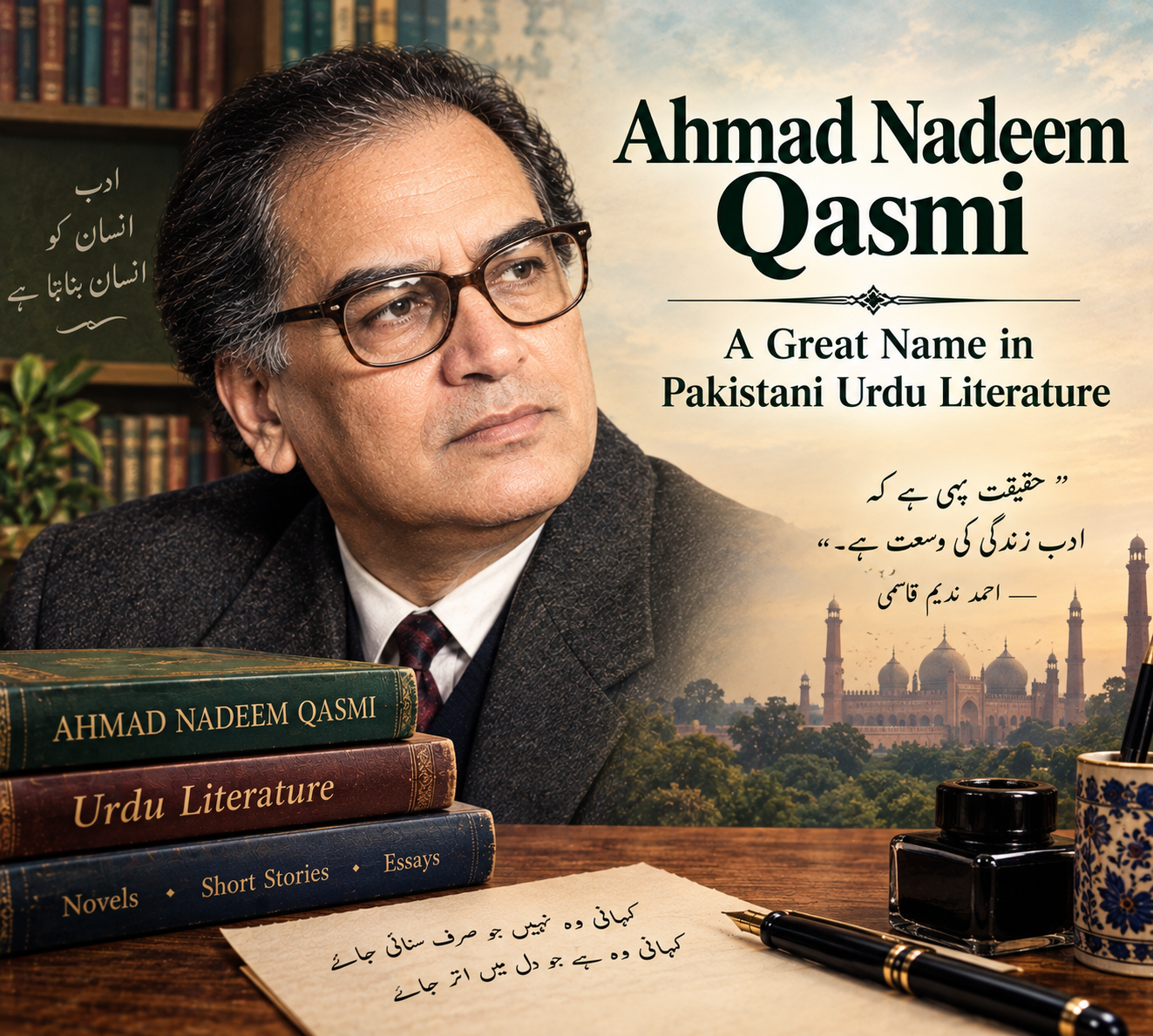
Ahmad Nadeem Qasmi was one of the important literary figures of Pakistan. He is remembered as an Urdu poet, short-story writer, journalist, editor, and intellectual. His literary career continued for many decades, and during this long journey he produced poetry and prose that connected with ordinary people. His writings discussed love, nature, human relationships, society, poverty, rural life, and many other aspects of human experience.
Qasmi had a special place in Urdu literature because he worked in several literary forms. He was not only a poet. He also became well known for his short stories, essays, journalism, and editorial work. His ability to observe society and present its realities through simple but meaningful language made his work valuable to Urdu readers.
For many readers, Ahmad Nadeem Qasmi represents a generation of Pakistani writers who used literature to understand society and human life. His writings often focused on people who were living ordinary lives but facing difficult circumstances. Instead of discussing only personal emotions, he also explored wider social issues.
Early Life of Ahmad Nadeem Qasmi
Ahmad Nadeem Qasmi was born as Ahmad Shah Awan in 1916 in the Khushab area of Punjab, British India. He later became known by his literary name, Ahmad Nadeem Qasmi. Growing up in Punjab gave him an opportunity to observe rural life closely.
The environment of Punjab had a strong influence on his literary imagination. Rural communities, farmers, natural landscapes, family relationships, traditions, and social problems became important elements in his writing.
His early surroundings helped him understand the lives of ordinary people. This understanding later appeared in his poetry and stories. He often presented characters and situations that readers could recognize from everyday life.
Qasmi developed an interest in literature at a young age. He gradually entered the literary world and began publishing his work. His talent allowed him to become recognized among Urdu writers of his generation.
Ahmad Nadeem Qasmi as a Poet
Poetry was one of the most important parts of Qasmi’s literary career. His poetry covered different subjects, including love, nature, human emotions, society, and hope.
His poetic style was generally understandable and connected with everyday human experience. He did not limit himself to one subject. His poetry could be personal, emotional, social, or philosophical depending on the theme.
Nature was also an important element of his poetry. The landscapes of Punjab and the natural world often provided him with images and ideas. Fields, seasons, villages, flowers, birds, and changing weather could become part of his literary expression.
Another important feature of his poetry was his interest in humanity. His writings showed concern for ordinary people and their difficulties. He believed that literature could express human feelings and help readers understand the world around them.
His Love for Nature
Nature appears repeatedly in Ahmad Nadeem Qasmi’s literary work. His connection with rural Punjab helped him develop a strong appreciation for natural beauty.
For Qasmi, nature was not simply decoration in poetry. It could also represent emotions and changes in life. A season could suggest happiness or sadness. A landscape could remind a person of childhood. A village could represent simplicity, tradition, or struggle.
His descriptions of nature were often connected with human life. This made his writing meaningful because the natural world became part of the emotional experience of his characters and speakers.
His love for nature is one reason his literary work continues to attract readers who appreciate poetry that connects human emotions with the environment.
Ahmad Nadeem Qasmi as a Short-Story Writer
Qasmi was also an important Urdu short-story writer. His short stories often focused on ordinary people and their daily lives.
He had a strong ability to observe society. Instead of creating completely distant fictional worlds, he often drew inspiration from situations that could exist in real life. His stories explored relationships, poverty, social differences, family problems, village life, and human emotions.
One of the strengths of his short stories was his understanding of characters. His characters could have different backgrounds and personalities, but they often faced recognizable human problems.
Through these characters, Qasmi explored questions about justice, kindness, suffering, dignity, and social responsibility.
His prose was another important part of his literary identity. His storytelling helped him communicate ideas that were sometimes difficult to express directly through poetry.
Focus on Ordinary People
A major quality of Ahmad Nadeem Qasmi’s literature was his attention to ordinary people.
Literature can sometimes focus on famous or powerful individuals. Qasmi frequently looked in another direction. He paid attention to farmers, villagers, workers, families, and people dealing with difficult circumstances.
This gave his writing a strong connection with society.
His work reminds readers that every person has a story. A poor farmer, a village woman, a worker, or an elderly person can experience love, sadness, hope, fear, and dignity just like anyone else.
This human-centered approach made many of his writings emotionally powerful.
Social Themes in His Literature
Ahmad Nadeem Qasmi’s writings were not limited to romance or beauty. He also discussed social realities.
Poverty, inequality, difficult living conditions, human relationships, and social traditions appear in different forms in his work.
He often showed how social conditions could affect individual lives. A person’s choices were sometimes shaped by poverty, family expectations, social customs, or economic difficulties.
His literature therefore provides readers with more than entertainment. It can also encourage them to think about society.
His Literary Career After Partition
The Partition of the Indian subcontinent in 1947 created enormous changes in the lives of millions of people. Like many writers of his generation, Ahmad Nadeem Qasmi lived and worked through this major historical period.
After the creation of Pakistan, he continued his literary activities and became an important figure in Pakistani Urdu literature.
The new country needed a strong literary and cultural identity, and writers such as Qasmi played a role in developing Pakistan’s literary environment.
He continued writing poetry, fiction, essays, and other forms of literature. He also worked in journalism and literary editing.
His long career allowed him to become connected with different generations of writers and readers.
Ahmad Nadeem Qasmi as an Editor
Qasmi also made an important contribution as an editor.
He was associated with the literary magazine Funoon, which became an important platform for Urdu writers. Through editorial work, he helped create opportunities for literary expression and discussion.
Editing a literary magazine requires more than writing ability. It requires knowledge of literature, an understanding of readers, and the ability to recognize valuable writing.
Through this work, Qasmi contributed to the development of the wider Urdu literary community.
His editorial role also allowed him to interact with many writers and intellectuals. This helped him become an influential figure in Pakistan’s literary circles.
Contribution to Urdu Literature
Ahmad Nadeem Qasmi’s contribution to Urdu literature can be understood through several areas.
First, he produced a large body of poetry. His poems explored personal and social themes.
Second, he wrote short stories that focused on human life and society.
Third, he worked as a journalist and editor.
Fourth, he supported literary activities and helped provide platforms for other writers.
Because of this wide contribution, Qasmi is remembered as more than a poet. He was a complete literary personality.
His Writing Style
Qasmi’s writing style was an important reason for his popularity.
He generally used language that could communicate ideas clearly. His writing could be emotional without becoming unnecessarily complicated.
His poetry combined beauty with meaning. His prose often contained detailed observations of people and society.
Another important quality was his ability to create atmosphere. In his stories, readers can often feel the environment in which characters live. Rural landscapes, homes, streets, families, and communities become part of the story.
His writing therefore creates a connection between the reader and the world of the text.
Themes of Love and Humanity
Love is a common theme in Urdu poetry, and Qasmi also wrote about love. However, his understanding of love could extend beyond romantic relationships.
His literary work often reflects love for humanity, nature, family, community, and life.
This broader idea of love gave his writing a humanistic quality.
He could discuss sadness and suffering while still recognizing the value of hope and compassion. His work suggests that literature can help people understand one another.
Importance of Rural Life
Rural life occupies a special position in Qasmi’s literature.
Punjab’s villages provided him with experiences and images that later appeared in his stories and poetry. He understood the relationship between people and land.
Farmers depended on agriculture, families followed traditions, and communities developed close relationships. At the same time, rural society also faced poverty and social restrictions.
Qasmi presented both sides.
He could appreciate the beauty and simplicity of village life while also showing its problems.
This balanced representation made his rural writing significant.
Qasmi and Human Dignity
Human dignity is another important idea found in his literary work.
His ordinary characters were not treated as unimportant simply because they were poor or socially weak. Instead, their experiences were presented as meaningful.
This approach reflects an important purpose of literature: giving a voice to people whose experiences may otherwise remain unnoticed.
By writing about ordinary people, Qasmi helped readers see the human value present in everyday life.
His Influence on Readers
Ahmad Nadeem Qasmi influenced many readers through both poetry and prose.
Students can find lessons about society and human relationships in his stories. Poetry readers can appreciate his treatment of nature, emotions, and humanity.
His work can also be useful for understanding the development of Pakistani Urdu literature after independence.
Because he worked for many decades, his influence extended across different literary generations.
Major Literary Works
Ahmad Nadeem Qasmi produced many works during his long literary career. His publications include poetry collections, short-story collections, essays, and other writings.
Some of his well-known poetry collections include Jalal-o-Jamal, Shola-e-Gul, and Dasht-e-Wafa. His short-story collections include works such as Chopaal, Kapاس Ka Phool, and Sannata.
His literary output was extensive, and studying his complete work provides a broader understanding of his contribution to Urdu literature.
Different works reflect different periods of his life and different literary concerns.
His Journalism
Journalism was another important part of Qasmi’s career.
Through journalism, he could engage directly with contemporary social and cultural issues. His work as a journalist complemented his literary activities.
Journalism requires attention to society and current events, while literature allows deeper reflection on human experiences. Qasmi worked in both areas.
This combination helped him develop a broad understanding of Pakistani society.
Awards and Recognition
Ahmad Nadeem Qasmi received recognition for his literary contribution during his lifetime.
He became a respected name in Urdu literature and was associated with major literary circles in Pakistan.
His work was recognized by literary institutions and readers, and his contribution continued to receive attention after his death.
Such recognition reflects the long-term importance of his literary career.
Ahmad Nadeem Qasmi’s Personality
Qasmi was known as a serious literary figure who remained deeply involved in writing and intellectual activities.
His long career demonstrates commitment to literature.
He lived through major historical changes, including Partition and the development of Pakistan as an independent country. These changes provided the wider historical background for much of his generation’s literature.
His work shows how a writer can remain connected with society while continuing to explore universal human emotions.
His Relationship with New Writers
Because of his long involvement in literary circles and editorial work, Qasmi became connected with many writers.
He supported literary discussion and provided opportunities for writers through platforms associated with literary publishing.
This role was important because literature develops through communities, not only through individual writers.
By encouraging new voices, editors and senior writers can help create a stronger literary culture.
Qasmi’s editorial activities therefore form an important part of his legacy.
Ahmad Nadeem Qasmi and Pakistani Culture
Qasmi’s work is closely connected with Pakistani cultural life.
His writing reflects Punjab’s landscapes, traditions, communities, and social experiences. At the same time, his themes are universal.
A reader from another region can understand feelings such as love, sadness, hope, family attachment, and concern for society.
This combination of local culture and universal emotion helped make his work meaningful to a wide audience.
Why Students Should Study Ahmad Nadeem Qasmi
Students of Urdu literature can learn many things from Ahmad Nadeem Qasmi.
They can study his poetry to understand imagery, emotions, nature, and social themes.
His short stories can help students understand character development and storytelling.
His journalism and editorial work can also show how writers participate in public and cultural life.
Most importantly, his work teaches students to observe the world around them. Literature begins with observation, imagination, and an understanding of human experience.
His Literary Legacy
Ahmad Nadeem Qasmi died in Lahore in 2006, but his literary work continues to be read.
His books remain part of discussions about Urdu poetry and fiction. His name is also remembered in Pakistani literary history.
His legacy is not limited to the number of poems or stories he wrote. It also includes the literary platforms he supported and the writers and readers who were connected with his work.
His contribution shows how one individual can participate in several areas of literature over many decades.
Ahmad Nadeem Qasmi’s Place in Urdu Poetry
Urdu poetry has a long and rich history, with poets from different periods introducing different styles and themes.
Ahmad Nadeem Qasmi occupies an important place in modern Pakistani Urdu literature.
His poetry combined personal feelings with broader human concerns. His connection with nature and ordinary people gave his work a distinctive character.
He should therefore be remembered not only as a poet but also as a literary worker who contributed to the wider development of Urdu culture.
Lessons from His Life
There are several lessons that can be taken from Ahmad Nadeem Qasmi’s life.
The first is the importance of consistency. His literary career continued for many decades.
The second is the value of observation. He closely observed people, nature, and society.
The third is the importance of humanity. His work frequently focused on ordinary people and their experiences.
The fourth is the value of supporting literature as a community. Through editorial and literary activities, he helped create space for other writers.
These lessons make his life relevant even for young readers today.
Conclusion
Ahmad Nadeem Qasmi was one of the significant figures of Pakistani Urdu literature. He made contributions as a poet, short-story writer, journalist, editor, and intellectual.
His poetry explored love, nature, humanity, and social realities. His short stories presented the lives of ordinary people and examined the problems they faced. His editorial work helped strengthen literary platforms and connect writers with readers.
His deep connection with rural Punjab gave his literature a distinctive cultural background, while his focus on universal human emotions made his work understandable to a broad audience.
Qasmi’s literary journey demonstrates the power of writing to preserve culture, express emotions, and encourage people to think about society. His work remains a valuable part of Pakistan’s literary heritage.
For students and readers interested in Urdu literature, Ahmad Nadeem Qasmi provides an important example of a writer who spent his life observing people, understanding society, and expressing human experiences through words.
Frequently Asked Questions
1. Who was Ahmad Nadeem Qasmi?
Ahmad Nadeem Qasmi was a renowned Pakistani Urdu poet, short-story writer, journalist, editor, and literary figure.
2. What was Ahmad Nadeem Qasmi famous for?
He was famous for his Urdu poetry, short stories, literary journalism, and editorial contribution to Urdu literature.
3. What themes did Ahmad Nadeem Qasmi discuss?
His writings discussed nature, love, humanity, rural life, social problems, poverty, relationships, and everyday human experiences.
4. Was Ahmad Nadeem Qasmi only a poet?
No. He was also a successful short-story writer, journalist, editor, and intellectual.
5. When did Ahmad Nadeem Qasmi die?
Ahmad Nadeem Qasmi died in Lahore in 2006. His literary work continues to be remembered in Pakistan.