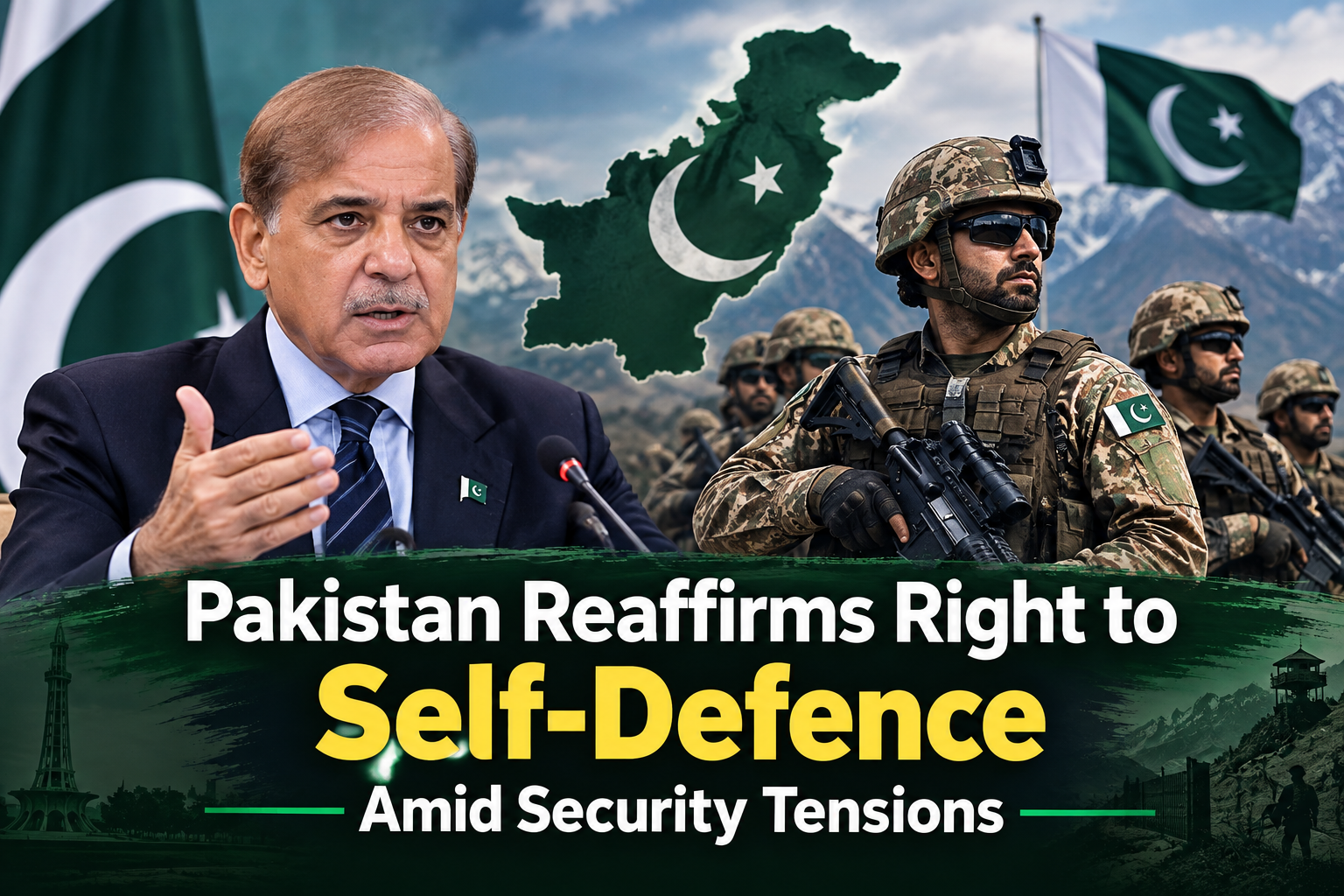
Pakistan’s military leadership reaffirmed on October 2, 2026 that the country considers itself entitled to defend its territory and security against terrorism it says is originating from Afghanistan. The statement came amid heightened tensions along the Pakistan-Afghanistan border and following Pakistani strikes that Islamabad said targeted militant hideouts in Afghanistan.
The development was one of the major security-related stories in Pakistan on October 2. It came as the country was simultaneously dealing with domestic political tensions, including negotiations between the federal government and PTI over the party’s planned October 4 protest.
Military Leadership Discusses Pakistan’s Security
The issue was discussed during a press briefing by Inter-Services Public Relations (ISPR) Director General Lt Gen Ahmed Sharif Chaudhry. He said Pakistan’s position was that there would be no compromise regarding the country’s territorial integrity, sovereignty, security and stability.
According to the military spokesperson, Pakistan has the right to self-defence and would take what it considers necessary measures in response to terrorism emanating from Afghanistan.
The statement reflected the seriousness with which Pakistani authorities are treating cross-border militancy. Pakistan has repeatedly raised concerns that militant groups operating from Afghan territory are involved in attacks inside Pakistan.
The Afghan Taliban authorities have disputed Pakistan’s accusations concerning support for militants and have rejected claims that Afghan territory is being used in the manner alleged by Islamabad. This disagreement remains one of the major sources of tension between the two neighbouring countries.
Pakistani Airstrikes in Afghanistan
The military statement followed Pakistani airstrikes reported in Afghanistan.
According to Pakistan’s information ministry, the strikes were conducted against what it described as terrorist camps and hideouts. The ministry said the targets were selected on the basis of intelligence and that the operation was designed to target militant infrastructure. It reported that 22 terrorists had been killed and that weapons and ammunition were destroyed.
Pakistan described the operation as part of its broader counterterrorism campaign.
The government said its objective was to eliminate terrorist networks and prevent attacks against Pakistani citizens.
However, reports from Afghan authorities and international sources have presented different accounts of the strikes and their consequences. Reuters reported that Afghan authorities said civilians were among those killed, while Pakistan maintained that its targets were terrorist hideouts.
These differing accounts highlight the complexity of the situation and the competing claims surrounding military operations across the border.
Pakistan’s Concerns About Cross-Border Terrorism
Pakistan has experienced repeated militant attacks, particularly in areas close to the Afghan border.
The government has attributed many of these attacks to groups that it says operate from bases or safe havens in Afghanistan. The Pakistani authorities have repeatedly called on Afghan authorities to take action against such groups.
The issue has become especially important because Khyber Pakhtunkhwa shares a long border with Afghanistan and has experienced significant security challenges.
Pakistan argues that attacks originating from across the border represent a direct security threat to its citizens and security personnel.
The Afghan side, however, has rejected Pakistan’s accusations and has argued that militancy inside Pakistan is an internal matter.
The disagreement has contributed to worsening relations between Islamabad and Kabul.
Corps Commanders’ Conference
The security situation was also discussed during the 277th Corps Commanders’ Conference held at General Headquarters in Rawalpindi on October 2.
The meeting was chaired by Chief of Defence Forces and Chief of Army Staff Field Marshal Asim Munir. Senior military commanders reviewed Pakistan’s security environment, counterterrorism operations and overall operational preparedness.
According to ISPR, the conference emphasized maintaining a high level of readiness.
The commanders also discussed measures intended to strengthen counterterrorism efforts, including intelligence-based operations, improved policing capacity and broader engagement with communities.
The military leadership stated that internal stability was important for national security.
Internal Stability Also Discussed
The Corps Commanders’ Conference was not focused exclusively on the external security situation.
According to ISPR, the military leadership also discussed the importance of internal stability. It stated that attempts to create a situation similar to the unrest of May 9 would be dealt with according to the law.
This statement came on the same day that the government and PTI began formal negotiations concerning PTI’s planned October 4 protest.
The timing made the issue particularly significant because political tensions and security concerns were developing simultaneously.
The government and opposition were attempting to resolve their differences through talks, while the military leadership was emphasizing internal stability.
Political Situation and Security Concerns
Pakistan’s political environment has been tense in recent years.
On October 2, representatives of the federal government and PTI met at National Assembly Speaker Ayaz Sadiq’s chambers in Islamabad. The meeting focused on PTI’s planned protest and other political demands.
The government wanted the protest cancelled, while PTI maintained its political demands.
The military leadership’s comments regarding internal stability therefore came during a period when political negotiations were already underway.
The security situation created an additional challenge for government authorities because any large political gathering would require substantial security arrangements.
Pakistan’s Position on Sovereignty
A major theme in the military leadership’s statements was national sovereignty.
Pakistan has emphasized that it considers protection of its territory and citizens a central responsibility of the state.
The ISPR chief said Pakistan would determine what steps were necessary in response to threats from Afghanistan.
This position reflects Islamabad’s broader argument that cross-border terrorism cannot be treated only as an Afghan domestic issue when attacks affect Pakistani territory.
Pakistan has therefore sought stronger action against militant groups that it says operate from Afghan territory.
Regional Implications
The worsening Pakistan-Afghanistan security situation has implications beyond the two countries.
Pakistan and Afghanistan share a long and strategically important border. Movement of people, trade, transportation and security operations are closely connected to relations between the two countries.
When relations deteriorate, border crossings and trade can also be affected.
Security tensions can additionally create difficulties for people living in border communities.
For Pakistan, maintaining security along the western border remains a major national priority.
For Afghanistan, accusations from Pakistan create diplomatic pressure and contribute to difficult relations with its neighbour.
Importance of Intelligence-Based Operations
The military leadership also highlighted the importance of intelligence in counterterrorism efforts.
According to ISPR, commanders discussed intelligence-based operations as part of Pakistan’s broader security strategy.
Intelligence plays an important role in identifying militant networks and preventing attacks.
Pakistan has increasingly emphasized intelligence-led counterterrorism operations rather than relying only on conventional security deployments.
The military leadership also mentioned the importance of strengthening police capacity and improving coordination between different parts of the security system.
Counterterrorism and Public Safety
The main stated objective of Pakistan’s counterterrorism policy is protecting citizens.
Militant violence has affected civilians, police officers, soldiers and other members of society.
The government has therefore continued to emphasize counterterrorism operations in areas where militant activity has been reported.
At the same time, security operations can have wider effects on local communities, particularly in areas close to conflict zones.
For this reason, authorities have repeatedly discussed the importance of minimizing harm to civilians during security operations.
In its October 2 statement, Pakistan said maximum precaution had been taken to avoid collateral damage during the strikes in Afghanistan.
Different Accounts of the Airstrikes
One of the most important aspects of the latest development is that Pakistan and Afghan authorities have given different accounts of the airstrikes.
Pakistan said its forces targeted militant camps and reported that 22 militants were killed.
Afghan authorities, however, reported civilian casualties. Reuters cited Afghan officials and UN information concerning civilian deaths following the strikes.
Because the two sides have provided different descriptions, the precise circumstances surrounding the strikes remain contested.
This difference also demonstrates why cross-border military operations can quickly become diplomatic issues.
Pakistan-Afghanistan Relations
Relations between Pakistan and Afghanistan have historically been complicated.
The two countries share cultural, economic and geographic links, but disagreements over border security and militant groups have repeatedly created tension.
Pakistan has repeatedly called on Afghanistan to prevent militant groups from using Afghan territory against Pakistan.
Afghan authorities have rejected accusations that they are responsible for attacks inside Pakistan.
The latest developments have therefore added another chapter to an already difficult relationship.
Operation Ghazab lil-Haq
Pakistan’s information ministry linked the latest strikes to the country’s counterterrorism campaign known as Operation Ghazab lil-Haq.
The government said the campaign would continue with the objective of eliminating terrorist networks and their supporters.
The operation forms part of Pakistan’s wider response to the security challenges facing the country.
The government has repeatedly said that terrorism is a major threat to national security and economic development.
Effects on Pakistan’s Economy
Security conditions can also influence Pakistan’s economy.
Businesses generally require a stable environment to operate effectively. Uncertainty along major transport routes or border areas can affect trade and investment.
Pakistan is already working to improve economic conditions, increase investment and strengthen exports.
A stable security environment can support these objectives, while prolonged insecurity can create additional challenges.
This is one reason security developments are closely followed by businesses and economic policymakers.
Impact on Border Communities
People living close to the Pakistan-Afghanistan border are particularly affected by security developments.
Border communities depend on trade, transportation and family connections across the region.
When security tensions increase, restrictions and disruptions can affect their daily lives.
Pakistan’s authorities argue that stronger security measures are necessary to protect communities from militant attacks.
At the same time, maintaining safe and functional border crossings remains important for legitimate movement and trade.
Pakistan’s Broader Security Policy
Pakistan’s current security policy involves several components.
These include intelligence-based operations, police strengthening, military operations, border management and diplomatic engagement.
The military leadership has also emphasized cooperation with the public.
According to ISPR, commanders discussed people-focused governance and engagement with communities as part of a broader strategy against terrorism.
This indicates that Pakistan’s security strategy is not limited to military action but also includes administrative and community-level measures.
Diplomatic Engagement Remains Important
Although Pakistan has carried out military strikes and strongly criticized militant activity from Afghanistan, diplomatic engagement remains an important part of the relationship.
Pakistan and Afghanistan have economic and geographical connections that make complete separation difficult.
Diplomatic channels can be used to discuss border security, militant activity, trade and movement of people.
The continuation of diplomatic engagement could therefore remain important even during periods of heightened security tensions.
The Role of Regional Stability
Pakistan’s security situation is also connected to wider regional developments.
The country shares borders with Afghanistan, Iran, India and China and occupies an important geographical position in South Asia.
Developments in neighbouring countries can affect Pakistan’s security and economic environment.
For this reason, Islamabad has repeatedly emphasized regional peace and stability.
At the same time, Pakistani officials have stated that national security and protection of citizens remain priorities.
Military Preparedness
The October 2 Corps Commanders’ Conference also reviewed operational preparedness.
According to ISPR, Field Marshal Asim Munir directed commanders to strengthen intelligence-based operations and improve combat capabilities through modern technology, training and multi-domain integration.
The discussion reflected the military’s focus on maintaining readiness amid a changing security environment.
Modern counterterrorism operations increasingly involve intelligence, surveillance, technology and coordination between different security institutions.
Importance of National Security
National security remains one of the major issues facing Pakistan.
The country has dealt with terrorism for many years and has conducted numerous operations against militant organizations.
The latest developments show that security concerns remain significant, particularly along the western border.
The military leadership has stated that Pakistan will continue taking measures it considers necessary to protect the country.
Challenges Ahead
Pakistan faces several challenges as it responds to the latest security situation.
The first is preventing militant attacks inside the country.
The second is managing relations with Afghanistan.
The third is protecting civilians during counterterrorism operations.
The fourth is maintaining economic and political stability while security concerns remain high.
Addressing these challenges will require coordination between military, police, civilian authorities and diplomatic institutions.
Need for Stability
Political and security stability are closely connected.
On October 2, Pakistan was dealing with both political negotiations and security concerns.
The government was negotiating with PTI about the planned protest, while the military leadership was discussing internal stability and terrorism.
A stable political environment can help government institutions focus on economic and security priorities.
Likewise, improved security can contribute to a more stable political and economic environment.
Conclusion
Pakistan’s reaffirmation of its right to self-defence on October 2, 2026, came amid heightened security tensions involving Afghanistan.
ISPR Director General Lt Gen Ahmed Sharif Chaudhry said Pakistan would take what it considered necessary measures in response to terrorism emanating from Afghanistan. The statement followed Pakistani airstrikes that Islamabad said targeted terrorist hideouts. Pakistan reported that 22 militants were killed, while Afghan authorities and international reporting presented different accounts, including reports of civilian casualties.
The same day, Pakistan’s senior military leadership met at the 277th Corps Commanders’ Conference to review national security, counterterrorism operations and military preparedness. The conference also emphasized internal stability and intelligence-based operations.
The developments highlight the continuing complexity of Pakistan-Afghanistan relations. Islamabad has maintained that militant groups operating from Afghan territory pose a security threat to Pakistan, while Afghan authorities have disputed Pakistan’s allegations.
The situation also demonstrates the importance of diplomatic communication alongside security measures. Pakistan’s security challenges cannot be viewed separately from its political, economic and regional environment.
As Pakistan continues to address terrorism and border security, the coming developments between Islamabad and Kabul will remain important for the country’s national security and regional stability.
FAQs
1. What did Pakistan say on October 2, 2026?
Pakistan’s military spokesperson reaffirmed that the country has a right to self-defence against security threats and terrorism.
2. What happened during the Corps Commanders’ Conference?
Senior military commanders reviewed the national security situation, counterterrorism operations and operational preparedness.
3. Why are Pakistan and Afghanistan facing tensions?
A major point of disagreement is Pakistan’s allegation that militant groups operating from Afghanistan are involved in attacks inside Pakistan. Afghan authorities have disputed these allegations.
4. What did Pakistan say about the airstrikes?
Pakistan said the strikes targeted terrorist hideouts and reported that 22 militants were killed.
5. Were there different accounts of the strikes?
Yes. Pakistan described the targets as militant hideouts, while Afghan authorities and international reporting raised claims of civilian casualties.