Introduction
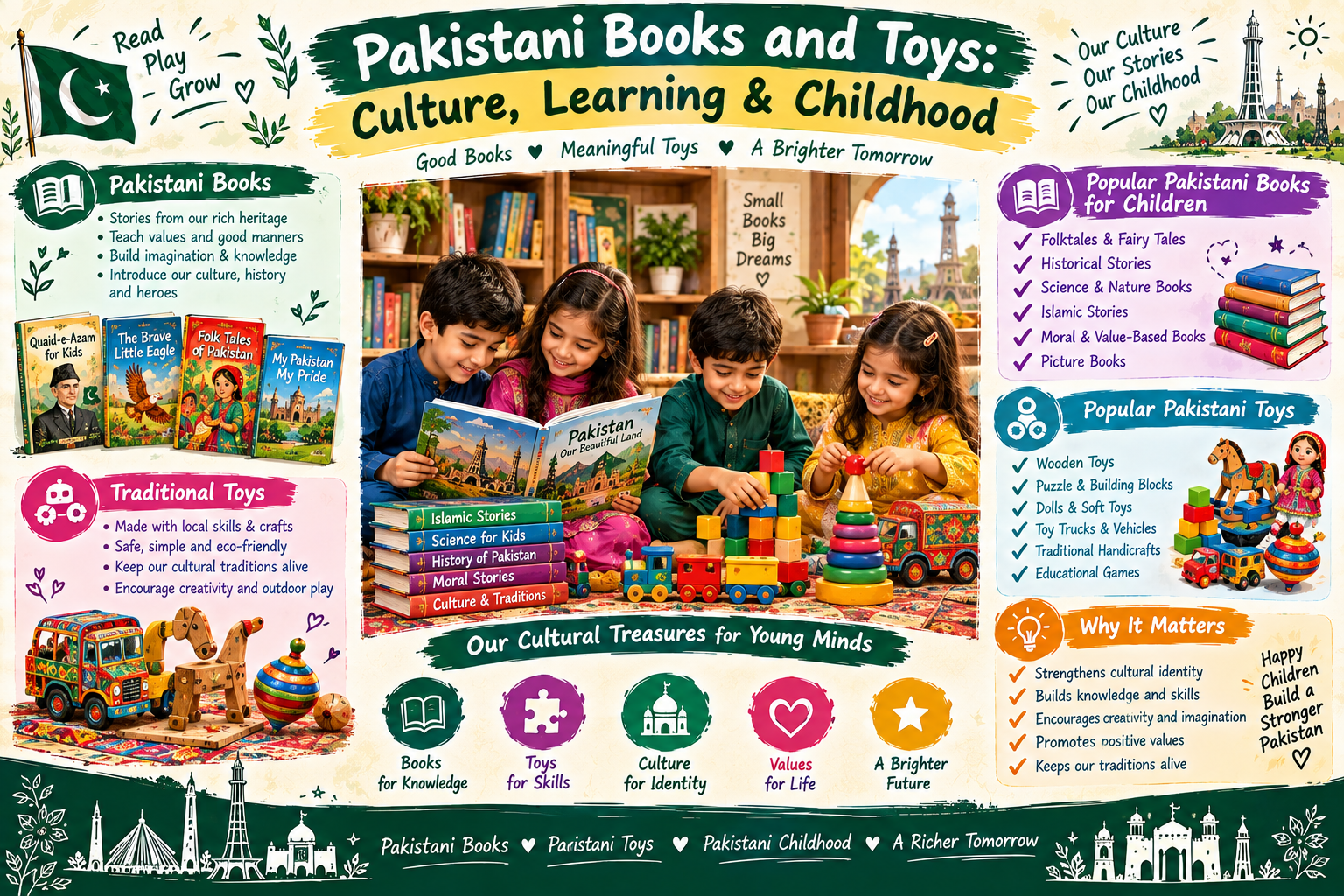
Childhood is a special stage of life when children learn about the world through stories, games, observation, questions, and imagination. Books and toys can play an important role in this process. In Pakistan, books and toys can also help children discover their cultural heritage while developing useful skills and enjoying their free time.
A children's book can introduce a child to Pakistani stories, languages, traditions, history, food, landscapes, and values. A traditional toy can introduce children to local craftsmanship, cultural designs, and older forms of play. When books and toys are connected with local culture, children can learn about their heritage in a natural and enjoyable way.
Pakistan has a rich cultural heritage that includes many languages, regional traditions, crafts, foods, clothing styles, historical places, folk stories, and artistic traditions. Children's books and toys can help preserve these elements by presenting them in forms that young readers and learners can understand.
Cultural learning does not have to be difficult. A colorful picture book, a traditional doll, a wooden toy, a story about a Pakistani family, or a simple map of Pakistan can become a starting point for learning.
By combining education, creativity, storytelling, and play, Pakistani books and toys can help children develop knowledge while building a connection with their cultural surroundings.
The Importance of Culture in Childhood
Children begin learning about their environment from an early age.
They observe how their families speak, eat, celebrate, dress, communicate, and spend time together. Books and toys can add another dimension to this learning process.
When children see familiar cultural elements in books and toys, they can better understand that their everyday experiences are part of a larger cultural story.
Culture can include:
Language
Food
Clothing
Music
Art
Crafts
Family traditions
Festivals
Stories
Historical places
Regional customs
Books and toys can introduce these subjects in child-friendly ways.
Pakistani Children’s Books and Cultural Learning
Children's books can be an effective way to introduce culture.
A story may take place in a Pakistani village, city, school, home, market, or historical location. Characters may speak familiar languages, eat traditional foods, wear local clothing, or participate in family traditions.
These details can make a story more relatable.
At the same time, books can introduce children to cultural traditions from other parts of Pakistan.
A child from Punjab can learn about Sindh. A child from Sindh can discover traditions from Khyber Pakhtunkhwa. A child from one city can learn about life in another region.
This can help children understand the diversity of their country.
Urdu Books and Cultural Identity
Urdu children's literature has an important place in Pakistan.
Urdu stories, poems, folk tales, and educational books can help children improve their language skills while introducing them to cultural ideas.
Reading Urdu books can help children become familiar with:
Urdu vocabulary
Traditional expressions
Poetry
Storytelling
Moral lessons
Cultural themes
Children can enjoy both modern and traditional stories in Urdu.
Regional Languages and Literature
Pakistan has many regional languages, each with its own literary and cultural traditions.
Children's books in regional languages can help preserve these traditions.
Languages such as Punjabi, Sindhi, Pashto, Balochi, and other local languages can carry stories, expressions, songs, folk traditions, and historical memories.
When children read stories in the languages used by their families and communities, they can develop both language skills and cultural awareness.
Regional-language children's literature can therefore contribute to the preservation of linguistic diversity.
Folk Stories for Children
Folk stories are an important part of cultural heritage.
They have traditionally been passed from one generation to another through oral storytelling.
Parents and grandparents may share stories with children, and these stories can later be adapted into books.
Folk stories can contain:
Interesting characters
Adventures
Humor
Traditional settings
Moral lessons
Cultural details
Children can enjoy the story while also learning about the traditions of earlier generations.
The Role of Traditional Toys
Toys can preserve culture in a different way.
Traditional toys may represent local crafts, clothing, animals, vehicles, household objects, and artistic styles.
Examples can include:
Wooden toys
Clay figures
Handmade dolls
Paper toys
Cloth toys
Traditional spinning toys
Miniature objects
These toys can show children how people used local materials and creative skills to make objects for play.
Wooden Toys and Pakistani Craftsmanship
Wooden toys can connect childhood play with traditional craftsmanship.
A wooden toy may be shaped into an animal, vehicle, person, building, or other object.
Children can use these toys for imaginative play while learning that wood can be transformed into useful and artistic objects.
Woodworking is also an example of a traditional skill that can be appreciated by younger generations.
Clay Toys and Pottery Traditions
Clay toys can introduce children to the idea of shaping natural materials.
A piece of clay can be turned into a figure, animal, pot, or decorative object.
This connects children's play with pottery and other traditional crafts.
Clay activities can also encourage creativity because children can create their own designs.
Traditional Dolls
Traditional dolls can represent cultural clothing and everyday life.
A handmade doll dressed in traditional clothing can introduce children to different styles of Pakistani dress.
Dolls can also encourage storytelling.
Children may create stories about families, celebrations, schools, journeys, or communities.
Through this type of play, children can explore social relationships and cultural settings.
Books About Pakistani Clothing
Books can introduce children to traditional clothing from different parts of Pakistan.
Children may learn about:
Shalwar kameez
Regional embroidery
Traditional fabrics
Cultural accessories
Different regional styles
Illustrated books can make these topics especially interesting.
A child can learn that clothing styles may vary between regions while remaining part of Pakistan's broader cultural heritage.
Books About Pakistani Food
Food is another important part of culture.
Children's books can introduce traditional Pakistani foods through colorful illustrations and simple stories.
Books can discuss foods associated with different regions and family traditions.
Food-related stories can also teach children about ingredients, cooking, hospitality, and family gatherings.
Such books can make cultural learning relatable because food is a familiar part of everyday life.
Pakistani Festivals and Celebrations
Children can learn about celebrations and cultural occasions through books, activity sets, and storytelling.
Age-appropriate books can explain the meaning and traditions associated with important occasions.
Illustrations can show families preparing food, wearing special clothing, visiting relatives, decorating homes, or participating in community activities.
These stories can help children understand how celebrations bring people together.
Books About Pakistani Landscapes
Pakistan has diverse landscapes.
Children's books can introduce them to:
Mountains
Rivers
Deserts
Forests
Plains
Coastal areas
Cities
Villages
Picture books can make geography more interesting.
A story about a child traveling through different parts of Pakistan can combine adventure with geographical learning.
Educational Maps and Toys
Maps can be turned into educational toys.
Children can use puzzles or simple maps to learn about Pakistan's provinces, cities, rivers, mountains, and other geographical features.
Map-based games can develop:
Observation
Memory
Geography knowledge
Spatial understanding
This type of learning can make children more familiar with their own country.
Books About Pakistani History
Children's history books can introduce young readers to the development of Pakistan and its cultural heritage.
Age-appropriate historical books can discuss important personalities, places, buildings, traditions, and events.
Using stories, pictures, timelines, and simple explanations can make history easier for children to understand.
History becomes more interesting when children can connect it with places and objects they recognize.
Museums and Cultural Learning
Museums can also support children's understanding of culture.
A museum visit can allow children to see traditional objects, crafts, clothing, artwork, historical items, and other cultural materials.
Parents and teachers can connect museum visits with books and toys.
For example, after seeing a traditional craft in a museum, children can read a related story or create a simple craft project.
This creates a complete learning experience.
Books and Toys as Learning Tools
Books and toys can complement each other.
A child can read a story about animals and then play with animal figures.
A child can read about Pakistan's geography and then use a map puzzle.
A child can read about traditional clothing and play with a doll wearing regional dress.
This combination allows children to experience the subject through different forms.
Encouraging Creativity
Books and toys can inspire children to create their own cultural projects.
Children can:
Draw traditional clothing
Make paper houses
Create clay figures
Write cultural stories
Design traditional patterns
Build miniature villages
Make paper maps
Create characters inspired by folk tales
These activities allow children to become creators rather than simply consumers of cultural information.
Storytelling at Home
Families can play an important role in cultural preservation.
Parents and grandparents can share stories from their childhood.
They can tell children about:
Old games
Family traditions
Local festivals
Traditional foods
Village life
Childhood memories
Regional customs
Children can then write these stories down or create drawings based on them.
This helps preserve family memories.
Grandparents and Cultural Knowledge
Grandparents often have memories of earlier forms of entertainment and everyday life.
A traditional toy or old story can become a conversation starter between generations.
A grandparent might explain how children played before smartphones and modern digital entertainment became common.
This type of conversation can help children understand how lifestyles change over time.
Modern Toys and Pakistani Culture
Preserving culture does not mean rejecting modern toys.
Modern toy designs can also include Pakistani themes.
For example, designers can create:
Pakistani landmark puzzles
Geography games
Cultural dolls
Traditional clothing sets
Local animal figures
Pakistani history cards
Urdu learning games
This allows children to experience modern play while remaining connected to local culture.
Digital Books and Cultural Preservation
Digital technology provides another way to preserve cultural stories.
Traditional stories can be adapted into digital books, illustrated stories, educational applications, and interactive learning materials.
This can make cultural content more accessible to children who are comfortable using digital devices.
However, digital material should remain age-appropriate and meaningful.
Supporting Pakistani Writers
Writers play an important role in preserving culture through children's literature.
They can create stories featuring Pakistani settings, characters, languages, traditions, and modern experiences.
At the same time, writers can explore universal themes such as friendship, curiosity, family, courage, creativity, and education.
This creates stories that are both culturally connected and enjoyable.
Supporting Pakistani Illustrators
Illustrators bring children's books to life.
Cultural details can be represented visually through clothing, architecture, landscapes, objects, and everyday activities.
Good illustrations can help young children understand cultural concepts even before they can read fluently.
Supporting local illustrators can therefore contribute to children's literature and cultural representation.
Supporting Local Toy Makers
Local toy makers and craftspeople can also help preserve cultural traditions.
Their work can introduce children to handmade objects and traditional designs.
Families can support these crafts by appreciating locally made products and teaching children about the effort behind handmade items.
This can help traditional skills remain meaningful in modern society.
Books and Toys for Different Age Groups
Cultural learning should be appropriate for a child's age.
Young Children
Picture books, simple puzzles, colorful dolls, blocks, and basic cultural objects can be suitable.
Preschool Children
Children can explore folk stories, alphabet games, simple maps, craft activities, and traditional dolls.
School-Age Children
They can read longer stories, history books, biographies, science books, and cultural literature.
They can also explore more detailed craft and geography activities.
Older Children
Older readers can explore novels, historical stories, biographies, regional literature, cultural research, and more complex creative projects.
How Parents Can Preserve Culture Through Books
Parents can introduce cultural reading into everyday life.
They can:
Read Pakistani stories with children.
Keep Urdu and regional-language books at home.
Share family stories.
Introduce children to traditional crafts.
Visit cultural places.
Encourage children to ask questions.
Discuss regional traditions.
Allow children to create cultural art projects.
These simple activities can make cultural education natural.
How Schools Can Support Cultural Learning
Schools can organize activities connected with Pakistani culture.
Examples include:
Storytelling sessions
Cultural book displays
Craft activities
Map projects
Traditional toy exhibitions
Reading competitions
Local-language reading activities
Historical projects
These activities can make cultural education interactive.
Cultural Book Corners
A classroom can have a small cultural reading corner.
It could contain books about:
Pakistani history
Folk tales
Regional languages
Traditional crafts
Famous Pakistani personalities
Geography
Local animals
Food
Clothing
Students can explore these books during free reading periods.
Traditional Toys in Cultural Exhibitions
Schools can also display traditional toys.
Students can learn about:
Materials used
How toys were made
Which regions have similar crafts
How children played in earlier generations
A traditional toy exhibition can turn a classroom into a small cultural learning space.
Books and Toys Can Teach Values
Cultural learning can also include positive values.
Stories and games can teach:
Cooperation
Respect
Honesty
Kindness
Responsibility
Creativity
Appreciation of others
Children can understand values more naturally when they see them demonstrated by characters and situations.
Preserving Culture in a Changing World
Culture changes over time.
Children today may use technology more frequently than previous generations. Their entertainment habits are also different.
This does not mean older cultural traditions have to disappear.
Books and toys can adapt traditions for modern children.
A traditional folk story can become an illustrated book.
A traditional toy design can inspire a modern educational toy.
A regional craft can become part of a school activity.
A family story can become a children's storybook.
In this way, culture can continue evolving while maintaining connections with the past.
The Role of Technology
Technology can support cultural preservation when used thoughtfully.
Digital archives, online libraries, educational applications, and digital storytelling can help preserve stories and cultural information.
Interactive maps can teach geography.
Digital picture books can introduce traditional clothing.
Animated educational content can explain historical places.
Technology can therefore become another tool for cultural education.
Benefits of Cultural Books and Toys
Culturally connected books and toys can provide many benefits.
Cultural Awareness
Children learn about their own heritage.
Language Development
Books in Urdu and regional languages can strengthen language skills.
Creativity
Traditional crafts and imaginative stories encourage creative thinking.
Historical Understanding
Children can learn about the past through stories and objects.
Family Connection
Traditional stories and toys can encourage conversations between generations.
Social Understanding
Children can discover the diversity of different regions and communities.
The Future of Pakistani Cultural Toys and Books
The future can bring together traditional culture and modern creativity.
Pakistani creators can develop books and toys that introduce children to cultural heritage while also exploring science, technology, environmental awareness, creativity, and modern life.
Future children's products can include:
Interactive cultural books
Educational map puzzles
Regional-language stories
Traditional craft kits
Pakistani history games
Cultural character dolls
Science toys inspired by local environments
Storytelling cards
Digital cultural learning tools
This can make cultural education more attractive to modern children.
Why Preserving Childhood Culture Matters
Children who understand their cultural heritage can develop a greater awareness of where their communities and traditions come from.
Books and toys are simple ways to introduce these ideas.
A child may learn about a traditional craft through a toy, discover a folk tale through a book, or learn about a regional language through a story.
These small experiences can become lasting memories.
Conclusion
Pakistani books and toys can play a valuable role in preserving cultural heritage while supporting children's learning, creativity, and imagination. Books can introduce children to Pakistani languages, stories, history, geography, traditions, food, clothing, and values. Traditional toys can connect children with local crafts, materials, artistic designs, and older forms of play.
The combination of books and toys creates a powerful learning experience because children can read, see, touch, create, and imagine. Parents, grandparents, teachers, writers, illustrators, craftspeople, schools, libraries, and local businesses can all contribute to this process.
Preserving culture does not mean keeping children away from modern technology or modern toys. Instead, it means finding creative ways to bring cultural heritage into modern childhood.
A traditional story can become a colorful children's book. A handmade craft can inspire a modern educational toy. A family memory can become a story for future generations.
When children learn about their heritage through enjoyable experiences, culture becomes something they can understand, appreciate, and carry forward.
Pakistani books and toys therefore have the potential to be more than sources of entertainment. They can become bridges between generations, connecting the knowledge of the past with the creativity of the future.
FAQs
1. How can books help preserve Pakistani culture?
Books can preserve Pakistani culture by introducing children to local languages, folk tales, history, traditions, clothing, food, crafts, and regional customs.
2. Why are traditional Pakistani toys culturally important?
Traditional toys can represent local craftsmanship, materials, designs, clothing, everyday life, and older forms of childhood play.
3. Can modern toys also promote Pakistani culture?
Yes. Modern educational toys can include Pakistani geography, history, languages, landmarks, cultural designs, traditional clothing, and local stories.
4. What can parents do to teach children about Pakistani culture?
Parents can read Pakistani stories, share family traditions, introduce children to traditional crafts and toys, visit cultural places, and encourage children to explore local languages and history.
5. How can schools preserve cultural heritage through books and toys?
Schools can organize cultural reading corners, storytelling sessions, craft activities, traditional toy exhibitions, map projects, and book displays focused on Pakistani heritage.