Introduction
Toys are an important part of childhood, but play can also become a valuable learning experience. Educational toys are designed to help children develop knowledge, creativity, problem-solving abilities, communication skills, coordination, and other useful abilities while they are playing.
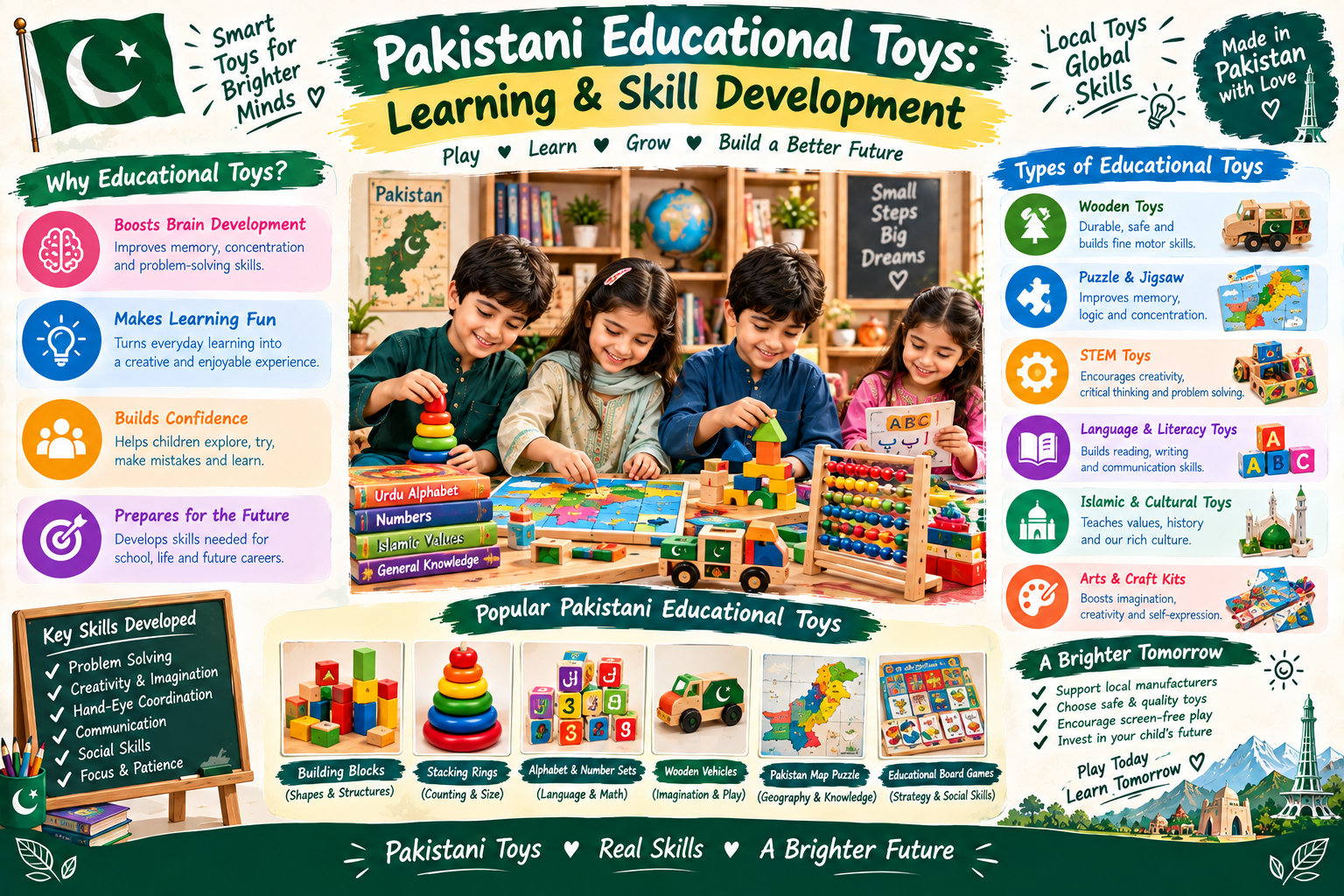
In Pakistan, educational toys can provide children with an enjoyable way to learn outside the classroom. From building blocks and puzzles to counting games, alphabet sets, science kits, art materials, educational cards, and locally made wooden toys, children can learn through different types of play.
Educational toys do not have to be expensive or technologically advanced. A simple puzzle can teach a child about shapes and problem-solving. Building blocks can introduce ideas about balance and structure. Flashcards can support vocabulary and recognition. Drawing materials can encourage creativity.
Pakistani families can also find educational toys inspired by local culture, languages, animals, geography, traditional crafts, and everyday life. Such toys can make learning more familiar and meaningful for children.
The purpose of educational play is not to turn every moment into a formal lesson. Instead, it is to allow children to explore, experiment, make mistakes, and discover ideas naturally.
What Are Educational Toys?
Educational toys are play materials that support children's learning and development.
They can be designed for different ages and different skills.
Examples include:
Puzzles
Building blocks
Counting games
Alphabet sets
Number games
Memory cards
Drawing kits
Craft materials
Science kits
Shape sorters
Educational board games
Model-building sets
Language-learning games
The most useful educational toy is usually one that matches the child's age and interests.
Why Educational Toys Are Important
Children learn through many different activities. Playing allows them to explore the world in a relaxed way.
Educational toys can help children develop:
Creativity
Memory
Concentration
Problem-solving
Communication
Coordination
Observation
Logical thinking
Basic academic skills
Social skills
When children enjoy an activity, they may become more willing to explore it.
For example, a child who finds numbers difficult in a textbook may enjoy a simple counting game involving colorful objects.
Learning Through Play
Play is naturally connected with curiosity.
Children often ask questions while playing:
“Why does this piece fit here?”
“How can I build this?”
“What happens if I move this?”
“Which shape is this?”
These questions can lead to learning.
Educational toys can provide children with opportunities to find answers through observation and experimentation.
This type of learning can be especially useful because children are actively involved.
Building Blocks and Construction Toys
Building blocks are among the simplest educational toys.
Children can use blocks to create:
Houses
Towers
Bridges
Roads
Vehicles
Buildings
Imaginary cities
While building, children can explore shapes, sizes, balance, and space.
They may also learn that a structure can fall if it is not balanced properly.
Construction play encourages children to plan, build, adjust, and try again.
These activities can support both creativity and problem-solving.
Puzzles for Pakistani Children
Puzzles can help children develop logical thinking.
Different puzzles can be designed for different age groups.
Younger children may enjoy simple shape or picture puzzles. Older children can explore more complex puzzles involving words, numbers, maps, or patterns.
Puzzles can teach children to:
Observe details
Recognize patterns
Compare shapes
Remember information
Solve problems
Stay patient
Completing a puzzle can also give children a sense of achievement.
Alphabet Learning Toys
Alphabet toys can help young children become familiar with letters.
These may include:
Letter cards
Wooden letters
Magnetic letters
Matching games
Alphabet puzzles
Letter blocks
In Pakistan, alphabet-learning toys can also support Urdu learning.
Children can learn letters through colorful objects and simple games rather than only memorizing them from a textbook.
Parents can combine alphabet toys with simple words and pictures.
Number and Counting Toys
Counting toys can make early mathematics more enjoyable.
Children can count objects such as:
Blocks
Beads
Cards
Toy animals
Shapes
They can gradually learn numbers, addition, subtraction, patterns, and comparisons.
A simple activity may ask a child to place five blocks in one group and three in another. The child can then compare the groups.
This turns mathematics into a practical activity.
Shape and Color Toys
Shape and color recognition are important early learning skills.
Children can learn to identify:
Circles
Squares
Triangles
Rectangles
Different colors
Shape-sorting toys can encourage children to match objects with the correct spaces.
Color games can encourage observation and classification.
These simple skills provide a foundation for later learning.
Memory Games
Memory games can help children practice remembering information.
A basic matching game may involve cards placed face down. Children turn over two cards and try to find matching pairs.
Such activities can encourage:
Memory
Concentration
Observation
Patience
Memory games can be adjusted according to age.
Younger children can use fewer cards, while older children can use larger sets.
Science Educational Toys
Science-based toys can introduce children to scientific ideas through practical activities.
Depending on age, science toys may explore:
Magnets
Plants
Light
Simple machines
Weather
Space
Animals
Human body
Electricity concepts
For young children, science activities should be simple and safe.
The goal is to encourage curiosity.
A child who enjoys exploring magnets may later become interested in physics. A child fascinated by plants may become interested in biology.
Space and Astronomy Toys
Space is a fascinating subject for many children.
Educational models and toys can introduce children to:
The Sun
Earth
The Moon
Planets
Stars
Orbits
Day and night
A simple solar-system model can help children visualize the relative positions of celestial objects.
Space-themed puzzles, books, models, and activity sets can make astronomy more accessible.
Geography Learning Toys
Geography can also be taught through play.
Maps, puzzles, globes, and location-based games can introduce children to countries, cities, mountains, rivers, and continents.
Pakistani educational toys can include material focused on Pakistan's geography.
Children can learn about:
Provinces
Major cities
Mountains
Rivers
Deserts
Coastal areas
Historical locations
This can help children develop geographical awareness while becoming familiar with their own country.
Pakistani Culture in Educational Toys
Educational toys can also represent Pakistan's cultural heritage.
A toy or activity set may introduce children to:
Traditional clothing
Local crafts
Pakistani landmarks
Regional foods
Traditional homes
Cultural festivals
Local animals
Regional languages
Such toys can make cultural learning interactive.
Instead of simply reading about a traditional object, a child may be able to see, arrange, build, or create something inspired by it.
Wooden Educational Toys
Wooden toys have a special place in educational play.
They can include:
Puzzles
Shape sorters
Number blocks
Alphabet blocks
Building sets
Stacking toys
Vehicles
Animal figures
Simple wooden toys often have fewer distractions than highly electronic toys.
This can encourage children to use their imagination.
Wooden educational toys can also connect modern learning with traditional craftsmanship.
Art and Craft Educational Toys
Art materials can also be educational.
Children can use:
Drawing pencils
Crayons
Paper
Clay
Paint
Safe craft materials
Coloring books
Art activities can encourage creativity and self-expression.
Children can create their own characters, houses, animals, landscapes, and stories.
This helps them explore ideas without needing a single correct answer.
Clay as a Learning Material
Clay can be a particularly useful creative material.
Children can shape clay into different objects.
They can create:
Animals
Fruits
Flowers
Houses
People
Vehicles
Decorative shapes
Working with clay can encourage children to think about three-dimensional shapes.
It can also provide a connection with Pakistan's traditional pottery and craft heritage.
Language Learning Toys
Language can be taught through games and toys.
Children can use picture cards, letter puzzles, word games, storytelling cards, and matching activities to develop vocabulary.
In Pakistan, educational toys can support different languages, including Urdu and English as well as regional languages.
For young learners, pictures can make new words easier to remember.
For example, a card showing an apple alongside its written name can connect the object with the word.
English Learning Through Toys
English-learning toys can be useful for children who are developing their English vocabulary.
Simple games can introduce:
Alphabet
Colors
Numbers
Animals
Fruits
Family words
Everyday objects
Children can practice words through matching, repetition, and storytelling.
The activity should remain enjoyable rather than feeling like a difficult examination.
Computer and Technology Learning Toys
Technology-based educational toys can introduce children to basic digital concepts.
Age-appropriate coding games, programmable toys, logic puzzles, and educational applications can encourage computational thinking.
Children can learn concepts such as:
Sequences
Patterns
Instructions
Logic
Problem-solving
However, children do not necessarily need expensive technology to learn these ideas. Simple offline games can also teach sequencing and logical thinking.
STEM Toys
STEM stands for Science, Technology, Engineering, and Mathematics.
STEM toys can encourage children to explore these fields through practical activities.
Examples include:
Building sets
Simple robotics kits
Science models
Mathematical puzzles
Engineering challenges
Coding games
These toys can encourage children to ask questions and test ideas.
A child may build something, discover that it does not work as expected, and then modify the design.
This teaches an important lesson: mistakes can be part of learning.
Educational Board Games
Board games can combine learning and social interaction.
Depending on the game, children may practice:
Counting
Strategy
Memory
Vocabulary
Geography
General knowledge
Decision-making
Board games can also teach children how to follow rules and take turns.
Playing with siblings, parents, or friends can make the activity more enjoyable.
Role-Playing Toys
Role-playing allows children to imagine different situations.
Children may use toy kitchens, shops, medical sets, vehicles, dolls, or other objects to create imaginary scenarios.
Through role-play, children can practice communication and social skills.
For example, children may create a pretend shop where one person becomes the shopkeeper and another becomes the customer.
This type of play encourages conversation and creativity.
Educational Toys and Social Skills
Not all educational development happens individually.
Some toys are designed for group play.
Children can learn:
Taking turns
Sharing
Cooperation
Listening
Communication
Following rules
Solving problems together
Group play can be especially useful because children learn to consider other people's ideas.
Educational Toys for Different Ages
Children's abilities change as they grow.
Toddlers
Young children can benefit from simple:
Shape sorters
Stacking toys
Large blocks
Picture cards
Safe sensory toys
Preschool Children
They can explore:
Puzzles
Alphabet games
Counting toys
Drawing
Simple science activities
Matching games
School-Age Children
They may enjoy:
Science kits
Building sets
Strategy games
Geography puzzles
Mathematics games
Art projects
Older Children
They can explore:
Coding
Robotics
Complex puzzles
Engineering sets
Advanced science models
Creative writing games
Age-appropriate selection is important for safety and enjoyment.
How Parents Can Choose Educational Toys
Parents do not need to buy every educational toy available.
A few well-chosen toys can provide many learning opportunities.
Parents can consider:
Age
The toy should be appropriate for the child's age.
Interest
Children are more likely to engage with something they enjoy.
Learning Goal
Parents can consider whether the toy supports language, mathematics, creativity, science, or another skill.
Simplicity
A simple toy can sometimes provide more opportunities for imagination than a highly complicated toy.
Safety
Toys should be suitable for the child's age and used according to safety guidance.
Educational Toys and Screen-Free Learning
Screen-free educational toys can provide an alternative to digital entertainment.
Blocks, puzzles, cards, crafts, books, board games, and science activities allow children to learn without a screen.
This does not mean that screens must always be avoided. Digital learning can also be useful when appropriate.
The goal is to provide children with a balanced range of activities.
DIY Educational Toys
Families can also create simple educational toys at home using safe materials.
Examples include:
Paper number cards
Homemade matching cards
Cardboard puzzles
Bottle-cap counting activities
Paper shapes
Homemade memory games
Drawing boards
These activities can be inexpensive and creative.
Children can also participate in making the toy, which adds another learning experience.
Reusing Materials for Educational Play
Safe reusable materials can become useful learning tools.
Cardboard boxes can become buildings.
Paper can become flashcards.
Bottle caps can be used for counting activities when appropriate and under adult supervision.
Fabric pieces can become craft materials.
The important point is that materials should be clean, safe, and suitable for the child's age.
Educational Toys and Pakistani Schools
Schools can use educational toys to support classroom lessons.
For example, teachers can use:
Number blocks for mathematics
Maps for geography
Models for science
Letter cards for language
Puzzles for problem-solving
Craft materials for art
Hands-on learning can help students connect abstract concepts with practical examples.
Educational Toy Libraries
Toy libraries can be useful for families who cannot purchase many educational toys.
Instead of owning every toy, families can borrow different toys for a period of time.
This allows children to experience a wider variety of activities.
Schools, community centers, and libraries can potentially provide such services as part of children's learning programs.
The Future of Educational Toys in Pakistan
The future of educational toys in Pakistan can combine local culture with modern learning.
Pakistani toy designers can create products inspired by:
Local languages
Pakistani geography
Cultural heritage
Science
Technology
Mathematics
Traditional crafts
Environmental awareness
There is also potential for combining physical toys with digital learning.
For example, a physical geography puzzle could be accompanied by age-appropriate educational information.
Supporting Local Educational Toy Makers
Supporting local toy makers can encourage creativity and entrepreneurship.
Local designers and craftspeople can develop educational products specifically for Pakistani children.
Such products can reflect local languages, cultural references, and educational needs.
Buying locally made toys can also help support small businesses and traditional craftsmanship.
Educational Toys and Creativity
A major benefit of educational toys is that they can encourage children to create rather than simply consume.
A child using blocks can design a building.
A child using art materials can create a picture.
A child using a science kit can test an idea.
A child using a storytelling game can invent a character.
This type of active participation can make learning more memorable.
Why Educational Toys Matter
Educational toys matter because they combine two important parts of childhood: learning and play.
Children do not always need formal lessons to develop useful skills.
Through the right toys, they can practice:
Thinking
Creating
Communicating
Observing
Building
Counting
Reading
Experimenting
Solving problems
The best educational toys make children want to explore.
Conclusion
Pakistani educational toys can provide children with enjoyable opportunities to learn, create, experiment, and develop useful skills. From puzzles and blocks to science kits, alphabet games, counting toys, art materials, geography puzzles, and traditional wooden toys, there are many ways to combine play with education.
Educational toys do not need to be expensive or complicated. Simple activities can teach children important concepts while giving them freedom to use their imagination.
Pakistani culture can also become part of educational play through toys inspired by local languages, crafts, geography, history, animals, and traditions. This can help children learn about their country while developing creativity and curiosity.
Parents, teachers, schools, local businesses, and craftspeople can all contribute to the growth of educational toys in Pakistan. By providing children with age-appropriate and interesting play materials, adults can create an environment where learning becomes a natural part of everyday life.
The greatest value of an educational toy is not how many features it has. Its real value lies in the questions it encourages, the ideas it inspires, and the skills children develop while playing.
FAQs
1. What are educational toys?
Educational toys are play materials designed to support children's learning and development. They can help with skills such as counting, reading, problem-solving, creativity, coordination, and communication.
2. Which educational toys are suitable for young Pakistani children?
Simple puzzles, alphabet sets, counting toys, blocks, picture cards, shape sorters, drawing materials, and age-appropriate activity sets can be useful for young children.
3. Can traditional Pakistani toys be educational?
Yes. Traditional toys can encourage imagination, storytelling, coordination, observation, creativity, and cultural learning.
4. Are expensive educational toys necessary?
No. Simple and affordable toys can provide valuable learning experiences. Homemade activities using safe materials can also support children's development.
5. How can parents use toys for learning at home?
Parents can choose age-appropriate toys and encourage children to explore, build, count, draw, solve puzzles, tell stories, and discuss what they are doing.