Introduction
Toys are an important part of childhood. They are not only objects used for entertainment but can also become tools for learning, creativity, imagination, and social development. In Pakistan, traditional toys have a special cultural value because many of them are connected with local crafts, materials, traditions, and childhood memories.
Before modern electronic toys became widely popular, Pakistani children enjoyed many simple toys made from wood, clay, cloth, metal, paper, and other locally available materials. Some toys were handmade by local craftspeople, while others were created by families themselves. These toys often reflected the culture and environment of the communities where they were made.
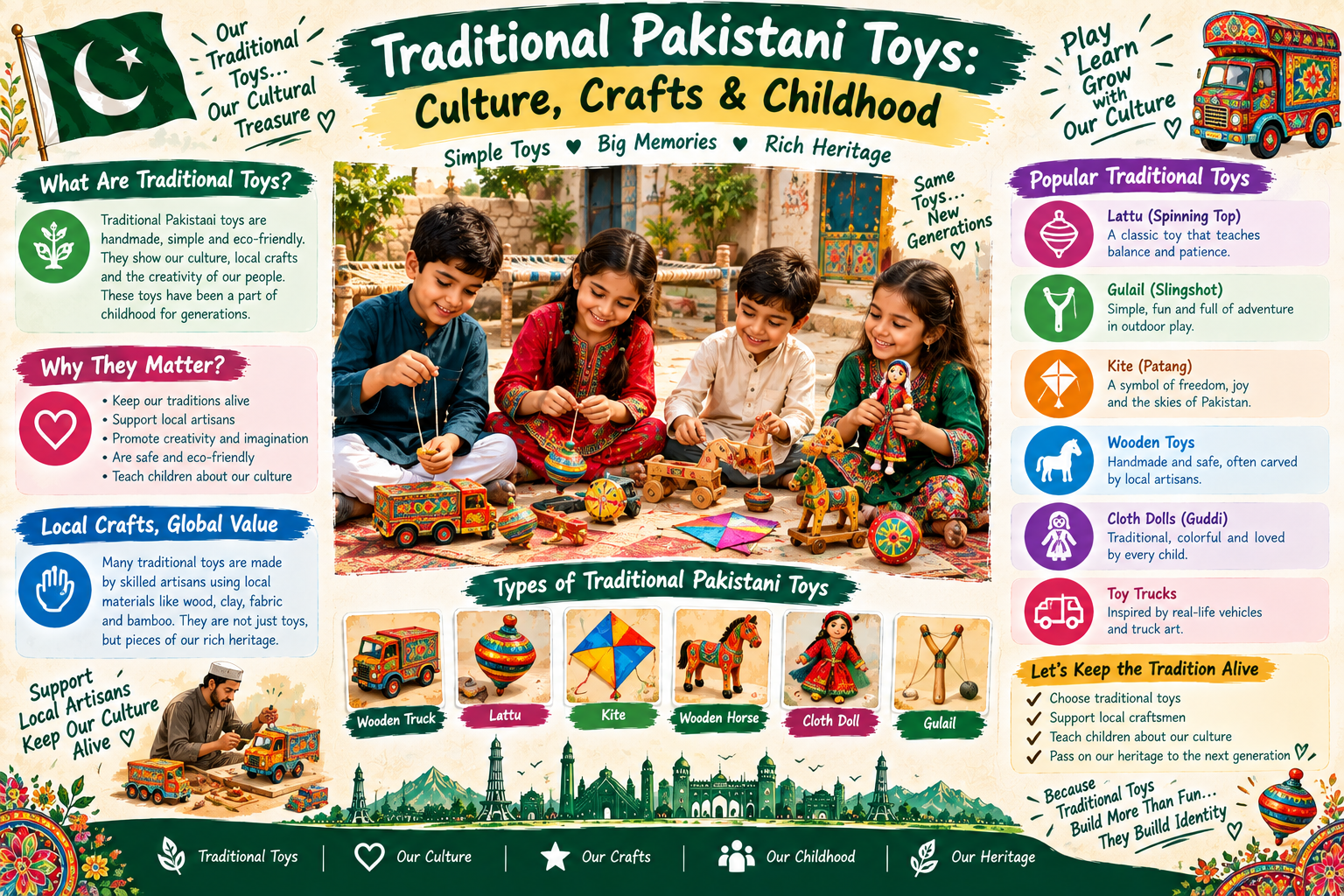
Traditional Pakistani toys can include wooden vehicles, clay figures, dolls, spinning toys, handmade animals, miniature household objects, colorful paper toys, and other craft-based creations. Their designs may differ from one region to another, making them an interesting part of Pakistan's cultural diversity.
Today, traditional toys can still have an important place in children's lives. They can encourage imaginative play while also introducing children to traditional craftsmanship and cultural heritage.
What Are Traditional Pakistani Toys?
Traditional toys are play objects that are connected with local cultures, crafts, and older forms of childhood entertainment.
Many traditional toys are simple compared with modern electronic toys. They may not have screens, batteries, speakers, or complicated mechanisms. Instead, their appeal often comes from their shape, colors, movement, texture, and the imagination of the child.
A simple wooden toy car, for example, may not have electronic features, but a child can create an entire imaginary journey around it.
Traditional toys can therefore encourage children to become active participants in play.
Cultural Importance of Traditional Toys
Toys can reflect the culture in which they are created.
A handmade doll may represent traditional clothing. A miniature household object may represent everyday life. A wooden animal may reflect local craftsmanship. A clay toy may demonstrate the skills of a potter.
In this way, traditional toys can become small examples of cultural heritage.
They can help children understand that objects used in everyday life can also have artistic and cultural value.
Handmade Toys in Pakistan
Handmade toys are an important part of traditional craft culture.
Instead of being produced through large industrial processes, handmade toys are created using the skills of individual craftspeople or small workshops.
Common materials may include:
Wood
Clay
Cloth
Paper
Natural fibers
Metal
Recycled materials
The exact materials and designs can vary between regions.
Handmade toys often have unique details because they are created through human skill and creativity.
Wooden Toys
Wood has traditionally been used to create many types of toys.
Wooden toys can include vehicles, animals, spinning toys, puzzles, figures, and miniature objects.
A wooden toy may be painted in bright colors or decorated with simple patterns.
One benefit of wooden toys is that they can encourage imaginative play. A child can turn a wooden vehicle into part of a larger story involving roads, houses, people, and adventures.
Wooden toys can also introduce children to the idea that ordinary materials can be transformed into useful and beautiful objects.
Clay Toys
Clay is another traditional material used in crafts.
Clay toys can include animals, people, household objects, and decorative figures.
The process of shaping clay can itself be educational. Children can learn that an object can begin as a simple piece of material and gradually become a recognizable shape.
Clay also connects toys with Pakistan's pottery and craft traditions.
Children can learn about creativity while discovering how traditional crafts are made.
Traditional Dolls
Dolls have been part of children's play in many cultures.
Traditional Pakistani dolls can represent local clothing, cultural styles, and family life. Handmade cloth dolls may be dressed in colorful fabrics and decorated with simple details.
Dolls can encourage imaginative storytelling. Children may create stories about families, schools, celebrations, journeys, or everyday life.
Traditional dolls can therefore serve both entertainment and cultural purposes.
Spinning Toys
Spinning toys are another interesting category of traditional playthings.
A simple spinning toy can provide children with an introduction to movement and balance. Watching an object spin can also create curiosity about motion.
Children do not need a complicated explanation of physics to enjoy such a toy. Through play, they can naturally observe that objects move differently depending on how they are pushed or spun.
This shows how simple toys can combine entertainment with learning.
Paper Toys
Paper can be transformed into many creative toys.
Children can make paper animals, boats, airplanes, figures, decorations, and other objects.
Paper toys are particularly useful because paper is easy to find and can be used for many different activities.
Making a paper toy can involve:
Drawing
Folding
Cutting
Coloring
Designing
Assembling
These activities can help develop creativity and hand-eye coordination.
Toys Made From Cloth
Cloth can be used to create dolls, animals, balls, puppets, and other soft toys.
Cloth toys can have colorful patterns and textures.
In traditional settings, families and craftspeople may use leftover pieces of fabric to create useful or decorative objects. This also demonstrates how everyday materials can be reused creatively.
Traditional Toy Vehicles
Toy vehicles are popular among children in many cultures.
Traditional Pakistani toy vehicles can be made from wood, metal, clay, or other materials.
A simple toy car, truck, bus, rickshaw, or cart can become part of imaginative play.
Children can create roads, stations, markets, homes, and entire imaginary cities around their toys.
This type of play can encourage storytelling and problem-solving.
Toy Animals
Animal-shaped toys can also be made using traditional materials.
Children may enjoy wooden, clay, cloth, or paper animals.
These toys can be used to create imaginary farms, forests, zoos, and stories.
They can also encourage children to learn about real animals.
A parent or teacher can use a toy animal as a starting point for questions such as:
Where does this animal live?
What does it eat?
How does it move?
What sounds does it make?
How does it help the environment?
In this way, a simple toy can become part of an educational activity.
Toys and Imagination
One of the strongest benefits of simple traditional toys is that they leave room for imagination.
An electronic toy may already have a specific function, but a simple handmade toy can be used in many different ways.
A wooden box can become a shop.
A cloth figure can become a story character.
A paper boat can become part of an imaginary journey.
A wooden vehicle can become a bus traveling through an imaginary city.
The child creates the story.
This encourages creativity and independent thinking.
Traditional Toys and Learning
Play is an important way for children to learn.
Traditional toys can support learning through:
Observation
Imagination
Movement
Creativity
Problem-solving
Storytelling
Social interaction
Basic understanding of materials
For example, building or arranging simple toys can encourage children to think about shapes, sizes, balance, and space.
Role-playing with dolls or miniature objects can help children explore communication and social situations.
Toys and Fine Motor Skills
Some traditional toys require children to hold, move, arrange, build, or manipulate objects.
These activities can support the development of fine motor skills.
Examples include:
Arranging small objects
Moving toy pieces
Building simple structures
Coloring paper toys
Folding paper
Connecting pieces
Shaping clay
Children can develop control and coordination through these activities.
Traditional Toys and Family Bonding
Traditional toys can also bring family members together.
Parents and grandparents may remember toys from their own childhoods. Sharing these memories with children can create meaningful conversations.
A grandparent may explain how a particular toy was made or how children used to play with it.
This creates an intergenerational connection.
Instead of being just a play object, a traditional toy can become a way of sharing family stories.
Traditional Toys and Pakistani Childhood Memories
For many people, simple toys are connected with childhood memories.
A handmade doll, wooden vehicle, spinning toy, paper airplane, or clay figure can remind someone of school holidays, family gatherings, village life, local markets, or time spent with siblings and friends.
These memories are part of cultural history.
Children today may grow up with very different forms of entertainment, but traditional toys can provide an opportunity to experience some of the simple pleasures associated with earlier generations.
Regional Diversity in Pakistani Toys
Pakistan has a diverse cultural landscape, and traditional crafts can vary between regions.
Different communities have their own artistic traditions, materials, patterns, and techniques.
Traditional toys may therefore look different depending on where they are made.
This diversity can make Pakistani toys particularly interesting.
Children can learn that Pakistan's cultural heritage includes many regional traditions rather than one single style.
The Role of Local Craftspeople
Craftspeople are important in preserving traditional toy-making skills.
Their work requires creativity, patience, and practical knowledge.
A craftsperson may know how to shape wood, mold clay, stitch cloth, paint patterns, or assemble different materials.
These skills are often developed through practice and experience.
Supporting traditional crafts can help keep such knowledge alive for future generations.
Traditional Toys and Creativity
Traditional toys can inspire children to become creators themselves.
After seeing a handmade toy, a child may want to make something similar.
For example, children can create:
Paper animals
Cardboard vehicles
Cloth puppets
Clay figures
Paper houses
Simple spinning toys
Decorative objects
The process encourages children to experiment.
They can make mistakes, try again, change designs, and develop their own ideas.
DIY Traditional Toy Activities
Families and schools can introduce simple craft activities inspired by traditional toys.
Children can use safe, age-appropriate materials to create their own designs.
For example, they can make a paper village with houses, trees, roads, and vehicles.
Another activity could involve creating simple paper characters and using them to tell a story.
These activities combine arts, crafts, storytelling, and play.
Traditional Toys in Schools
Schools can use traditional toys as part of cultural and educational activities.
A classroom project could introduce students to different traditional crafts and materials.
Students could learn:
How wooden toys are made
How clay can be shaped
How paper can be folded
How cloth can be stitched
How colors and patterns are used
Teachers can also connect these activities with subjects such as art, history, science, and social studies.
Toys and Cultural Education
Cultural education becomes more meaningful when children can see and touch examples of traditional objects.
A traditional toy can introduce a child to a particular craft or cultural practice.
For example, a clay figure can lead to a discussion about pottery. A traditional doll can introduce clothing styles. A wooden toy can lead to a conversation about woodworking.
This makes cultural learning more interactive.
Traditional Toys and Modern Childhood
Modern children have access to many forms of entertainment, including digital games, videos, smartphones, computers, and electronic toys.
There is nothing wrong with modern toys when they are suitable for children. However, traditional toys can provide a different kind of experience.
They can encourage children to use their imagination without depending entirely on electronic features.
A balanced childhood can include different forms of play, including creative, physical, social, educational, traditional, and modern activities.
Traditional Toys and Environmental Awareness
Some traditional toys can also support conversations about materials and sustainability.
When toys are made from natural or reused materials, children can learn that objects do not always need to be discarded after one use.
Craft activities using paper, cardboard, fabric scraps, or other safe reusable materials can teach children about creativity and responsible use of resources.
The focus should be on safe materials and age-appropriate activities.
Supporting Traditional Toy Makers
Traditional craftspeople can benefit when people appreciate and purchase locally made crafts.
Supporting local artisans can help preserve traditional skills and encourage the continuation of handmade work.
Families can also teach children to appreciate the effort behind handmade objects.
A child who understands how much time and skill goes into creating a toy may value it differently from a mass-produced item.
Traditional Toys as Gifts
Traditional toys can make meaningful gifts for children.
A handmade toy can be selected based on the child's age and interests.
Traditional dolls, wooden toys, simple craft sets, puzzles, and handmade decorative objects can provide opportunities for play and creativity.
Such gifts can also introduce children to Pakistani craftsmanship.
Preserving Traditional Toys
Some traditional toys may become less common as entertainment habits change.
Preserving knowledge about these toys can therefore be valuable.
Families can:
Share stories about old toys
Teach children traditional games
Visit craft markets
Support local artisans
Collect examples of traditional crafts
Encourage school cultural projects
Document traditional designs
Introduce children to handmade toys
Museums, schools, cultural organizations, and communities can also contribute to preserving traditional crafts.
Traditional Toys and Storytelling
A traditional toy can become the starting point for an entire story.
For example, a child holding a wooden horse may imagine a journey through the mountains. A cloth doll may become the main character in a family story. A paper boat may travel across an imaginary river.
This combination of object and imagination can make storytelling more interactive.
Parents can encourage children to create stories around their toys.
The Educational Value of Simple Toys
Simple toys can teach children important concepts without looking like textbooks.
A building toy can introduce ideas about balance and structure.
A spinning toy can encourage observation of movement.
A puzzle can develop problem-solving.
A doll can support role-play.
A paper craft can develop creativity and coordination.
This is why simple toys should not be underestimated.
Traditional Toys and Social Play
Many traditional toys can be enjoyed with siblings and friends.
Children can create games together, exchange roles, make rules, and solve problems.
This type of play can encourage communication and cooperation.
For example, children may create an imaginary shop using miniature objects and take different roles.
One child may become the shopkeeper while another becomes the customer. Through this simple game, children practice communication and social interaction.
The Future of Traditional Pakistani Toys
Traditional toys can continue to have a place in modern Pakistan.
Their future does not necessarily require rejecting modern toys. Instead, traditional craftsmanship can be combined with modern design and safe materials.
Modern designers can create toys inspired by Pakistani culture while keeping them attractive to today's children.
Traditional patterns, regional designs, local stories, and handmade techniques can inspire new generations of toys.
This can create a connection between heritage and modern childhood.
Why Traditional Toys Matter
Traditional Pakistani toys matter because they represent more than childhood entertainment.
They can represent:
Cultural heritage
Local craftsmanship
Creativity
Family memories
Imagination
Learning
Regional diversity
Traditional skills
A small handmade toy can carry a surprisingly large cultural story.
Conclusion
Traditional Pakistani toys are a valuable part of the country's cultural and creative heritage. From wooden vehicles and clay figures to handmade dolls, paper crafts, spinning toys, and animal figures, these simple objects can provide children with opportunities for imaginative play and learning.
Traditional toys can also connect generations. Parents and grandparents can share memories of their childhood while introducing children to older forms of play.
For children, these toys can encourage creativity, storytelling, problem-solving, social interaction, and an appreciation for handmade crafts. For craftspeople, traditional toy-making represents valuable skills and cultural knowledge.
Pakistan's traditional toys can continue to evolve alongside modern childhood. By supporting local craftspeople, introducing children to traditional designs, and combining heritage with modern creativity, families and communities can help keep this cultural tradition alive.
The value of a toy is not always measured by how advanced it is. Sometimes, a simple handmade object can give a child something very important: the freedom to imagine.
FAQs
1. What are traditional Pakistani toys?
Traditional Pakistani toys are play objects connected with local crafts, culture, and older forms of childhood entertainment. They may be made from wood, clay, cloth, paper, metal, or other materials.
2. What materials are commonly used in traditional toys?
Wood, clay, cloth, paper, natural fibers, and other locally available materials can be used to create traditional toys.
3. How do traditional toys help children learn?
Traditional toys can encourage creativity, imagination, observation, coordination, problem-solving, storytelling, and social interaction.
4. Why are traditional toys important for Pakistani culture?
They can preserve traditional crafts, regional designs, cultural memories, and skills while introducing children to aspects of Pakistan's cultural heritage.
5. Can traditional toys be used alongside modern toys?
Yes. Traditional and modern toys can both have a place in childhood. Traditional toys provide opportunities for creative and imaginative play, while modern toys can offer different educational and entertainment experiences.