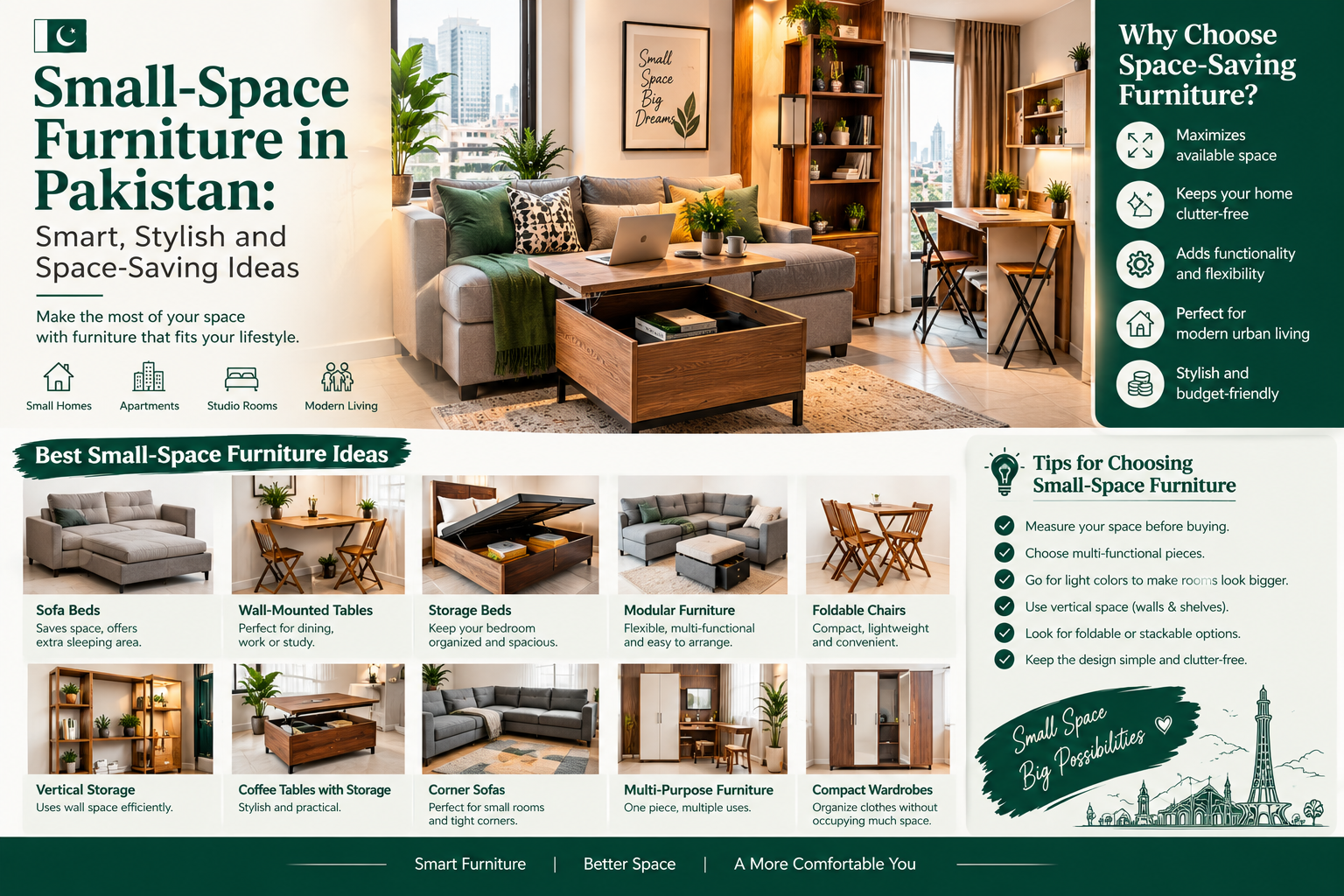
Small homes and apartments are becoming an important part of modern living in Pakistan. Whether it is a compact apartment in a busy city, a small family home, a student room, or a portion of a house, limited space can make furniture selection challenging. The good news is that a small room does not have to feel uncomfortable or unattractive. With the right furniture choices, even a limited space can become organized, functional, and stylish.
Furniture plays an especially important role in small homes because every piece takes up valuable floor space. Large sofas, oversized beds, wide cabinets, and unnecessary tables can quickly make a room feel crowded. On the other hand, compact furniture, multifunctional designs, wall-mounted storage, and customized pieces can help homeowners use available space more effectively.
Pakistan has a wide range of furniture options, including traditional wooden furniture, modern MDF designs, customized storage units, compact sofas, folding tables, and multifunctional furniture. Choosing the right combination can help create comfortable homes without sacrificing style.
This guide explores practical small-space furniture ideas for Pakistani homes and explains how to make the most of limited rooms.
Why Small-Space Furniture Matters
Furniture is not only about decoration. It affects how people move, work, relax, and store their belongings.
In a small room, every piece should ideally have a clear purpose.
For example, instead of using a large table only for decoration, homeowners can choose a compact table with storage. Instead of placing a separate cabinet in a bedroom, a wardrobe can include shelves and drawers.
This approach helps reduce unnecessary furniture while increasing functionality.
Measure Your Space First
The most important step before buying furniture for a small room is measuring the available space.
Measure:
Room length
Room width
Wall height
Door openings
Window positions
Available wall space
Existing furniture
Walking areas
Do not rely only on visual judgment.
A piece that looks small in a showroom may appear much larger inside a compact bedroom.
Taking measurements before shopping can prevent many furniture-related problems.
Choose Furniture According to Room Size
Small rooms need appropriately sized furniture.
A large sofa may dominate a small living room, while a compact sofa can leave enough space for movement.
Similarly, a large bed may reduce the available space for wardrobes and tables.
Choose furniture that provides the required function without occupying unnecessary floor area.
Multifunctional Furniture
Multifunctional furniture is one of the most useful solutions for small Pakistani homes.
A single furniture piece can perform two or more functions.
Examples include:
Storage beds
Sofa beds
Folding dining tables
Ottoman storage
Desk-and-shelf combinations
Beds with drawers
Wall-mounted desks
Cabinets with multiple storage sections
Multifunctional furniture can reduce the number of separate items needed in a room.
Storage Beds
Storage beds are particularly useful in compact bedrooms.
The area underneath the mattress can be designed with drawers, compartments, or lifting storage systems.
This space can be used for:
Bedding
Seasonal clothing
Blankets
Bags
Extra cushions
Other household items
A storage bed can reduce the need for additional cabinets.
Compact Sofas
The sofa is often the largest piece of furniture in a living room.
For a small living room, consider a compact sofa with an appropriate depth and width.
L-shaped sofas can also be useful in certain layouts because they can fit into corners and provide multiple seating positions.
However, the exact shape should depend on the room dimensions.
Sofa Beds
A sofa bed can provide seating during the day and sleeping space when needed.
This can be useful in:
Small apartments
Guest rooms
Studio-style spaces
Multipurpose rooms
Instead of maintaining separate furniture for seating and occasional sleeping, one piece can serve both purposes.
Folding Dining Tables
A large dining table can take up significant floor space.
Folding dining tables provide an alternative for smaller homes.
The table can remain compact when not in use and be expanded when needed.
This can be particularly useful for households that need dining space but do not want a large permanent table.
Wall-Mounted Desks
A traditional study table may require considerable floor space.
A wall-mounted desk can provide a practical working surface while leaving the floor more open.
It can be useful for:
Students
Home workers
Small bedrooms
Study corners
Shelves can be installed above the desk to provide additional storage.
Wall-Mounted Shelves
Wall-mounted shelves are useful because they use vertical space instead of taking up floor space.
They can hold:
Books
Decorative items
Small plants
Accessories
Study materials
Storage boxes
In small homes, vertical storage can make a significant difference.
Tall Wardrobes
A wardrobe does not always need to be very wide.
A tall wardrobe can use vertical space efficiently.
Additional upper shelves can be used for seasonal items or less frequently used belongings.
This approach can leave more floor space available for other furniture.
Sliding-Door Wardrobes
Traditional wardrobe doors require additional space to open.
Sliding-door wardrobes can be useful in compact bedrooms because the doors move horizontally rather than outward.
This can make the area directly in front of the wardrobe easier to use.
Mirrored sliding doors can also visually increase the sense of openness in a room.
Corner Furniture
Corners are often underused in small homes.
Corner shelves, cabinets, desks, and storage units can transform unused corners into functional areas.
A corner study desk, for example, can create a workspace without occupying the center of the room.
Nesting Tables
Nesting tables are designed so that smaller tables can fit underneath larger ones.
They can be separated when needed and stored together when not required.
This makes them useful for compact living rooms.
Ottoman Furniture
Ottomans can serve several purposes.
Depending on their design, an ottoman can function as:
Seating
Footrest
Small table
Storage
An ottoman with internal storage can be especially useful in a small living room.
Foldable Chairs
Foldable chairs can be stored when they are not needed.
They can be useful when a household occasionally needs additional seating for guests.
Instead of keeping many chairs permanently around the dining or living area, extra chairs can be folded and stored.
Compact Bedside Tables
A large bedside table may not be necessary in a small bedroom.
A narrow bedside table with a drawer or shelf can provide space for:
Books
Phone
Lamp
Small personal items
Wall-mounted bedside shelves can also be considered where floor space is extremely limited.
Under-Bed Storage
The space underneath a bed can be used efficiently even if the bed was not originally designed as a storage bed.
Storage boxes, organized containers, or drawers can help keep belongings out of sight.
This can be particularly useful for seasonal items.
Furniture with Built-In Storage
Furniture with integrated storage can help reduce clutter.
Examples include:
Benches with storage
TV units with cabinets
Beds with drawers
Coffee tables with compartments
Sofas with storage
Desks with shelves
These designs combine furniture and storage in a single footprint.
Modular Furniture
Modular furniture can be rearranged or adapted according to changing needs.
For example, modular shelving can be expanded or rearranged as storage requirements change.
Modular furniture can be particularly useful for young people, students, rented homes, and families whose needs change over time.
Custom Furniture for Small Pakistani Homes
Custom furniture can be an excellent option when standard furniture does not fit the room.
A local furniture maker can create pieces according to exact measurements.
For example, a narrow wall may be converted into a custom wardrobe, bookshelf, or storage cabinet.
A small bedroom can also benefit from a customized bed with integrated drawers and bedside storage.
Small Living Room Furniture
A small living room should maintain enough space for movement.
Instead of filling the room with many individual pieces, choose a few useful items.
A practical combination may include:
Compact sofa
Small coffee table
Wall-mounted TV unit
Narrow side table
Wall shelves
The goal is to create comfortable seating while keeping the floor visually open.
Small Bedroom Furniture
A small bedroom needs careful planning.
The bed should usually be selected first because it occupies the most important area.
After placing the bed, determine where the wardrobe, dressing table, and other storage can fit.
Furniture with multiple functions can reduce the need for additional pieces.
Small Kitchen Furniture
Kitchen furniture should maximize storage without making the kitchen difficult to use.
Tall cabinets can use vertical space.
Wall-mounted cabinets can provide storage without occupying the floor.
Pull-out drawers and organized shelves can make small kitchens more practical.
Compact dining solutions can also be integrated into the kitchen where appropriate.
Small Dining Areas
Not every home needs a separate dining room.
A small dining area can be created using:
Compact dining table
Foldable table
Wall-mounted table
Bench seating
Stackable chairs
A bench can sometimes provide seating while taking less visual space than several individual chairs.
Small Study Areas
A small study corner can be created with a narrow desk and wall-mounted shelves.
The desk should provide enough space for the intended work.
Cable management is also important because tangled cables can make a small area appear cluttered.
Furniture for Children's Small Rooms
Children's rooms often need to accommodate sleeping, studying, playing, and storage.
Space-saving furniture can help combine these functions.
Examples include:
Beds with drawers
Study desks with shelves
Tall wardrobes
Wall shelves
Compact bookcases
Storage should be easy to organize so that the room can remain practical.
Use Vertical Space
One of the most useful principles for small homes is to think vertically.
Walls can provide additional storage through:
Shelves
Cabinets
Wall-mounted desks
Hanging organizers
Tall wardrobes
Vertical bookcases
Using vertical space can reduce pressure on the floor area.
Keep the Floor Open
A small room can feel more spacious when more of the floor remains visible.
Wall-mounted furniture can help achieve this.
Examples include:
Floating shelves
Wall-mounted TV units
Floating desks
Wall-mounted cabinets
However, all wall-mounted furniture should be installed securely and appropriately for its intended load.
Choose Simple Designs
Highly detailed furniture can sometimes make a small room feel visually busy.
Simple designs with clean lines can create a more organized appearance.
Modern furniture with minimal decorative elements can work particularly well in compact interiors.
Traditional wooden furniture can also be used successfully if the number of pieces is carefully controlled.
Use Mirrors Carefully
Mirrors can help reflect light and create a greater sense of openness.
A wardrobe with mirrored doors can combine storage and visual reflection.
A decorative wall mirror can also make a compact room feel brighter.
The mirror should be positioned thoughtfully rather than simply adding more reflective surfaces.
Furniture Color for Small Rooms
Furniture color can affect the visual appearance of a room.
Light and neutral furniture can create an airy feeling.
Natural wood tones can add warmth.
Dark furniture can still work in small rooms, but too many dark and bulky pieces may make the space feel visually heavier.
A balanced color scheme can help maintain a comfortable atmosphere.
Choose Furniture That Matches the Room
Furniture should work with existing walls, flooring, curtains, lighting, and décor.
A compact modern room may benefit from simple furniture with clean lines.
A traditional Pakistani interior may look attractive with carefully selected wooden furniture.
The goal is not to fill the room but to create a coordinated environment.
Small Balcony Furniture
Balconies are another area where space-saving furniture can be useful.
Consider:
Folding chairs
Compact tables
Wall-mounted shelves
Narrow benches
Small storage units
Furniture should be selected according to the balcony's conditions and protected appropriately from weather exposure.
Small Entryway Furniture
A small entrance can become more functional with compact furniture.
A narrow shoe cabinet, wall-mounted hooks, or a small bench can provide useful storage without blocking the entrance.
A mirror can also provide a practical decorative element.
Small Bathroom Storage Furniture
Bathrooms generally have limited floor space.
Wall-mounted cabinets and narrow storage units can help organize:
Towels
Toiletries
Cleaning supplies
Personal-care items
Materials should be selected carefully because bathrooms experience moisture.
Small Office Furniture
For home offices, choose a desk that fits the available wall or corner.
Wall-mounted shelves can provide document and book storage.
A compact ergonomic chair should still provide sufficient comfort for its intended use.
The goal is to maintain a functional workspace without turning the entire room into an office.
Furniture for Rental Homes
Renters may prefer furniture that can be moved easily.
Lightweight modular furniture, compact tables, freestanding shelves, and multipurpose storage can be practical.
Furniture that does not require permanent structural changes may also be convenient for rented properties.
Choose Furniture According to Lifestyle
Furniture should reflect how a household actually lives.
A family that frequently hosts guests may need flexible seating.
A student may need a compact desk and bookshelf.
A family with children may prioritize storage.
Someone living in a studio apartment may need furniture that performs multiple functions.
There is no single furniture arrangement suitable for every home.
Avoid Unnecessary Furniture
One of the easiest ways to improve a small space is to reduce unnecessary furniture.
Before buying something, ask:
Do I really need it?
Where will it go?
What purpose will it serve?
Can another piece perform the same function?
Will it make movement difficult?
Thoughtful furniture selection can prevent overcrowding.
Quality Still Matters
Space-saving furniture should not mean low-quality furniture.
Even compact furniture needs proper construction.
Check:
Material
Joints
Hardware
Stability
Finishing
Weight capacity
Ease of use
A small piece of furniture may be used frequently, so construction quality remains important.
Budget-Friendly Small-Space Furniture
Small homes can be furnished effectively without purchasing the most expensive furniture.
Affordable options can include:
Simple MDF shelves
Compact tables
Second-hand wooden furniture
Modular storage
Basic storage benches
DIY-style organizers
However, buyers should still check quality and condition.
A low-cost piece that breaks quickly may not provide good long-term value.
Repurposing Existing Furniture
Before buying new furniture, consider whether existing pieces can be reused.
An old wooden cabinet may be refinished.
A small table can become a study desk.
An unused shelf can be moved to another room.
Repurposing can save money and reduce unnecessary furniture purchases.
Furniture and Organization
Good furniture design works together with good organization.
Even the best storage furniture can become ineffective if items are not organized.
Use separate sections for:
Daily-use items
Seasonal belongings
Books
Accessories
Documents
Household supplies
Organized storage helps small rooms remain functional.
Common Small-Space Furniture Mistakes
Buying Oversized Furniture
Large furniture can quickly consume the available floor space.
Ignoring Measurements
Always check dimensions before buying.
Using Too Many Tables
Small rooms rarely need multiple side tables and decorative tables.
Forgetting Storage
A beautiful room can become cluttered without sufficient storage.
Blocking Windows
Avoid placing large furniture where it unnecessarily blocks natural light.
Ignoring Movement
Leave enough room for comfortable movement between furniture pieces.
A Simple Small-Space Furniture Checklist
Before purchasing furniture for a compact room, check:
Room measurements
Furniture dimensions
Door and window positions
Walking space
Storage requirements
Material
Construction
Multifunctional features
Maintenance
Budget
Delivery
Assembly
Overall room appearance
Final Thoughts
Small-space living does not mean giving up comfort or style. The key is to choose furniture carefully and make every part of the room work efficiently.
Multifunctional furniture, storage beds, compact sofas, folding tables, wall-mounted shelves, tall wardrobes, modular furniture, and customized designs can all help Pakistani homeowners make better use of limited space.
The best small-space furniture is not necessarily the smallest furniture. It is furniture that provides the required function while fitting naturally into the room.
With proper measurements, thoughtful planning, suitable materials, and practical designs, even a compact Pakistani home can feel organized, comfortable, and welcoming.
Small spaces can have their own unique charm. By selecting furniture according to actual needs rather than simply following trends, homeowners can create interiors that are both stylish and practical.
FAQs
1. What furniture is best for small homes in Pakistan?
Multifunctional furniture such as storage beds, compact sofas, folding tables, wall-mounted desks, and modular storage can work well in small homes.
2. How can I save space with furniture?
Use vertical storage, multifunctional furniture, compact designs, built-in storage, and furniture that can be folded or rearranged.
3. Are storage beds useful for small bedrooms?
Yes. Storage beds can provide additional space for bedding, clothes, bags, and other household items without requiring a separate cabinet.
4. Is custom furniture good for small rooms?
Yes. Custom furniture can be designed according to exact room dimensions and can make use of otherwise unused corners and walls.
5. How can I make a small room look less crowded?
Choose appropriately sized furniture, keep walking areas open, avoid unnecessary pieces, use vertical storage, and select a coordinated furniture and color scheme.