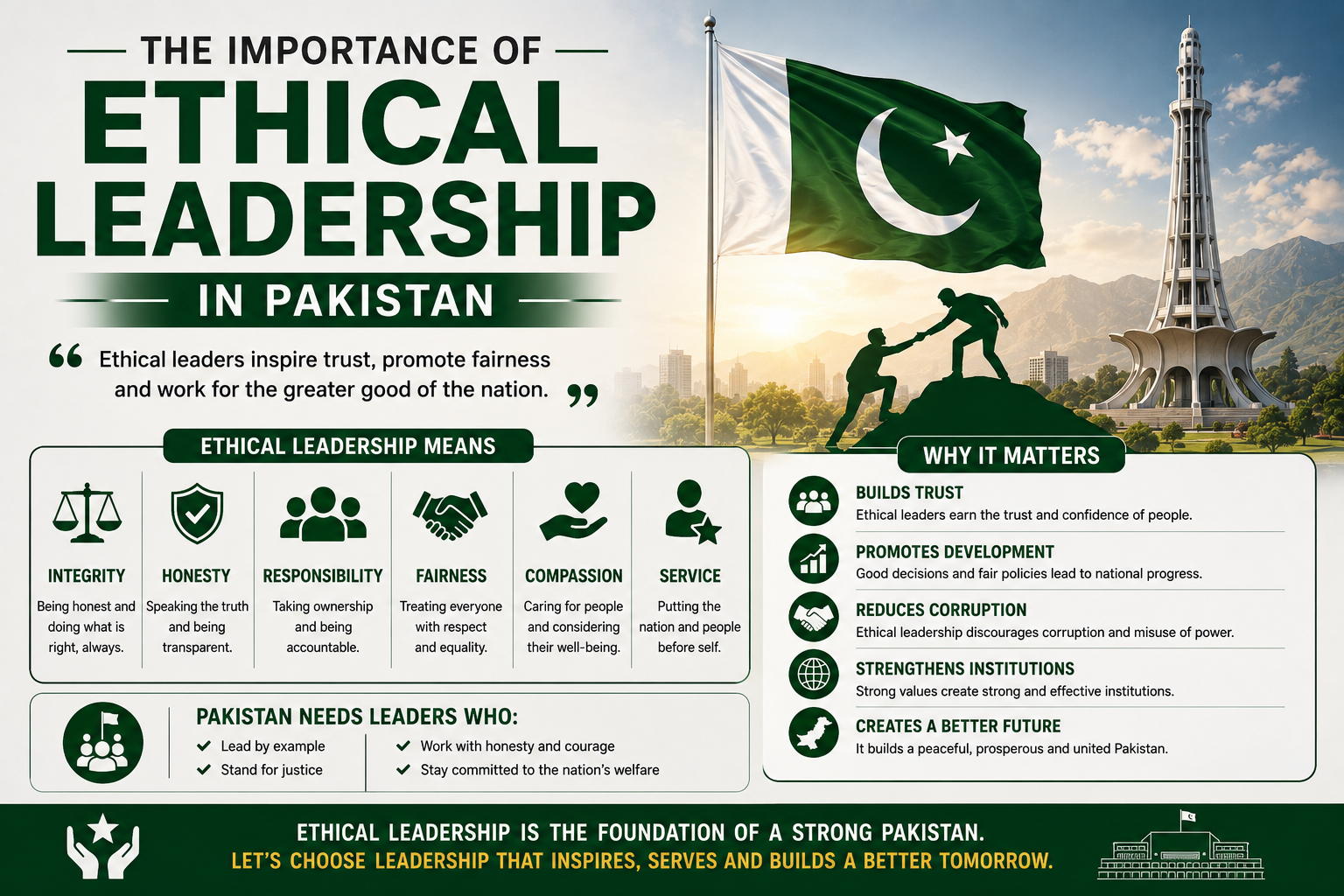
Leadership plays an important role in the development of every country. A leader can influence people, organizations and institutions through decisions, ideas and actions. However, leadership is not only about having authority or holding an important position. Good leadership also requires honesty, responsibility, fairness and strong moral values. This is where ethical leadership becomes important.
For Pakistan, ethical leadership can play a major role in improving society, strengthening institutions and creating opportunities for future generations. Whether in government, education, business, community organizations or schools, leaders who follow ethical principles can build trust and encourage others to act responsibly.
Pakistan has a talented and energetic population, especially its young generation. With the right leadership and guidance, this potential can contribute to economic growth, social development, education, innovation and national progress.
What Is Ethical Leadership?
Ethical leadership means leading people according to honesty, fairness, responsibility and moral principles.
An ethical leader does not use authority only for personal benefit. Instead, the leader considers the interests of the people and organization they are responsible for.
Ethical leadership includes:
Honesty
Integrity
Fairness
Accountability
Respect
Transparency
Responsibility
Good decision-making
Service to others
An ethical leader understands that leadership is a responsibility rather than simply a position of power.
Why Ethical Leadership Matters in Pakistan
Ethical leadership is important because trust is essential for the success of any society.
When people trust their leaders and institutions, they are more likely to cooperate with them and participate in development activities.
Ethical leadership can help Pakistan:
Strengthen institutions
Improve public trust
Encourage responsible citizenship
Support economic development
Improve organizational performance
Promote fairness
Develop future leaders
Encourage social cooperation
Good leadership can create a positive environment in which people feel motivated to contribute to society.
Leadership Is More Than Authority
A common misunderstanding is that a leader is simply a person who has power over others.
In reality, leadership is much broader.
A teacher can be a leader in a classroom. A business owner can lead employees. A student can lead a school project. A community member can organize a useful local activity.
These examples show that leadership exists at many levels.
Ethical leadership means using influence responsibly, regardless of how large or small the position may be.
Honesty as a Foundation of Leadership
Honesty is one of the most important qualities of an ethical leader.
Honest leaders communicate truthfully and avoid deliberately misleading people.
Honesty can create trust within organizations and communities.
When leaders are honest about both successes and challenges, people can better understand situations and contribute to solutions.
For Pakistan, promoting honesty in leadership can help create a culture where responsibility and trust are valued.
Integrity and Leadership
Integrity means remaining committed to ethical principles even when doing so is difficult.
A person with integrity tries to ensure that their actions match their values.
For example, a leader who talks about fairness should also make fair decisions.
Integrity is especially important when leaders face difficult choices.
A strong ethical foundation can help leaders make decisions based on principles rather than temporary pressure.
Accountability in Leadership
Accountability means accepting responsibility for one's decisions and actions.
Ethical leaders should be willing to explain their decisions and accept constructive criticism.
Accountability can also help organizations identify weaknesses and improve performance.
In public institutions, accountability is particularly important because decisions can affect large numbers of people.
A culture of accountability can encourage leaders and employees to take their responsibilities seriously.
Transparency and Trust
Transparency means providing clear and understandable information about decisions and processes.
When people understand how decisions are made, they may have greater confidence in institutions.
Transparency can be encouraged through clear procedures, accessible information and responsible communication.
It is an important part of ethical leadership because it reduces unnecessary confusion and encourages accountability.
Fairness in Leadership
An ethical leader should treat people fairly.
Fairness does not always mean giving everyone exactly the same thing. It means making decisions based on reasonable and relevant principles rather than personal favoritism.
In schools, businesses and institutions, fair treatment can improve morale and encourage people to perform better.
Fairness can also help create an environment where talented individuals have opportunities to succeed.
Respect for Others
Respect is another important quality of ethical leadership.
Leaders work with people who may have different opinions, backgrounds and experiences.
An ethical leader listens to others and treats them with dignity.
Respectful communication can reduce unnecessary conflict and encourage cooperation.
Pakistan is a diverse country, so respect and understanding are particularly important for social harmony.
Ethical Leadership in Education
Educational institutions play an important role in developing future leaders.
Teachers, principals and administrators can demonstrate ethical leadership through fairness, honesty and responsibility.
Students learn not only from textbooks but also from the behavior of adults around them.
When educational leaders demonstrate good values, students can learn the importance of responsibility and integrity.
Schools and colleges can also teach leadership through:
Debates
Student societies
Group projects
Community service
Sports
Research activities
These activities give students opportunities to practice leadership in practical situations.
The Role of Young People
Young people are an important part of Pakistan's future.
Developing ethical leadership among youth can help prepare the next generation for professional and community responsibilities.
Young people can practice leadership by:
Taking responsibility for projects
Helping others
Participating in community activities
Learning new skills
Working in teams
Communicating respectfully
Making responsible decisions
Leadership development can begin long before someone receives an official position.
Ethical Leadership and Technology
Technology has changed how leaders communicate with society.
Social media allows information to reach large audiences very quickly.
This creates opportunities but also responsibilities.
Ethical leaders should avoid spreading false or misleading information. They should communicate carefully and encourage responsible digital behavior.
Young people can also contribute by using technology for education, creativity, entrepreneurship and community development.
Ethical Leadership in Business
Business leaders have an important role in Pakistan's economy.
Ethical business leadership involves treating employees fairly, serving customers responsibly and following relevant laws and professional standards.
Businesses that develop a culture of trust and responsibility can create stronger relationships with employees and customers.
Ethical leadership can also encourage innovation because employees may feel more comfortable sharing ideas in a respectful environment.
Leadership and Economic Development
Ethical leadership can support economic development by creating a stable and trustworthy environment for businesses and investors.
Economic development requires:
Productive businesses
Skilled workers
Innovation
Investment
Strong institutions
Reliable systems
When organizations are managed responsibly, they can operate more efficiently and create opportunities for employment.
Ethical leadership can therefore contribute indirectly to economic growth.
Leadership and Entrepreneurship
Entrepreneurs are leaders because they take ideas and turn them into businesses or projects.
Ethical entrepreneurship means building businesses responsibly.
Young entrepreneurs can contribute to Pakistan by developing new products, creating jobs and solving community problems.
They also need leadership qualities such as:
Creativity
Confidence
Responsibility
Decision-making
Communication
Persistence
Ethical values can help entrepreneurs build businesses that benefit both customers and society.
Ethical Leadership in Public Service
Public servants have important responsibilities because their work affects citizens.
Ethical public leadership means focusing on service, responsibility and fairness.
Public institutions can work more effectively when employees understand their responsibilities and follow transparent procedures.
Citizens also benefit when public services are delivered professionally and responsibly.
Leadership and Strong Institutions
Ethical leadership can help strengthen institutions.
Institutions need clear rules, professional standards and accountability.
Leaders should work to improve systems rather than making organizations dependent on individual personalities.
Strong institutions provide continuity and can help countries deal with changing circumstances.
For Pakistan, institutional development is an important part of long-term progress.
Leadership and National Unity
Pakistan has many cultures, languages and traditions.
Ethical leaders can encourage cooperation and mutual respect.
Instead of focusing only on differences, responsible leadership can highlight shared goals such as education, economic opportunity, public welfare and national development.
Young people can play an important role in promoting positive communication among different communities.
Ethical Leadership and Social Responsibility
Leadership should involve service to society.
Social responsibility means understanding how decisions affect other people.
Community leaders can encourage activities such as:
Educational support
Environmental awareness
Volunteer work
Community improvement
Youth development
Such activities can strengthen communities while teaching young people valuable leadership skills.
Women and Ethical Leadership
Women can make important contributions to leadership in Pakistan.
Women work in education, healthcare, business, technology, law, science, administration and many other fields.
Providing opportunities for women to develop their leadership skills can help Pakistan make better use of its human potential.
Ethical leadership should focus on competence, responsibility and fairness.
Leadership and Environmental Responsibility
Environmental challenges require responsible decision-making.
Leaders in government, business and communities can encourage better use of natural resources.
Environmental leadership can include:
Water conservation
Waste reduction
Clean energy
Tree planting
Pollution awareness
Sustainable development
Young people can also participate in environmental projects and awareness campaigns.
The Importance of Listening
Good leadership is not only about speaking.
It is also about listening.
Ethical leaders should listen to employees, students, citizens and community members.
Listening can help leaders understand problems that they may not see themselves.
It also makes people feel respected and included.
Decision-Making and Ethics
Leaders often have to make difficult decisions.
Ethical decision-making requires considering both immediate and long-term consequences.
Before making an important decision, a leader can ask:
Is this decision fair?
Is it honest?
Who will be affected?
Is the information reliable?
Does it follow established rules?
Will it create long-term benefits?
These questions can help leaders make more responsible choices.
Ethical Leadership and Accountability
Accountability and ethical leadership are closely connected.
A leader who accepts responsibility for mistakes can learn from them and improve future decisions.
Trying to hide every mistake can create bigger problems.
Organizations can benefit when mistakes are examined constructively and systems are improved.
The Role of Families
Families are the first place where many values are learned.
Parents and guardians can teach children honesty, respect, responsibility and kindness.
These values can become the foundation of ethical leadership later in life.
Young people who learn to take responsibility for their actions can become more confident and reliable adults.
The Role of Teachers
Teachers can influence students for many years.
A teacher who demonstrates fairness and respect can become an example of ethical leadership.
Teachers can encourage students to:
Think independently
Respect others
Complete responsibilities
Work in teams
Solve problems
Help their communities
These habits can prepare students for future leadership roles.
Challenges to Ethical Leadership
Developing ethical leadership can be difficult.
Some challenges include:
Lack of leadership training
Many people receive professional education but limited training in leadership and ethics.
Short-term thinking
Leaders may sometimes focus on immediate results instead of long-term benefits.
Lack of accountability
Weak accountability systems can make responsible leadership more difficult.
Misinformation
The rapid spread of incorrect information can make responsible decision-making challenging.
Limited opportunities for youth
Young people may have leadership potential but lack opportunities to gain practical experience.
Addressing these challenges requires cooperation between educational institutions, businesses, government and communities.
How Pakistan Can Promote Ethical Leadership
Pakistan can promote ethical leadership through several practical steps.
1. Teach Ethics in Education
Schools and universities can include discussions about honesty, responsibility and ethical decision-making.
2. Develop Leadership Programmes
Students and young professionals can benefit from leadership training and mentorship.
3. Encourage Community Service
Volunteering can teach responsibility and empathy.
4. Strengthen Accountability
Organizations should have clear systems for responsibility and performance.
5. Promote Transparency
Institutions should communicate important decisions clearly.
6. Support Youth Participation
Young people should have opportunities to contribute to constructive projects.
7. Encourage Professional Standards
Businesses and organizations should promote ethical behavior among employees and managers.
Ethical Leadership and the Future of Pakistan
Pakistan's future will depend greatly on the quality of its leaders.
Future leaders will work in different sectors, including technology, education, business, healthcare, law, science, agriculture and public service.
They will face new challenges created by technology, climate change, economic competition and changing social needs.
These leaders will need more than technical knowledge.
They will need character.
They will need to understand how their decisions affect other people.
They will need to communicate clearly, work with diverse teams and remain responsible under pressure.
This is why ethical leadership should be developed from an early age.
Building a Culture of Leadership
Pakistan can build a stronger leadership culture by encouraging people at every level to take responsibility.
Leadership should not be seen as something limited to powerful positions.
Students can lead school projects.
Employees can take responsibility for workplace improvements.
Entrepreneurs can create useful businesses.
Community members can organize local initiatives.
Teachers can inspire students.
Each of these activities contributes to a culture of responsible leadership.
Leadership Through Service
One of the most important ideas in ethical leadership is service.
A leader should ask not only, "What can I achieve?" but also, "How can I help others?"
Service-oriented leadership can create stronger relationships between leaders and communities.
It encourages leaders to understand people's needs and focus on meaningful results.
The Connection Between Character and Leadership
Skills can make someone a capable professional, but character helps determine how those skills are used.
A highly skilled person without responsibility may make poor decisions.
An ethical leader combines knowledge with good values.
This combination can help leaders use their abilities for constructive purposes.
Developing Responsible Future Leaders
Pakistan can prepare future leaders by giving young people opportunities to practice responsibility.
Schools and universities can provide leadership projects.
Businesses can provide internships.
Community organizations can offer volunteering opportunities.
Mentors can guide young people.
Families can encourage responsible decision-making.
Together, these experiences can help create confident and ethical leaders.
Conclusion
Ethical leadership is essential for Pakistan's long-term development. It can help strengthen institutions, improve public trust, support economic growth and encourage social cooperation.
A good leader is not simply someone who has authority. A good leader is someone who uses responsibility wisely, treats people fairly, communicates honestly and works toward meaningful goals.
Pakistan needs leaders who value integrity, accountability, transparency, respect and service.
Developing such leadership should begin early. Schools, families, universities, businesses and communities all have a role to play.
Young people especially need opportunities to develop leadership skills through education, teamwork, volunteering, entrepreneurship and practical experience.
The future of Pakistan will be shaped by people who are willing to take responsibility and contribute positively to society.
Ethical leadership can provide an important foundation for that future.
When leaders act with honesty and responsibility, they can inspire others to do the same. When institutions become more accountable and transparent, public confidence can improve. When young people receive opportunities to lead, they can develop the skills needed for tomorrow.
Ultimately, ethical leadership is not about power—it is about responsibility, character and service. By promoting these values across society, Pakistan can develop stronger leaders and create a more stable, productive and hopeful future.
5 FAQs
1. What is ethical leadership?
Ethical leadership means leading with honesty, fairness, responsibility and strong moral values.
2. Why is ethical leadership important in Pakistan?
It can strengthen trust, improve institutions and support social and economic development.
3. What are the qualities of an ethical leader?
Honesty, integrity, accountability, fairness, respect, transparency and responsibility are important qualities.
4. How can young people develop ethical leadership?
They can develop it through education, teamwork, volunteering, mentorship and practical experience.
5. How can Pakistan promote ethical leadership?
Pakistan can promote it through better education, leadership training, strong accountability systems and opportunities for youth participation.