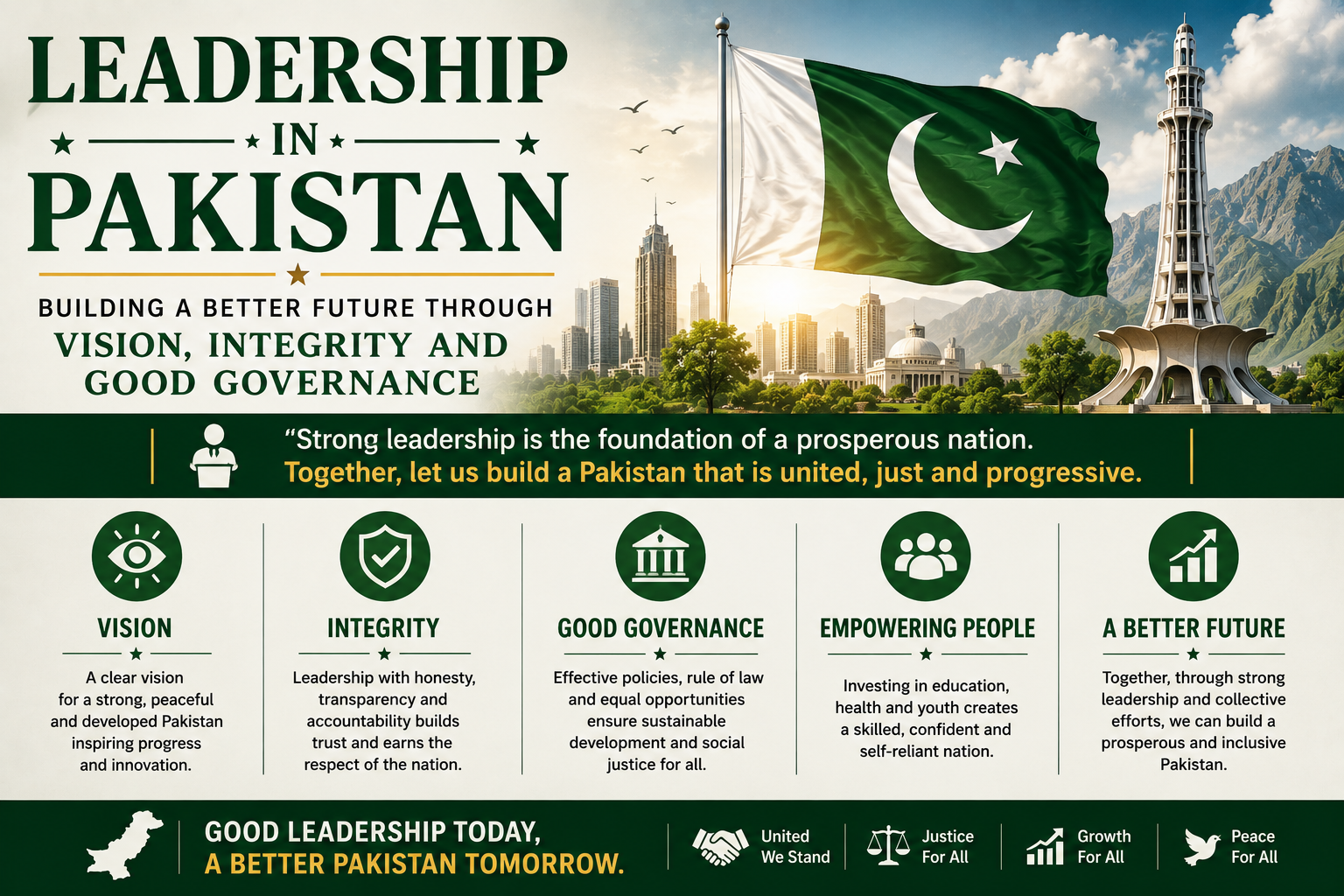
Leadership is one of the most important factors in the progress of any country. A nation can have natural resources, talented people, modern technology and a large economy, but without responsible and effective leadership, it can struggle to turn its potential into long-term development. For Pakistan, leadership is especially important because the country has a young population, a growing economy and significant opportunities in education, technology, agriculture, tourism and entrepreneurship.
Leadership in Pakistan is not limited to politics. It can be found in schools, universities, businesses, communities, government institutions and families. A teacher who inspires students, an entrepreneur who creates jobs, a student who leads a community project and a public servant who works honestly are all examples of leadership.
This article explores the importance of leadership in Pakistan, the qualities of effective leaders, the role of young people, education, good governance, technology, entrepreneurship and institutions, and the ways Pakistan can develop stronger leadership for the future.
What Is Leadership?
Leadership is the ability to guide, motivate and work with people to achieve a common goal.
A leader is not simply someone who has authority. True leadership involves responsibility, decision-making, communication and service.
A good leader listens to others, understands problems, considers different opinions and works toward practical solutions.
Leadership can take many forms. Political leaders influence public policies, business leaders manage organizations, educational leaders develop students, and community leaders work to solve local problems.
The common factor is the ability to positively influence others and take responsibility.
Why Leadership Matters in Pakistan
Pakistan has enormous potential. The country has a large young population, agricultural resources, a strategic geographical location, talented professionals and opportunities in technology and business.
However, potential alone does not guarantee progress.
Effective leadership can help Pakistan make better use of its resources and develop long-term strategies.
Strong leadership can contribute to:
Better governance
Economic development
Quality education
Job creation
Strong institutions
Technological progress
Social development
National unity
Greater accountability
Sustainable growth
Leadership is therefore important not only for solving current problems but also for preparing Pakistan for future challenges.
Qualities of a Good Leader
A successful leader needs more than popularity or authority. Several qualities are essential for effective leadership.
1. Vision
A good leader needs a clear vision.
Vision means understanding where an organization or country should go in the future.
A leader with vision does not focus only on today's problems. They also think about what the next generation will need.
For Pakistan, long-term vision could include better education, stronger institutions, modern infrastructure, technological development and a competitive economy.
2. Integrity
Integrity means being honest and following strong ethical principles.
People are more likely to trust leaders who are consistent in their words and actions.
Integrity is especially important in public leadership because decisions can affect large numbers of people.
A leader should understand that public responsibility is more important than personal benefit.
3. Accountability
Accountability means accepting responsibility for decisions and actions.
Good leaders should be willing to explain their decisions and accept criticism when necessary.
Accountability also applies to institutions.
When organizations have transparent systems, responsibilities become clearer and performance can improve.
4. Communication Skills
Communication is a major part of leadership.
A leader needs to explain ideas clearly, listen to people and respond to concerns.
Poor communication can create misunderstandings and reduce trust.
Modern leaders also need to understand digital communication because social media and online platforms have become major sources of information.
5. Decision-Making
Leaders often have to make difficult decisions.
Good decision-making requires information, careful thinking and an understanding of possible consequences.
A strong leader does not make decisions simply because they are popular. They consider evidence and long-term effects.
6. Teamwork
No leader can achieve major goals alone.
Effective leaders build strong teams and recognize the abilities of others.
Pakistan's development requires cooperation between government institutions, businesses, educational organizations and communities.
Teamwork allows different people to contribute their knowledge and experience.
Leadership and Good Governance
Good governance is one of the most important elements of national development.
Governance refers to how institutions make decisions, manage resources and provide services to citizens.
Effective leadership can improve governance by encouraging:
Transparency
Accountability
Efficiency
Rule-based decision-making
Public service
Institutional responsibility
Good governance does not depend entirely on one person. It requires systems that continue working effectively over time.
Strong Institutions and Strong Leadership
A country needs strong institutions to maintain stability.
Institutions include schools, universities, courts, government departments, regulatory bodies and other organizations.
Strong institutions have clear rules, professional staff and systems of accountability.
Leadership should focus on strengthening institutions rather than making everything dependent on individual personalities.
When institutions become stronger, governments and organizations can function more effectively even when leadership changes.
The Role of Education in Developing Leaders
Education is one of the most powerful tools for developing future leaders.
Schools and universities should not only teach academic subjects. They should also help students develop practical skills.
Important leadership skills include:
Critical thinking
Communication
Problem-solving
Teamwork
Creativity
Time management
Decision-making
Responsibility
Students can develop these skills through debates, presentations, sports, student societies, research projects and community activities.
Education should encourage students to ask questions and understand problems instead of simply memorizing information.
Youth Leadership in Pakistan
Young people have an important role in Pakistan's future.
Youth leadership can contribute to technology, entrepreneurship, education, social development and community service.
Young people can become leaders by starting businesses, developing digital skills, participating in volunteer activities or creating solutions to local problems.
Leadership does not require a government position.
A student who organizes a useful school project is practicing leadership. A young entrepreneur creating employment is demonstrating leadership. A volunteer helping their community is also contributing through leadership.
Technology and Modern Leadership
Technology has transformed leadership.
Today, leaders can communicate with people through websites, social media and digital platforms.
Technology also provides opportunities for young Pakistanis to learn skills and work with international organizations.
Fields such as:
Artificial intelligence
Software development
Cybersecurity
Digital marketing
E-commerce
Data analysis
Online education
can provide new opportunities for economic growth.
Future leaders therefore need digital awareness and the ability to understand technological change.
Leadership and Entrepreneurship
Entrepreneurship is another important area of leadership.
Entrepreneurs identify problems and develop products or services to solve them.
They also take responsibility for their decisions and manage teams.
Pakistan can benefit from more young entrepreneurs because successful businesses can contribute to employment and economic activity.
Entrepreneurship education can teach young people about business planning, financial management, marketing and customer needs.
Universities and business organizations can support this process through training and mentorship.
Leadership and Economic Development
Strong leadership can support economic development by creating an environment where businesses can operate and investment can grow.
Pakistan needs long-term economic strategies that encourage:
Business growth
Investment
Exports
Innovation
Skills development
Industrial development
Digital services
Economic leadership should focus on sustainable growth rather than temporary solutions.
A stable economic environment can encourage businesses to invest and create jobs.
Leadership and Job Creation
Employment is an important issue for young people.
Leaders can support job creation by encouraging entrepreneurship, investment and skills development.
Education should also be connected to market needs.
Technical and vocational training can help young people develop practical skills.
Businesses can contribute through internships, apprenticeships and training programmes.
A skilled workforce can improve productivity and strengthen the economy.
Women and Leadership in Pakistan
Women are an important part of Pakistan's social and economic development.
Women can contribute as teachers, doctors, lawyers, entrepreneurs, scientists, researchers, administrators and professionals.
Creating opportunities for women to develop leadership skills can strengthen families, communities and the economy.
Leadership opportunities should be based on competence, responsibility and ability.
Leadership in Rural Communities
Leadership development should not be limited to large cities.
Pakistan's rural areas also have talented young people who can contribute to agriculture, education, entrepreneurship and community development.
Improved internet access can provide rural youth with educational and professional opportunities.
Modern agricultural technology can also create opportunities for young people interested in farming and agribusiness.
Local leadership can help communities identify and solve their own problems.
Leadership and Agriculture
Agriculture remains an important part of Pakistan's economy.
Leadership in agriculture can involve adopting modern technology, improving water management and developing better supply chains.
Young people can contribute through agricultural entrepreneurship and technology.
Digital tools can help farmers access information about markets, weather and modern farming methods.
Innovative leadership can therefore contribute to agricultural productivity.
Leadership and Tourism
Pakistan has significant tourism potential because of its mountains, valleys, historical locations, cultural heritage and diverse landscapes.
Leadership can help develop tourism by improving infrastructure, promoting responsible tourism and supporting local businesses.
Young entrepreneurs can contribute through hospitality businesses, travel services, digital tourism platforms and content creation.
Responsible tourism leadership should also focus on protecting natural and cultural heritage.
Leadership and Environmental Responsibility
Environmental issues require long-term leadership.
Pakistan faces challenges involving water resources, pollution, waste management and climate-related risks.
Effective leadership can encourage environmental awareness and responsible resource use.
Young people can participate in tree planting, recycling, water conservation and community awareness projects.
Businesses can also contribute by adopting more efficient and environmentally responsible practices.
Leadership and National Unity
Pakistan is a diverse country with different languages, cultures and traditions.
Strong leadership can help create unity while respecting diversity.
Leaders can encourage cooperation and mutual respect.
Young people can contribute by participating in cultural activities, educational programmes and community projects.
National unity becomes stronger when people focus on shared goals and respect differences.
The Role of Teachers in Leadership Development
Teachers have a powerful influence on future leaders.
A teacher can inspire students to work hard, think independently and take responsibility.
Teachers can also encourage students to participate in debates, presentations, competitions and community activities.
A supportive teacher can help students discover their strengths and develop confidence.
This makes education one of the most important areas for long-term leadership development.
The Role of Families
Leadership development begins at home.
Families can teach children important values such as honesty, responsibility, respect and cooperation.
Young people should also be encouraged to make appropriate decisions and learn from mistakes.
Parents and guardians can support leadership development by encouraging education, reading, constructive activities and healthy communication.
The Role of Businesses
The private sector can play an important role in developing future leaders.
Businesses can provide:
Internships
Training
Mentorship
Career opportunities
Entrepreneurship support
Professional development
Companies can also work with universities to help students understand workplace requirements.
Such partnerships can make education more practical.
The Role of Government
Government institutions have an important responsibility in creating an environment where leadership can develop.
This includes improving education, supporting youth development, encouraging entrepreneurship and strengthening institutions.
Youth-focused programmes can provide training, employment and development opportunities.
However, programmes are most effective when they are transparent, accessible and implemented properly.
Leadership and Accountability
Accountability is essential for building public confidence.
Leaders should be answerable for their decisions.
Transparent systems can help organizations identify problems and improve performance.
Accountability should apply across different sectors, including government, businesses and educational institutions.
A culture of responsibility can strengthen leadership at every level.
Leadership and Ethics
Ethical leadership is particularly important for Pakistan's future.
A leader should understand that authority is a responsibility.
Ethical leadership includes:
Honesty
Fairness
Respect
Responsibility
Transparency
Service
A leader who follows ethical principles can create a positive example for others.
Leadership in the Digital Age
The digital age has created both opportunities and challenges.
Young people can access enormous amounts of information, but not all online information is accurate.
Future leaders need digital literacy so they can evaluate information carefully.
Responsible digital leadership means communicating respectfully, checking information and using technology for productive purposes.
Leadership and Critical Thinking
Critical thinking allows leaders to analyze information before making decisions.
A critical thinker asks:
What is the evidence?
What are the possible consequences?
Are there different viewpoints?
Is the information reliable?
What solution is practical?
Developing these habits can help young people make better decisions in their personal and professional lives.
Leadership and Innovation
Innovation can help Pakistan address longstanding challenges.
Innovation can involve creating new technologies or finding better ways to use existing resources.
Young people can contribute innovative ideas in:
Education
Agriculture
Healthcare
Energy
Transportation
Technology
Tourism
Universities and businesses can encourage innovation through research programmes, competitions and entrepreneurship initiatives.
Challenges Facing Pakistani Leadership
Developing effective leadership is not easy.
Pakistan faces several challenges, including:
Limited access to quality education
Not every young person has equal access to educational opportunities.
Skills gaps
There can be a difference between what students learn and what employers require.
Unemployment
Limited employment opportunities can make it difficult for young people to gain professional experience.
Lack of mentorship
Many young people have talent but lack experienced people to guide them.
Institutional challenges
Weak systems can make effective leadership more difficult.
Economic pressures
Economic uncertainty can limit investment and development opportunities.
These challenges require long-term solutions.
How Pakistan Can Develop Better Leaders
Pakistan can strengthen leadership by taking several practical steps.
Improve Education
Schools and universities should focus on critical thinking, communication and practical skills.
Expand Skills Training
Technical and digital training can prepare young people for modern careers.
Encourage Entrepreneurship
Young entrepreneurs should have access to education, mentorship and suitable financial opportunities.
Promote Community Service
Volunteering can develop responsibility, teamwork and empathy.
Create Mentorship Programmes
Experienced professionals can guide young people in their education and careers.
Support Innovation
Research centres and innovation programmes can encourage new ideas.
Strengthen Institutions
Strong institutions can provide stability and improve governance.
Encourage Ethical Leadership
Integrity and accountability should be central to leadership development.
The Future of Leadership in Pakistan
The future of Pakistan's leadership will depend greatly on how the country develops its people and institutions.
Young Pakistanis are growing up in a rapidly changing world. Technology, globalization and new industries are creating opportunities that previous generations did not have.
At the same time, future leaders will face complex challenges.
They will need to understand technology, economics, environmental issues and social development.
Most importantly, they will need strong character and a sense of responsibility.
The future leader of Pakistan may be a politician, scientist, teacher, entrepreneur, engineer, lawyer, doctor, researcher or community worker.
Leadership can emerge from every profession.
A Simple Leadership Roadmap for Young Pakistanis
Young people who want to become better leaders can start with simple steps:
Learn continuously – Develop knowledge and useful skills.
Communicate clearly – Learn to speak and listen effectively.
Take responsibility – Complete tasks honestly and on time.
Help others – Leadership should involve service.
Think critically – Do not accept every piece of information without checking it.
Work in teams – Learn how to cooperate with different people.
Accept mistakes – Use mistakes as opportunities to improve.
Stay ethical – Choose honesty even when it is difficult.
Use technology wisely – Turn digital tools into opportunities for learning and productivity.
Think long-term – Focus on goals that can create lasting benefits.
Conclusion
Leadership is one of the most important foundations for Pakistan's future. Effective leadership can help improve governance, education, economic development, technology, entrepreneurship and social progress.
However, leadership is not only the responsibility of politicians or senior officials. It is a responsibility shared by teachers, students, parents, entrepreneurs, professionals, community members and institutions.
Pakistan needs leaders who can think beyond short-term interests and focus on long-term national development. Such leaders should have vision, integrity, accountability, communication skills, courage, knowledge and a commitment to serving others.
Young people have a particularly important role in this journey. With quality education, practical skills, mentorship and meaningful opportunities, they can become the leaders Pakistan needs in the coming decades.
The country can build a stronger future by investing in people and institutions today. Strong schools can create knowledgeable citizens. Strong businesses can create jobs. Strong institutions can provide stability. Responsible communities can promote cooperation.
Ultimately, the strength of Pakistani leadership will depend not simply on who holds a position of authority, but on how responsibly that authority is used.
A better Pakistan can be built through leadership that values knowledge over ignorance, service over personal interest, cooperation over division and long-term progress over short-term gains.
When responsible leadership becomes a shared value across society, Pakistan can make better use of its human potential and move toward a more stable, productive and prosperous future.
5 FAQs
1. Why is leadership important in Pakistan?
Leadership can help Pakistan improve governance, economic development, education, institutions and social progress.
2. What are the qualities of a good leader?
Important qualities include honesty, vision, responsibility, communication, teamwork, accountability and good decision-making.
3. How can young Pakistanis develop leadership skills?
They can develop leadership through education, teamwork, volunteering, entrepreneurship, communication and practical experience.
4. What is the role of education in leadership?
Education develops knowledge, critical thinking, communication and problem-solving skills that are important for future leaders.
5. How can Pakistan develop better leaders?
Pakistan can develop better leaders by improving education, supporting youth, strengthening institutions, promoting mentorship and encouraging ethical leadership.