Introduction
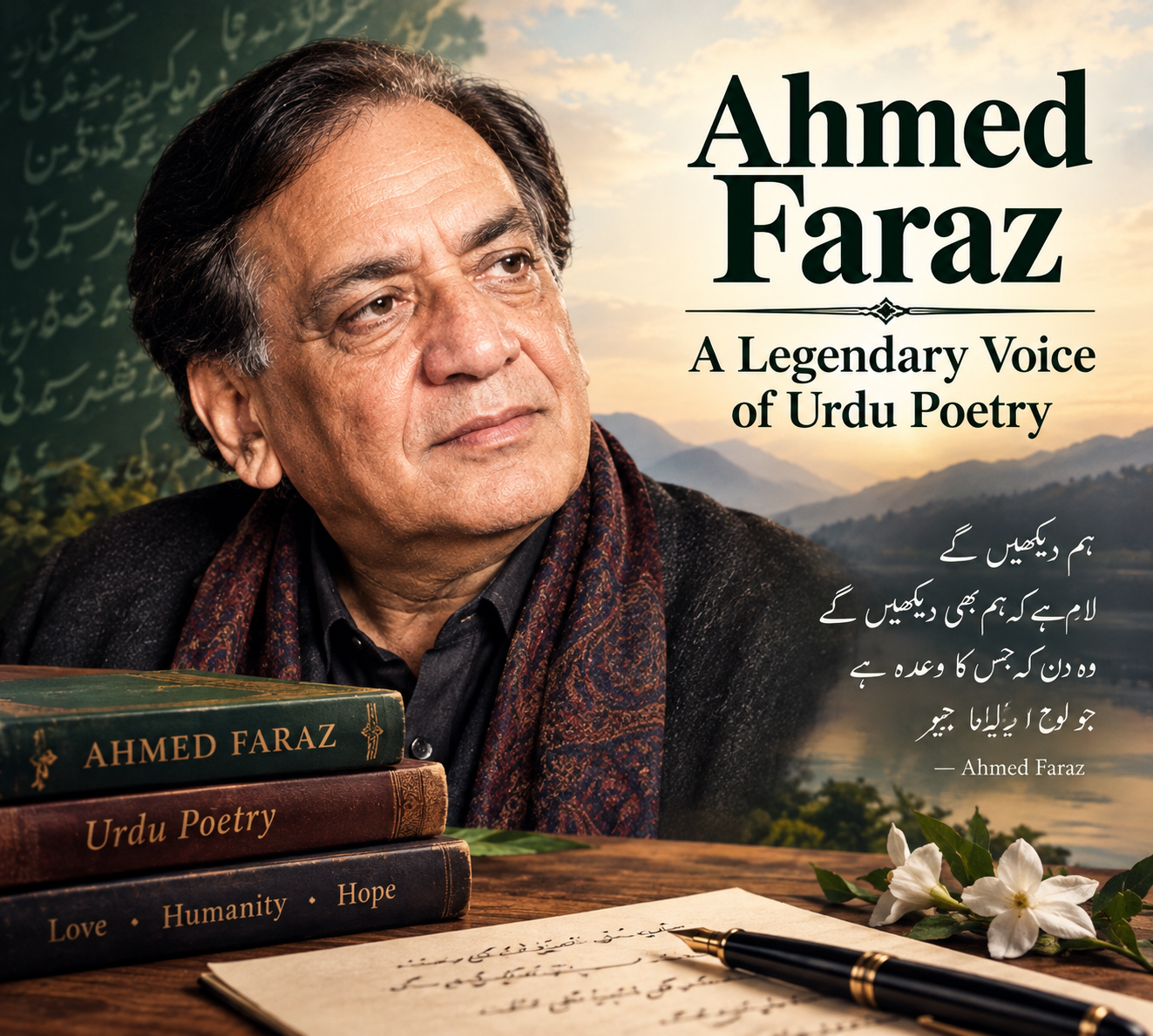
Ahmed Faraz was one of the most famous Urdu poets of Pakistan. He is remembered for his beautiful and emotional poetry, especially his poems about love, separation, loneliness, hope, and human feelings. At the same time, he also used poetry to express his thoughts about society, freedom, injustice, and difficult political circumstances.
Faraz had a special ability to describe complicated emotions in beautiful and understandable Urdu. His poetry could make readers feel the happiness of love, the sadness of separation, and the hope of meeting someone again. This emotional quality made him especially popular among young people.
Although Ahmed Faraz is often remembered as a romantic poet, his literary personality was much broader. He was also a socially and politically conscious writer. He believed that literature could play an important role in society. His poetry therefore contains both personal emotions and wider human concerns.
Ahmed Faraz was born as Syed Ahmed Shah in 1931 in Kohat, which was then part of British India and is now in Khyber Pakhtunkhwa, Pakistan. He later became famous under his literary name, Ahmed Faraz.
Throughout his life, he experienced important political and social changes. These experiences influenced his poetry and writing. His work became an important part of modern Urdu literature.
Early Life of Ahmed Faraz
Ahmed Faraz was born into a respected family in Kohat. His early life was influenced by the culture and literary traditions of the region.
From a young age, Faraz developed an interest in poetry and literature. Urdu poetry already had a long and rich tradition, with famous poets such as Mir Taqi Mir, Mirza Ghalib, Allama Iqbal, and others influencing generations of readers.
Faraz studied classical poetry and gradually developed his own literary style. He admired the beauty of traditional Urdu poetry but wanted to express the feelings and problems of modern life.
His early interest in literature eventually became the foundation of his professional literary career.
Education
Ahmed Faraz received his early education in Kohat. He later moved to Peshawar for higher education.
He studied at Edwards College and the University of Peshawar. His university years were particularly important because he came into contact with literature, poetry, intellectual discussions, and other young writers.
During this period, his interest in poetry became stronger. He began writing seriously and participating in literary activities.
His education also exposed him to different literary traditions. He developed an understanding of both classical Urdu poetry and modern literary ideas.
This combination later became an important characteristic of his writing.
Beginning of His Poetry Career
Ahmed Faraz started writing poetry when he was young. His talent gradually attracted attention in literary circles.
He became particularly famous for the Urdu ghazal. The ghazal is one of the most important forms of Urdu poetry and traditionally deals with subjects such as love, longing, beauty, separation, and emotional pain.
Faraz used the traditional ghazal form but gave it a modern voice. His poetry did not feel distant or old-fashioned to younger readers. Instead, his words often felt like the expression of real emotions experienced by ordinary people.
His popularity grew through poetry collections, literary gatherings, and mushairas.
Meaning of His Pen Name
Ahmed Faraz used "Faraz" as his literary pen name, or takhallus. The name became so closely associated with him that most readers knew him simply as Ahmed Faraz.
Using a pen name is a traditional practice in Urdu poetry. Poets often use their takhallus in their poetry as a literary identity.
For Faraz, the name became part of his lasting literary reputation.
Romantic Poetry
Love is one of the most important themes in Ahmed Faraz's poetry.
He wrote about the beauty of love, emotional attachment, memories, longing, separation, and the difficulties that can exist in relationships.
His romantic poetry is not simply about happiness. It also explores the pain and uncertainty that can come with love.
This emotional balance is one reason his poetry became popular. Readers could recognize their own feelings in his words.
Faraz's poetry often presents love as a powerful human experience. It can bring happiness, but it can also create sadness and longing.
His ability to express these emotions made him one of the most recognizable romantic voices in modern Urdu poetry.
Poetry About Separation
Separation is another major theme in Faraz's work.
Urdu poetry has a long tradition of discussing separation from a beloved. Faraz continued this tradition but expressed it in a contemporary way.
His poems often describe waiting, memories, emotional distance, silence, and the desire to reconnect.
These emotions are universal. People from different cultures and generations can understand the feelings associated with missing someone important.
This universality helped Faraz's poetry remain popular long after it was first written.
Social Awareness
Ahmed Faraz was not only interested in personal emotions. He also cared about society and the problems faced by ordinary people.
His writing sometimes addressed injustice, political restrictions, inequality, and freedom.
He believed that poets and writers could contribute to social awareness through literature.
This made his poetry different from poetry focused only on romance.
His work demonstrated that a poet could write about love while also caring deeply about society.
Political Expression
Faraz lived through several important political periods in Pakistan. Political conditions influenced his writing and public life.
He sometimes expressed disagreement with political policies and restrictions. His outspoken literary voice created difficulties for him during certain periods.
His poetry became associated with freedom of expression and resistance to restrictions on writers.
However, his political poetry remained connected to his broader concern for humanity and dignity.
Exile and Difficult Times
Ahmed Faraz experienced difficult periods because of his literary and political views. At one stage of his life, he spent time outside Pakistan.
Living away from one's homeland can create feelings of loneliness, separation, and homesickness. Such experiences also influenced Faraz's writing.
His personal experiences became part of the emotional world of his poetry.
Rather than keeping his poetry limited to personal experiences, he transformed them into emotions that other people could understand.
Ahmed Faraz and Mushairas
Ahmed Faraz was a popular participant in Urdu mushairas.
A mushaira is a gathering where poets recite their poetry before an audience. Mushairas have played an important role in the development and popularity of Urdu poetry.
Faraz had a strong ability to connect with audiences. His poetry was emotional, memorable, and suitable for public recitation.
People enjoyed listening to his poetry because his verses often expressed feelings that they themselves had experienced.
His popularity at mushairas helped him reach audiences beyond readers of poetry books.
Famous Poetry Collections
Ahmed Faraz wrote many poetry collections throughout his career.
Some of his well-known works include:
Tanha Tanha
Dard-e-Aashob
Shab-e-Khoon
Janan Janan
Nayaft
Be-Aawaz Gali Kuchon Mein
Mere Khwab Reza Reza
Sab Aawazain Meri Hain
These collections demonstrate the range of his literary work.
Some poems focus heavily on love and emotions, while others contain social, political, and philosophical themes.
"Ranjish Hi Sahi"
One of the most famous ghazals associated with Ahmed Faraz is "Ranjish Hi Sahi."
The poem expresses the desire to reconnect after emotional distance. It contains feelings of longing, sadness, and hope.
The popularity of this ghazal has continued for decades. Different singers have performed it, introducing the poetry to audiences who may not normally read Urdu poetry.
Its continued popularity shows the emotional strength of Faraz's writing.
"Suna Hai Log Usay Aankh Bhar Ke Dekhte Hain"
Another well-known poem associated with Ahmed Faraz is "Suna Hai Log Usay Aankh Bhar Ke Dekhte Hain."
The poem presents admiration for the beloved and creates an atmosphere of curiosity and longing.
The language is elegant but accessible. This combination is one of the reasons Faraz's poetry became so popular.
His ability to create strong emotional images with relatively simple language is an important part of his literary style.
Language of Ahmed Faraz
The language of Ahmed Faraz's poetry is one of its greatest strengths.
He used beautiful Urdu vocabulary, metaphors, and imagery, but his poetry often remained understandable to ordinary readers.
He did not rely only on complicated expressions. Instead, he used familiar emotions and situations.
This helped him reach a wide audience.
His poetry can be enjoyed by people with a strong knowledge of Urdu literature as well as people who are simply interested in emotional poetry.
Literary Style
Faraz's literary style combines traditional Urdu poetry with modern sensibilities.
He respected classical poetic forms, especially the ghazal, but used them to discuss modern experiences.
His poetry often contains musical rhythm and emotional intensity.
He also used images of night, memories, distance, roads, dreams, silence, and separation.
These images create a strong emotional atmosphere and help readers understand the feelings behind his poems.
Love and Society
An important feature of Ahmed Faraz's poetry is the connection between love and society.
He did not treat personal emotions as completely separate from the world around them.
A person can experience love, sadness, and loneliness while also living through political and social problems.
Faraz's poetry reflects this connection.
This gave his work a wider meaning and allowed him to become both a romantic poet and a socially aware writer.
Faraz and Young People
Ahmed Faraz became especially popular among young readers.
His poetry speaks about feelings that young people often find meaningful, including love, friendship, waiting, disappointment, memories, and emotional uncertainty.
His verses have frequently been shared in books, newspapers, television programs, cultural events, and later through social media.
Modern technology has introduced his poetry to people who may never have attended a traditional mushaira.
As a result, his literary voice continues to reach new generations.
Influence on Music
Ahmed Faraz's poetry has had a strong influence on Pakistani and South Asian music.
Many singers have performed his poetry, particularly his famous ghazals.
Music adds another dimension to poetry by emphasizing its rhythm and emotion.
Through musical performances, Faraz's poetry reached audiences beyond the traditional literary community.
Some people may first encounter his poetry through a song before later discovering his books.
This connection between poetry and music has helped preserve his literary legacy.
Awards and Recognition
Ahmed Faraz received considerable recognition for his contribution to Urdu literature.
He received major literary honors during his career, including the Hilal-e-Imtiaz.
His work was appreciated by readers, literary organizations, writers, and cultural institutions.
These honors reflected the important place he held in modern Pakistani literature.
Ahmed Faraz as a Literary Personality
Faraz was more than a poet who wrote books.
He was an active literary personality who participated in cultural activities and literary gatherings.
He remained connected with writers, poets, students, and readers.
His public appearances and mushaira performances helped him develop a close relationship with his audience.
His popularity was based not only on written poetry but also on the way he presented and communicated his literary ideas.
Contribution to Modern Urdu Literature
Ahmed Faraz made a lasting contribution to modern Urdu literature.
He helped maintain the popularity of the ghazal while giving it a modern emotional voice.
His poetry combined classical beauty with contemporary experiences.
He demonstrated that traditional Urdu poetic forms could still speak to modern readers.
His work also showed that poetry could address personal emotions and social issues at the same time.
This balance became an important part of his literary identity.
Human Emotions in His Poetry
Faraz understood the emotional complexity of human life.
His poetry discusses love, sadness, hope, disappointment, loneliness, memories, and separation.
These emotions are not limited to any particular country or generation.
This universal quality helped his poetry become popular among Urdu speakers in Pakistan and other parts of the world.
Readers can approach his poetry from different perspectives. One reader may see a love poem, while another may notice themes of loneliness, freedom, or social struggle.
Legacy of Ahmed Faraz
Ahmed Faraz left a strong literary legacy.
His poetry continues to be published, read, recited, and performed.
His famous ghazals remain popular at literary events and musical performances.
Students continue to study his work, while younger readers discover his poetry through digital platforms.
His poems have become part of the cultural memory of Urdu-speaking communities.
His influence can be seen in poetry, music, television, literature, and online discussions.
Why Ahmed Faraz Is Still Remembered
Ahmed Faraz is still remembered because his poetry speaks directly to human emotions.
His poems can make readers think about love and relationships while also encouraging them to consider larger questions about society.
His language is beautiful without being unnecessarily difficult.
His poetry is emotional without losing its literary depth.
Most importantly, he gave readers words for feelings that can sometimes be difficult to express.
Death of Ahmed Faraz
Ahmed Faraz died on August 25, 2008, in Islamabad.
His death was a significant loss for Pakistani literature.
However, his poetry did not disappear with him.
His books continue to be read, his ghazals continue to be performed, and his poetry continues to be discussed by readers and literary scholars.
His continued popularity demonstrates the lasting power of his literary contribution.
Conclusion
Ahmed Faraz was one of the most important Urdu poets of Pakistan. He became famous for his romantic poetry, but his literary contribution was much wider.
He wrote about love, separation, loneliness, hope, freedom, society, and human dignity. His poetry combined the beauty of classical Urdu with the experiences of modern life.
His ability to express deep emotions in accessible and memorable language made him especially popular among young readers.
Works associated with him, including "Ranjish Hi Sahi" and "Suna Hai Log Usay Aankh Bhar Ke Dekhte Hain," remain widely recognized.
Faraz also played an important role in mushairas and literary culture. His poetry reached large audiences through public recitations and musical performances.
His life was shaped by important social and political changes, and these experiences became part of his literary journey.
Ahmed Faraz died in 2008, but his words continue to live through books, songs, literary gatherings, classrooms, and new generations of readers.
For Pakistan and the Urdu-speaking world, Ahmed Faraz remains a memorable literary voice whose poetry continues to express the beauty, pain, hope, and complexity of human life.
FAQs
1. Who was Ahmed Faraz?
Ahmed Faraz was a famous Pakistani Urdu poet known for his romantic, emotional, and socially conscious poetry.
2. What was Ahmed Faraz famous for?
He was especially famous for his Urdu ghazals about love, separation, longing, loneliness, and hope.
3. What are some famous works of Ahmed Faraz?
Some well-known works associated with him include Tanha Tanha, Dard-e-Aashob, Janan Janan, and Nayaft.
4. When did Ahmed Faraz die?
Ahmed Faraz died on August 25, 2008, in Islamabad.
5. Why is Ahmed Faraz important in Urdu literature?
Ahmed Faraz is important because he combined traditional Urdu poetic forms with modern emotions and social themes, making his poetry popular across generations.