Introduction
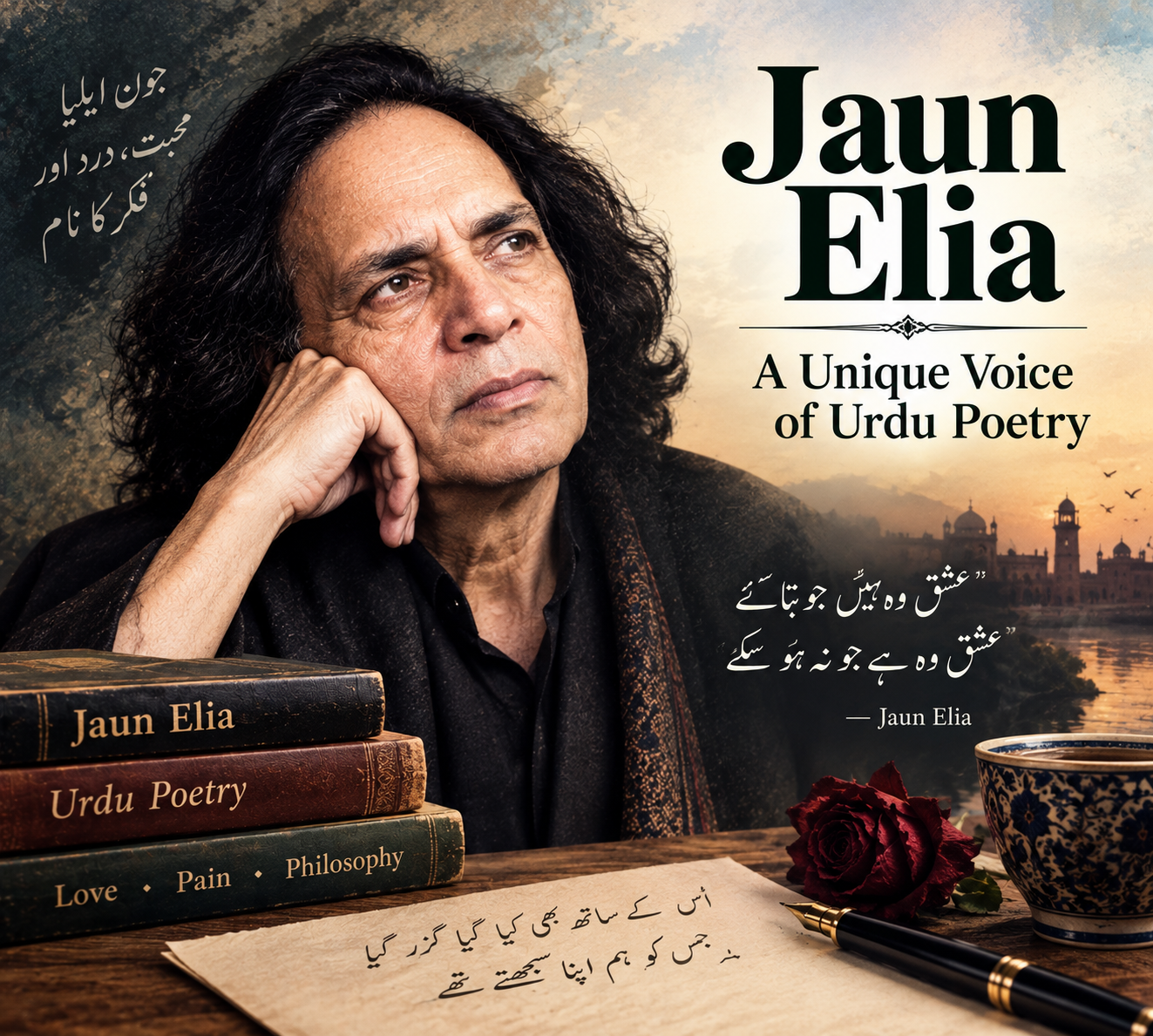
Jaun Elia was one of the most distinctive and memorable Urdu poets of Pakistan. His poetry is known for its emotional intensity, philosophical thinking, unusual style, and honest expression of human feelings. He wrote about love, loneliness, separation, disappointment, identity, existence, and the difficulties of human life.
Unlike many poets who tried to present life in an idealized way, Jaun Elia often wrote about its contradictions. His poetry could express sadness and humor at the same time. He could discuss serious philosophical questions while using a conversational style.
Jaun Elia became especially popular among younger generations because many readers found his poetry relatable. His poems often express emotions that people experience but find difficult to explain.
He was not only a poet. He was also a scholar, writer, translator, and intellectual. His knowledge of languages, history, philosophy, religion, and literature influenced his literary work.
Jaun Elia was born on December 14, 1931, in Amroha, British India. He later migrated to Pakistan after the creation of Pakistan in 1947 and eventually settled in Karachi.
His literary journey made him an important figure in modern Urdu literature.
Early Life
Jaun Elia was born in Amroha, a town in the United Provinces of British India. He belonged to a highly educated family with strong literary and intellectual traditions.
His father, Shafiq Hasan Elia, was a scholar and poet. Jaun grew up in an environment where books, languages, poetry, and intellectual discussions were important.
This environment had a strong influence on his personality.
From an early age, Jaun developed an interest in literature and languages. He studied classical texts and became familiar with different intellectual traditions.
His childhood and early education helped create the foundation for his later work as a poet and scholar.
Interest in Languages
One of the most remarkable aspects of Jaun Elia's intellectual life was his knowledge of languages.
He studied several languages and became familiar with Arabic, Persian, Urdu, Hebrew, and other literary traditions.
His interest in languages was not simply academic. It helped him understand different cultures and literary traditions.
This broad knowledge influenced the vocabulary, references, and philosophical ideas found in his writing.
His poetry sometimes contains references to history, religion, philosophy, and classical literature.
This made his work richer and more complex than ordinary romantic poetry.
Migration to Pakistan
After the creation of Pakistan in 1947, Jaun Elia eventually moved to Pakistan.
Like many people who experienced the Partition of British India, migration became an important part of his life.
He eventually settled in Karachi, where he became connected with literary and intellectual circles.
Karachi was an important cultural center, and its diverse literary environment provided opportunities for Jaun to develop his career.
His life in Pakistan became the main setting for his later literary work.
Jaun Elia as a Scholar
Jaun Elia was not only interested in poetry.
He had a deep interest in history, philosophy, religion, and classical literature.
His intellectual curiosity was broad. He studied different schools of thought and explored questions about human existence.
This intellectual background can be seen in his poetry.
Many of his poems are not simply emotional expressions. They also contain questions about identity, existence, relationships, society, and human nature.
His scholarship gave his poetry a distinctive character.
Beginning of His Literary Career
Jaun Elia started writing poetry at a young age.
His early work reflected the influence of classical Urdu poetry, but he gradually developed a very personal style.
He did not try to imitate other poets completely. Instead, he created a voice that was recognizable as his own.
His poetry often sounds like an intimate conversation.
This conversational quality became one of the defining characteristics of his literary style.
Unique Style of Jaun Elia
Jaun Elia's poetic style was highly distinctive.
He frequently used simple conversational expressions alongside sophisticated philosophical ideas.
His poetry could shift quickly from humor to sadness, from love to disappointment, or from an ordinary observation to a deeper philosophical question.
This unpredictability made his work interesting.
He also used irony extensively.
Sometimes he appeared to criticize himself, question his own decisions, or challenge traditional ideas.
This gave his poetry a sense of honesty and individuality.
Themes of Love
Love is one of the most important themes in Jaun Elia's poetry.
He wrote about attraction, longing, separation, disappointment, memories, and emotional conflict.
However, his treatment of love was different from simple romantic poetry.
His poems often show that love can bring both happiness and pain.
The poet may desire closeness while simultaneously recognizing the difficulties of relationships.
This complexity makes his love poetry especially appealing to readers.
Loneliness and Separation
Loneliness appears frequently in Jaun Elia's work.
His poetry often describes the feeling of being emotionally distant from others.
Separation from loved ones, disappointment in relationships, and the difficulty of understanding oneself are recurring ideas.
Rather than hiding these emotions, Jaun expressed them openly.
This honesty helped many readers connect with his poetry.
Philosophical Ideas
Philosophy is another major element of Jaun Elia's writing.
He was deeply interested in questions about existence, identity, death, society, religion, and human nature.
His poetry sometimes asks questions rather than providing simple answers.
This is one reason his work can be read repeatedly.
A reader may understand one meaning at first and notice another idea after reading the poem again.
His philosophical interests gave his poetry intellectual depth.
Existential Concerns
Jaun Elia frequently explored existential questions.
He was interested in the meaning of life, individual identity, human relationships, and the experience of uncertainty.
His poetry often reflects the struggle between what people want and what reality allows.
These themes remain relevant because human beings continue to ask similar questions about their lives and relationships.
Humor and Irony
Although much of Jaun Elia's poetry is associated with sadness and emotional pain, he also had a strong sense of humor.
He used irony to express ideas in unexpected ways.
Sometimes a humorous statement in his poetry can reveal a serious observation about human behavior.
This mixture of humor and seriousness made his style unusual.
His poetry does not remain emotionally heavy all the time. It can move between different moods.
Famous Poetry Collection: "Shayad"
Jaun Elia's first major poetry collection, Shayad, was published in 1991.
The collection introduced his poetry to a wider audience.
The title itself, meaning "perhaps" or "maybe," reflects the uncertainty that often appears in his work.
The collection contains poems about love, loneliness, philosophy, and human experience.
It became an important milestone in his literary career.
Other Important Works
Jaun Elia produced several literary works during his lifetime.
His poetry collections include:
Shayad
Yaani
Gumaan
Lekin
Goya
Some of his works were published after his death.
His literary output demonstrates the depth and range of his writing.
He also worked on scholarly and translation projects, showing that his intellectual interests went beyond poetry.
"Yaani"
Yaani is another important collection associated with Jaun Elia.
Like his other work, it contains poetry dealing with emotional and philosophical subjects.
The collection helped strengthen his reputation as a distinctive modern Urdu poet.
His use of unusual expressions and conversational language makes the collection particularly recognizable.
"Gumaan"
Gumaan is another well-known poetry collection by Jaun Elia.
The word "gumaan" can suggest doubt, assumption, or uncertainty.
Such ideas fit naturally with the philosophical and questioning nature of Jaun's poetry.
His poems frequently explore uncertainty in love, relationships, identity, and life.
"Lekin"
Lekin is another important work in Jaun Elia's literary legacy.
The title itself means "but," a word often associated with contrast and contradiction.
Contradictions are central to Jaun's poetry.
His work frequently explores the difference between desire and reality, love and separation, confidence and doubt, and hope and disappointment.
Relationship With Classical Urdu Poetry
Jaun Elia respected the classical traditions of Urdu poetry.
He was familiar with major Urdu and Persian poets and literary traditions.
However, he did not simply reproduce classical styles.
He used classical techniques while introducing modern ideas and conversational expressions.
This combination helped him develop a unique literary identity.
His work shows that classical Urdu poetry can continue to evolve.
Influence of Philosophy and History
Jaun's knowledge of philosophy and history influenced his literary work.
He had a strong interest in intellectual history and different traditions of thought.
As a result, his poetry sometimes contains references and ideas that require careful reading.
This intellectual quality separates his poetry from purely romantic writing.
Readers can enjoy his poetry emotionally while also thinking about its deeper ideas.
Jaun Elia and Young Readers
Jaun Elia became particularly popular among younger Urdu readers.
His poetry is frequently shared on social media, quoted in conversations, and discussed online.
One reason for this popularity is the directness of his emotional expression.
Young readers often find his poems relatable because he wrote openly about uncertainty, loneliness, relationships, and disappointment.
His unconventional personality and style also contributed to his popularity.
Recitation and Public Image
Jaun Elia's poetry became especially popular through recitations.
His distinctive manner of expressing poetry helped create a strong connection with audiences.
Over time, recordings and videos of his poetry recitations also introduced his work to people who had never attended traditional literary gatherings.
This helped extend his literary influence beyond printed books.
Influence on Modern Urdu Poetry
Jaun Elia had a significant influence on modern Urdu poetry.
His work demonstrated that a poet could combine emotional honesty, philosophical thought, irony, and conversational language.
He did not always follow conventional expectations about how poetry should sound.
Instead, he developed his own recognizable voice.
This individuality is one of the main reasons he continues to be studied and remembered.
Human Emotions in His Poetry
Jaun Elia's poetry is deeply connected with human emotions.
He wrote about feelings that many people experience but may not express openly.
These include loneliness, regret, love, disappointment, confusion, longing, and uncertainty.
His willingness to express such emotions directly made his work meaningful to many readers.
He showed that vulnerability could become a source of literary expression.
The Importance of Individuality
One of Jaun Elia's most important literary qualities was his individuality.
He did not attempt to fit completely into established literary expectations.
His poetry had its own rhythm, vocabulary, tone, and emotional character.
This individuality made his work recognizable.
A reader can often identify the distinctive voice of Jaun Elia through his unusual combination of philosophical ideas and emotional expression.
Jaun Elia as a Writer
Although he is best known as a poet, Jaun Elia was also involved in other forms of writing.
His interests included scholarship, translation, editing, and intellectual research.
His knowledge of different languages allowed him to engage with a wide range of texts.
This broader literary work demonstrates that his intellectual life was much larger than poetry alone.
Literary Recognition
Jaun Elia became an important figure in Urdu literary circles during his lifetime.
His work was respected for its originality and intellectual depth.
Although his first major poetry collection appeared relatively late, his reputation grew considerably over time.
After his death, interest in his poetry increased even further.
His books became widely read, particularly among younger generations.
Later Years
During the later years of his life, Jaun Elia remained connected with literary activities.
His health and personal circumstances became increasingly difficult, but he continued to be remembered for his intellectual and literary personality.
He lived in Karachi for much of his later life.
His literary work continued to attract readers even as he became more private.
Death
Jaun Elia died on November 8, 2002, in Karachi.
His death was a significant loss for Urdu literature.
However, his literary legacy continued to grow after his death.
New collections of his poetry were published, and his work became increasingly popular among younger readers.
His poetry continues to be discussed, recited, and studied.
Legacy of Jaun Elia
Jaun Elia's legacy is based on his originality.
He created a literary voice that was deeply personal and difficult to confuse with that of another poet.
His poetry combined love, loneliness, philosophy, humor, irony, and existential questions.
His books remain popular, and his poetry continues to circulate widely.
Modern readers often discover his work through social media and online literary communities.
This has helped bring his poetry to audiences who may not have encountered it through traditional literary institutions.
Why Jaun Elia Remains Popular
Jaun Elia remains popular because his poetry speaks openly about complicated emotions.
He did not pretend that life was always simple or beautiful.
He acknowledged uncertainty and contradiction.
His poetry gives readers a way to think about emotions such as loneliness, love, disappointment, and doubt.
At the same time, his philosophical ideas encourage readers to think beyond immediate emotions.
This combination of emotional and intellectual depth makes his work distinctive.
Contribution to Pakistani Literature
Jaun Elia made an important contribution to Pakistani literature by developing a highly individual modern Urdu voice.
He showed that Urdu poetry could combine classical literary knowledge with contemporary language and ideas.
His work also demonstrated the importance of individuality in literature.
Rather than simply following existing patterns, he developed his own approach.
His influence continues to be visible in the way younger readers approach Urdu poetry.
Conclusion
Jaun Elia was one of the most distinctive Urdu poets associated with Pakistan. He was a poet, scholar, writer, translator, and intellectual whose work combined emotional expression with philosophical thought.
His poetry explored love, loneliness, separation, uncertainty, identity, human relationships, and the meaning of life.
His unique conversational style made his poetry accessible to many readers, while his philosophical references gave it intellectual depth.
Collections such as Shayad, Yaani, Gumaan, and Lekin remain important parts of his literary legacy.
Jaun Elia's popularity has continued to grow after his death. His poetry is widely read by young people and continues to appear in literary discussions, recitations, music, and digital spaces.
He died in Karachi in 2002, but his literary voice remains alive.
For readers of Urdu poetry, Jaun Elia represents individuality, emotional honesty, intellectual curiosity, and the freedom to express complicated human experiences through literature.
His work remains an important part of Pakistan's modern literary heritage and continues to introduce new generations to the beauty and depth of Urdu poetry.
FAQs
1. Who was Jaun Elia?
Jaun Elia was a famous Pakistani Urdu poet, scholar, writer, translator, and intellectual known for his unique literary style.
2. What was Jaun Elia famous for?
He was famous for his poetry about love, loneliness, separation, philosophy, human emotions, and existential questions.
3. What is Jaun Elia's first major poetry collection?
His first major poetry collection was Shayad, which was published in 1991.
4. When did Jaun Elia die?
Jaun Elia died on November 8, 2002, in Karachi.
5. Why is Jaun Elia still popular?
Jaun Elia remains popular because his poetry expresses complicated emotions in a distinctive, conversational, and philosophical style that continues to connect with modern readers.