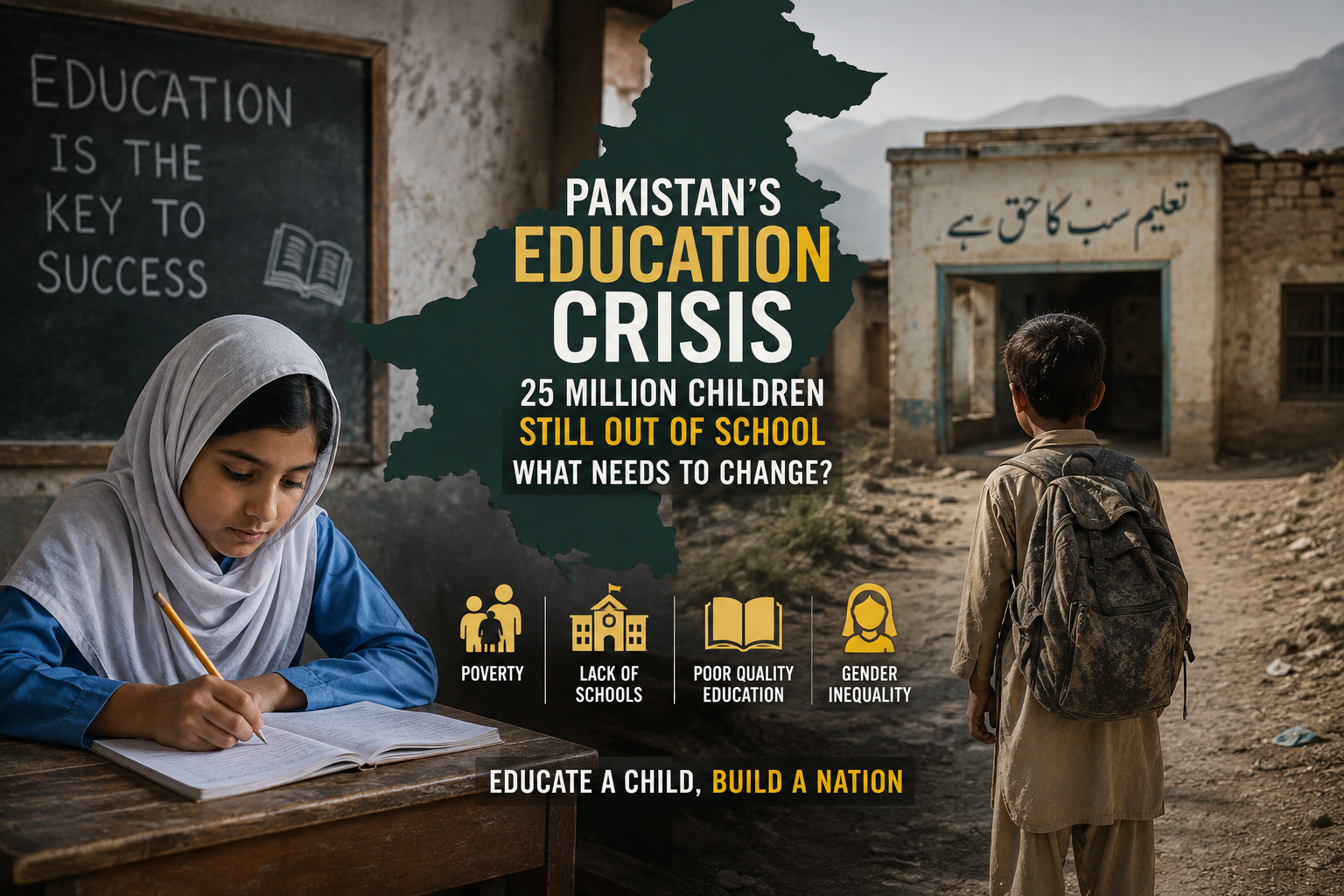
Education is one of the strongest foundations of a country’s economic and social development. Yet Pakistan continues to face a serious education crisis, with millions of children still outside the formal education system. The issue is not simply about schools or classrooms; it is connected to poverty, unequal access, gender disparities, poor infrastructure, teacher shortages, and the quality of education available to children.
The figure of around 25 million children out of school has become a powerful indicator of the scale of Pakistan’s education challenge. Behind this number are children who could otherwise become teachers, doctors, engineers, entrepreneurs, researchers, and skilled workers. If these children remain excluded from education, Pakistan risks losing an important part of its future human capital.
Addressing the crisis requires more than increasing enrollment. Children must be able to enter school, remain there, learn effectively, and develop the skills needed for further education and employment.
Understanding Pakistan’s Education Crisis
Pakistan has made progress in expanding access to education, but the pace of improvement has not been sufficient to meet the needs of its rapidly growing population. Many children, particularly those from low-income families and underserved communities, continue to face barriers to attending school.
In some areas, schools are too far from communities. In others, families cannot afford transportation, uniforms, books, or other educational expenses. For some households, children are expected to contribute to household income or take care of younger siblings.
The problem is particularly serious in rural and disadvantaged areas where educational facilities can be limited. Some schools lack adequate classrooms, toilets, electricity, clean drinking water, or other basic facilities. These conditions can discourage attendance and make learning more difficult.
Poverty: A Major Barrier to Education
Poverty remains one of the biggest reasons children leave school or never enroll in the first place.
For a family struggling to meet basic needs, education can sometimes be viewed as an additional expense. Even when public schooling does not charge tuition, parents may still need to pay for uniforms, stationery, transportation, examination fees, or other costs.
Children may also be required to work to support their families. This creates a difficult cycle: limited education reduces future employment opportunities, while limited employment opportunities contribute to continued poverty.
Breaking this cycle requires policies that make education genuinely affordable for low-income families. Scholarships, stipends, free learning materials, school meals, and transportation support can help reduce the financial pressure that keeps children away from classrooms.
Gender Inequality and Girls’ Education
Girls face additional barriers to education in many parts of Pakistan. These can include long distances to schools, concerns about safety, household responsibilities, social attitudes, and a lack of suitable facilities.
The availability of female teachers can also influence whether parents feel comfortable sending their daughters to school. In communities where girls are expected to take on household responsibilities, education may receive less priority.
Educating girls has benefits that extend beyond individual students. Women with better education generally have greater opportunities to participate in the workforce, make informed decisions, and contribute to their families and communities.
Pakistan therefore needs targeted measures to improve girls’ enrollment and retention. Safe transportation, functional sanitation facilities, more female teachers, scholarships, and community awareness programs can all play an important role.
The Quality of Education Matters
Getting children into school is only one part of the solution. Quality of education is equally important.
A child can spend years in school without developing strong reading, writing, mathematics, communication, or problem-solving skills. This creates another dimension of the education crisis: children may be physically present in classrooms but still fail to acquire foundational learning.
Teachers need proper training, teaching resources, and supportive working environments. Schools also need effective systems for monitoring student progress.
Instead of focusing only on how many children are enrolled, policymakers should also ask:
Can students read and understand age-appropriate texts?
Can they perform basic mathematical operations?
Can they think critically and solve problems?
Are they developing digital and communication skills?
Are teachers receiving adequate professional development?
These questions are essential for measuring real educational progress.
Teacher Shortages and Training
Teachers are at the center of every education system. Pakistan cannot improve learning outcomes without investing in teachers.
Some schools face shortages of qualified teachers, while others have teachers who need additional training in modern teaching methods. In overcrowded classrooms, teachers may struggle to give individual attention to students.
Regular professional development can help teachers introduce more effective approaches to learning. Training should not be limited to theoretical concepts; it should provide practical strategies for classroom management, assessment, technology use, inclusive education, and student engagement.
At the same time, teachers need appropriate resources and reasonable working conditions. A strong education system requires both accountability and support.
Infrastructure and Access
A school building alone does not guarantee quality education. Students need safe and functional learning environments.
Many schools across developing regions face infrastructure challenges such as inadequate classrooms, unreliable electricity, poor sanitation, insufficient furniture, and limited access to clean drinking water.
Digital connectivity is another growing concern. Technology can provide students with access to educational materials, online courses, digital libraries, and interactive learning tools. However, the digital divide means that children in poorer and rural communities may have fewer opportunities to benefit from these resources.
Investment in school infrastructure should therefore include both physical facilities and appropriate digital infrastructure.
Technology as Part of the Solution
Technology cannot replace teachers or solve every educational problem, but it can expand access to learning.
Digital learning platforms can provide educational content to students who have limited access to traditional resources. Mobile-based learning, recorded lessons, online libraries, and educational applications can support students both inside and outside classrooms.
However, technology initiatives must be designed around Pakistan’s realities. Not every family has a reliable internet connection, computer, or smartphone. Programs should therefore consider offline learning materials, low-cost devices, community digital centers, and other accessible solutions.
Technology should be used to reduce educational inequality rather than unintentionally increase it.
Curriculum Reform
Pakistan also needs to examine what students are learning and how they are being taught.
A modern curriculum should develop more than the ability to memorize information. Students need communication, creativity, critical thinking, digital literacy, collaboration, and problem-solving skills.
Examinations can strongly influence classroom teaching. If exams primarily reward memorization, students and teachers may naturally focus on memorizing textbooks rather than understanding concepts.
Assessment systems should increasingly evaluate understanding and practical application. This can encourage deeper learning and better prepare students for higher education and employment.
The Role of Parents and Communities
Government policies alone cannot solve the education crisis. Parents, communities, teachers, civil society organizations, and the private sector all have roles to play.
Parents need awareness about the long-term value of education. Community leaders can encourage families to keep children in school. Local organizations can support literacy programs and help identify children who have dropped out.
Community involvement is particularly important in areas where social or cultural barriers prevent children from attending school. Solutions are more likely to succeed when local communities participate in designing and implementing them.
What Government Needs to Change
The government has a central responsibility in addressing Pakistan’s education crisis. Increasing education spending is important, but how resources are used matters just as much.
Funding should be directed toward areas with the greatest educational needs. Governments should improve school infrastructure, recruit and train teachers, strengthen monitoring systems, and develop programs for children who have already dropped out.
There should also be greater coordination between federal and provincial authorities, particularly because education responsibilities are distributed across different levels of government.
Reliable data is essential. Policymakers need accurate information about enrollment, attendance, dropout rates, teacher availability, school facilities, and learning outcomes. Better data can help authorities identify where resources are most urgently required.
Bringing Out-of-School Children Back
A major challenge is reaching children who are already outside the education system.
Simply building more schools may not be enough. Flexible learning programs can provide alternative pathways for children who have missed several years of schooling.
Accelerated learning programs can help older children catch up with their peers. Non-formal education centers can provide basic literacy and numeracy skills. Vocational and technical education can also offer pathways for older students who need practical skills.
The objective should be to ensure that being out of school does not permanently close the door to education.
Education and Pakistan’s Economic Future
Education is not merely a social service; it is an investment in Pakistan’s economy.
A better-educated population can contribute to a more skilled workforce, higher productivity, entrepreneurship, innovation, and technological development. Countries that invest effectively in human capital are better positioned to compete in an increasingly knowledge-based global economy.
Pakistan has a young population, which presents both an opportunity and a challenge. If young people receive quality education and relevant skills, they can become a major economic asset. If they remain excluded from education and employment, the country may face greater economic and social pressures.
This makes education reform an urgent national priority.
What Needs to Change?
Pakistan’s education crisis cannot be solved through a single policy. A comprehensive strategy is required.
First, children from low-income families need financial support so poverty does not force them out of school. Second, girls need safe and accessible educational opportunities. Third, teachers need better training and resources. Fourth, schools need functional infrastructure and appropriate technology.
At the same time, curriculum and assessment systems should focus more strongly on understanding and practical skills. Government institutions need stronger monitoring and better use of education data.
Finally, education policies should be implemented consistently over the long term. Frequent changes in priorities can weaken reforms before they produce meaningful results.
Conclusion
Pakistan’s education crisis is one of the country’s most important long-term challenges. The millions of children currently outside school represent not only a failure of access but also a missed opportunity for national development.
The solution requires commitment from government, schools, teachers, parents, communities, and society as a whole. Expanding enrollment is important, but Pakistan must also focus on retention, learning quality, teacher development, gender equality, infrastructure, and practical skills.
If the country succeeds in bringing more children into quality education, it can strengthen its workforce, reduce poverty, and create greater opportunities for future generations. The question is no longer whether Pakistan can afford to invest in education.
FAQs
1. How many children are out of school in Pakistan?
Recent estimates commonly place the number at around 25 million, although the exact figure can vary depending on the source, age range, and year of the estimate.
2. What are the main causes of Pakistan’s education crisis?
Major causes include poverty, school accessibility, gender inequality, inadequate infrastructure, teacher shortages, child labor, and weaknesses in education quality.
3. Why are girls more likely to face barriers to education?
Girls can face challenges including distance from schools, safety concerns, household responsibilities, limited sanitation facilities, social attitudes, and insufficient availability of female teachers.
4. How can Pakistan reduce the number of out-of-school children?
Pakistan can expand affordable schooling, provide financial support to disadvantaged families, improve school infrastructure, strengthen teacher training, offer flexible learning programs, and increase community participation.
5. Why is education important for Pakistan’s future?
Quality education can improve employment opportunities, productivity, innovation, economic growth, and social development while helping young people build skills needed for the future.