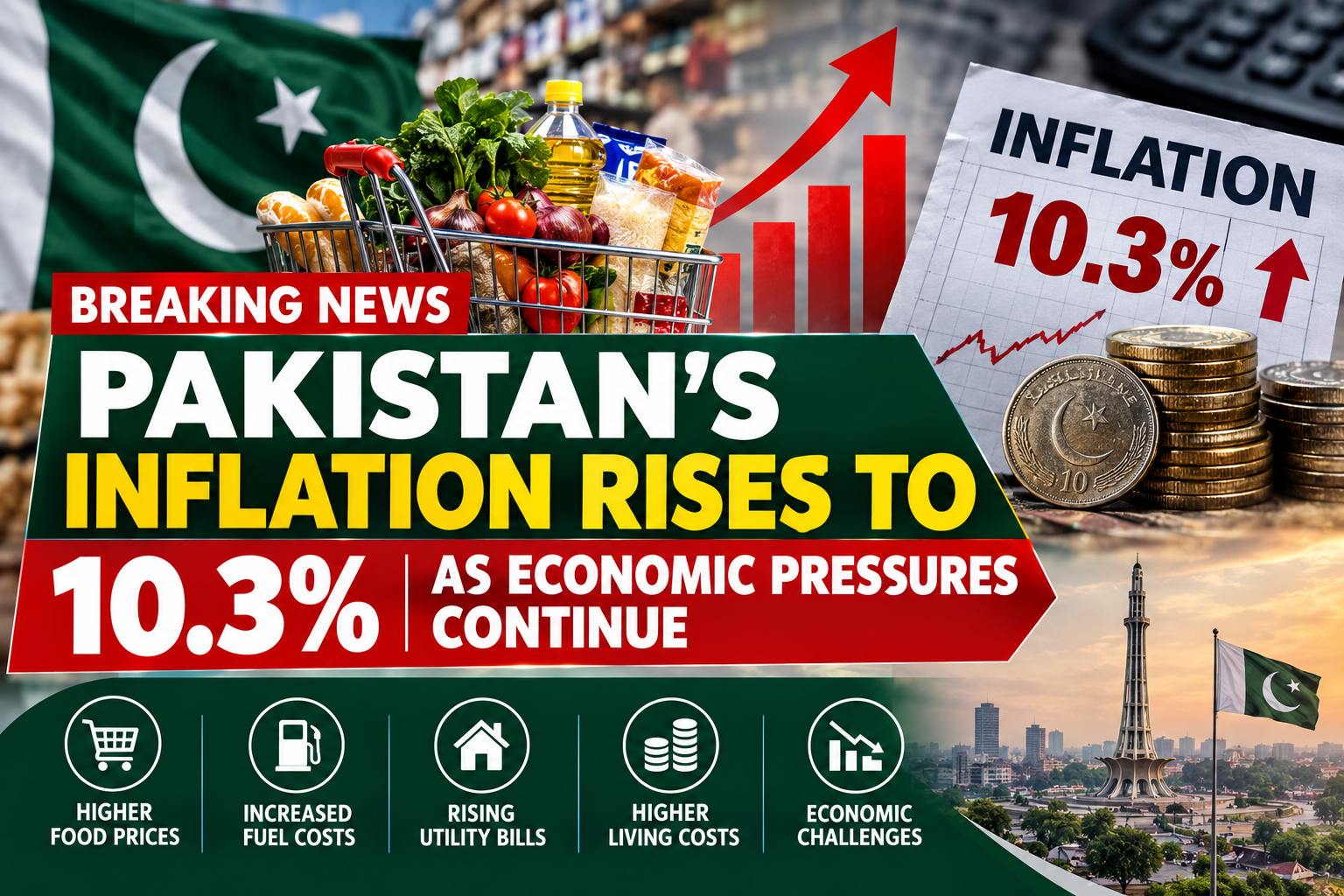
Pakistan’s inflation rate has remained a major economic concern as consumer prices continue to put pressure on households, businesses, and the wider economy. Recent official data showing inflation at 10.3 percent highlights the continuing challenges faced by the country as policymakers work to maintain economic stability while supporting growth.
Inflation affects almost every part of daily life. When prices rise, families need more money to purchase the same goods and services. Food, transportation, housing, healthcare, education, clothing, and household necessities can all become more expensive.
For Pakistan, controlling inflation remains particularly important because a large part of household income is spent on essential goods and services.
What Does a 10.3 Percent Inflation Rate Mean?
An inflation rate of 10.3 percent means that the overall consumer price level is significantly higher than it was during the corresponding period of the previous year.
Inflation does not mean that every product becomes 10.3 percent more expensive. Prices of individual goods can increase at different rates, while some products may become cheaper or remain relatively stable.
However, the overall increase in the consumer price basket indicates continued pressure on purchasing power.
For ordinary households, even moderate increases in essential expenses can create financial difficulties, particularly when incomes do not increase at the same pace.
Pressure on Household Budgets
Rising prices directly affect household budgets.
Families have to make decisions about how they spend their available income. When the cost of food, electricity, transportation, and other necessities increases, less money may remain for savings, education, recreation, or other expenses.
Lower-income households can face greater pressure because they generally spend a larger share of their income on basic necessities.
Inflation can therefore have an unequal impact across different sections of society.
Food Prices and Consumer Concerns
Food prices remain one of the most closely watched components of inflation in Pakistan.
Items such as vegetables, fruits, wheat products, cooking ingredients, dairy products, meat, and other household staples can have a significant impact on monthly budgets.
Changes in agricultural production, transportation costs, weather conditions, supply shortages, and market conditions can influence food prices.
When essential food items become more expensive, consumers may change their purchasing habits or reduce spending on non-essential products.
Energy Costs and Inflation
Energy prices are another important factor affecting the economy.
Electricity, fuel, and gas costs can influence household expenses directly. They also affect businesses because companies use energy to manufacture products, operate offices, transport goods, and provide services.
When energy costs increase, businesses may face higher operating expenses. Some businesses may respond by increasing the prices of their products or services.
This can create additional inflationary pressure throughout the economy.
Transportation Costs
Transportation is closely connected to fuel prices and overall economic activity.
Higher transportation costs can increase the expense of moving agricultural products, industrial goods, and consumer products from one location to another.
For consumers, higher transport costs can also increase the cost of commuting and travel.
Because transportation is connected to many sectors, changes in fuel and transport costs can have wider effects on consumer prices.
Impact on Businesses
Inflation creates challenges for businesses as well.
Companies have to manage higher costs for raw materials, electricity, transportation, salaries, rent, and other inputs.
Small and medium-sized businesses can be particularly vulnerable because they may have limited financial resources and less ability to absorb rising costs.
Some businesses may increase prices to protect their profit margins, while others may reduce expenses or delay expansion plans.
Monetary Policy and Inflation
The State Bank of Pakistan plays an important role in managing inflation through monetary policy.
Interest rates can influence borrowing, investment, consumer spending, and overall economic activity.
When inflation is high, central banks may use tighter monetary policy to reduce demand and control price pressures.
However, very high interest rates can also create challenges for businesses and borrowers because loans become more expensive.
Policymakers therefore face the difficult task of balancing inflation control with economic growth.
Inflation and Economic Growth
Inflation and economic growth are closely connected.
A stable price environment can support long-term investment and business planning. When prices change rapidly and unpredictably, companies may find it harder to plan future investments.
Consumers can also become more cautious about spending.
For Pakistan, maintaining economic stability while encouraging growth remains a major policy challenge.
Impact on Savings
Inflation can reduce the real value of money over time.
If prices rise faster than the return earned on savings, the purchasing power of those savings can decline.
This is one reason why inflation is an important consideration for households planning their finances.
People may need to review their budgets, savings strategies, and long-term financial goals when the cost of living changes significantly.
Impact on Fixed-Income Households
People with fixed or slowly increasing incomes can face particular difficulties during periods of rising inflation.
If salaries do not keep pace with higher living costs, households may have less purchasing power.
Government employees, pensioners, and other groups with relatively fixed incomes may therefore experience increased financial pressure.
Wage adjustments and targeted support programs can become important considerations when inflation remains elevated.
Housing and Rental Costs
Housing expenses are another major part of household budgets.
Rent, maintenance, utilities, and household services can all contribute to the cost of living.
In major Pakistani cities, rising housing expenses can create additional pressure on families already dealing with higher food and transportation costs.
Housing affordability is therefore an important part of the wider inflation and cost-of-living discussion.
Healthcare and Education Costs
Inflation can also affect healthcare and education.
Medical services, medicines, transportation to healthcare facilities, school fees, books, uniforms, and other educational expenses can increase household financial burdens.
Families may find it difficult to maintain spending on these essential areas when a large share of their income is already being used for food and utilities.
Government Response
The government has several tools available to address inflation.
These can include monetary coordination, fiscal measures, improved supply chains, targeted subsidies, better market monitoring, and policies designed to increase domestic production.
Improving agricultural productivity can also help reduce food-supply pressures.
At the same time, policies aimed at increasing exports, investment, and industrial production can strengthen economic growth and create employment opportunities.
Importance of Supply-Side Reforms
Inflation is not always caused by excessive demand. Supply-side factors can also play an important role.
Weak infrastructure, high transportation costs, energy shortages, inefficient markets, and supply disruptions can increase the cost of producing and distributing goods.
Long-term reforms aimed at improving productivity and reducing unnecessary costs can therefore help control inflation more sustainably.
Role of Agriculture
Agriculture is particularly important because food prices have a major effect on the cost of living.
Better agricultural technology, improved irrigation, stronger storage facilities, efficient transportation, and reduced post-harvest losses can help strengthen food supplies.
A more efficient agricultural supply chain can also reduce the difference between farm-gate prices and prices paid by consumers.
Importance of Currency Stability
Exchange-rate movements can also influence inflation in Pakistan.
Pakistan imports various products, including energy, machinery, raw materials, and other goods.
When imported products become more expensive because of exchange-rate pressures, businesses may face higher costs.
Maintaining greater currency stability can therefore help reduce some external inflationary pressures, although exchange rates are influenced by many domestic and international factors.
Impact on Employment
Persistent inflation can also influence employment.
Businesses facing higher costs may become more cautious about hiring new workers or expanding operations.
At the same time, sectors that experience increased demand may continue to create employment opportunities.
Maintaining stable economic conditions is therefore important not only for controlling prices but also for supporting job creation.
Consumer Spending Habits
Inflation often changes consumer behavior.
People may compare prices more carefully, purchase smaller quantities, switch brands, delay non-essential purchases, or search for discounts.
Retailers may respond by offering promotions or smaller product packages.
These changes can influence the broader market and the strategies used by businesses.
Need for Long-Term Economic Stability
Controlling inflation requires more than short-term measures.
Pakistan needs policies that encourage investment, increase productivity, improve energy efficiency, strengthen public finances, and support sustainable economic growth.
Stable economic institutions and predictable policies can also improve business confidence.
When businesses have greater confidence in future economic conditions, they may be more willing to invest and expand.
Outlook for Pakistan
The future direction of inflation will depend on several factors, including food and energy prices, exchange-rate movements, government policies, monetary conditions, international commodity prices, and domestic supply conditions.
If supply pressures ease and macroeconomic stability improves, inflationary pressure could gradually decline.
However, unexpected increases in energy or food prices could create renewed pressure.
For policymakers, careful monitoring will therefore remain essential.
Conclusion
Pakistan’s 10.3 percent inflation rate highlights the continuing economic pressure faced by households and businesses. Rising prices can reduce purchasing power, increase business costs, and make financial planning more difficult.
The challenge for policymakers is to control inflation without unnecessarily weakening economic growth. Monetary policy, fiscal discipline, stronger supply chains, agricultural improvements, energy reforms, and investment can all contribute to greater economic stability.
For ordinary citizens, the most visible effect of inflation is the changing cost of everyday life. Ensuring stable prices and stronger purchasing power will therefore remain an important economic priority for Pakistan.
A sustained reduction in inflation, combined with employment growth and higher productivity, would provide a stronger foundation for households, businesses, and the overall Pakistani economy.
FAQs
1. What is Pakistan’s reported inflation rate?
The reported inflation rate is 10.3 percent.
2. How does inflation affect households?
Inflation increases the cost of goods and services, reducing the purchasing power of household income.
3. Which factors can influence inflation in Pakistan?
Food prices, energy costs, exchange rates, transportation expenses, supply conditions, and monetary policy can all influence inflation.
4. How does inflation affect businesses?
Businesses may face higher costs for raw materials, energy, transportation, wages, and other inputs.
5. Why is controlling inflation important?
Stable prices help protect purchasing power, improve financial planning, support investment, and create a more predictable environment for economic growth.