Introduction
Ethical leadership is an important foundation for the progress of any country. A nation can have natural resources, talented people, modern technology, and economic opportunities, but these advantages need responsible leadership to be used effectively. In Pakistan, ethical leadership can play a significant role in improving governance, education, business, institutions, and social development.
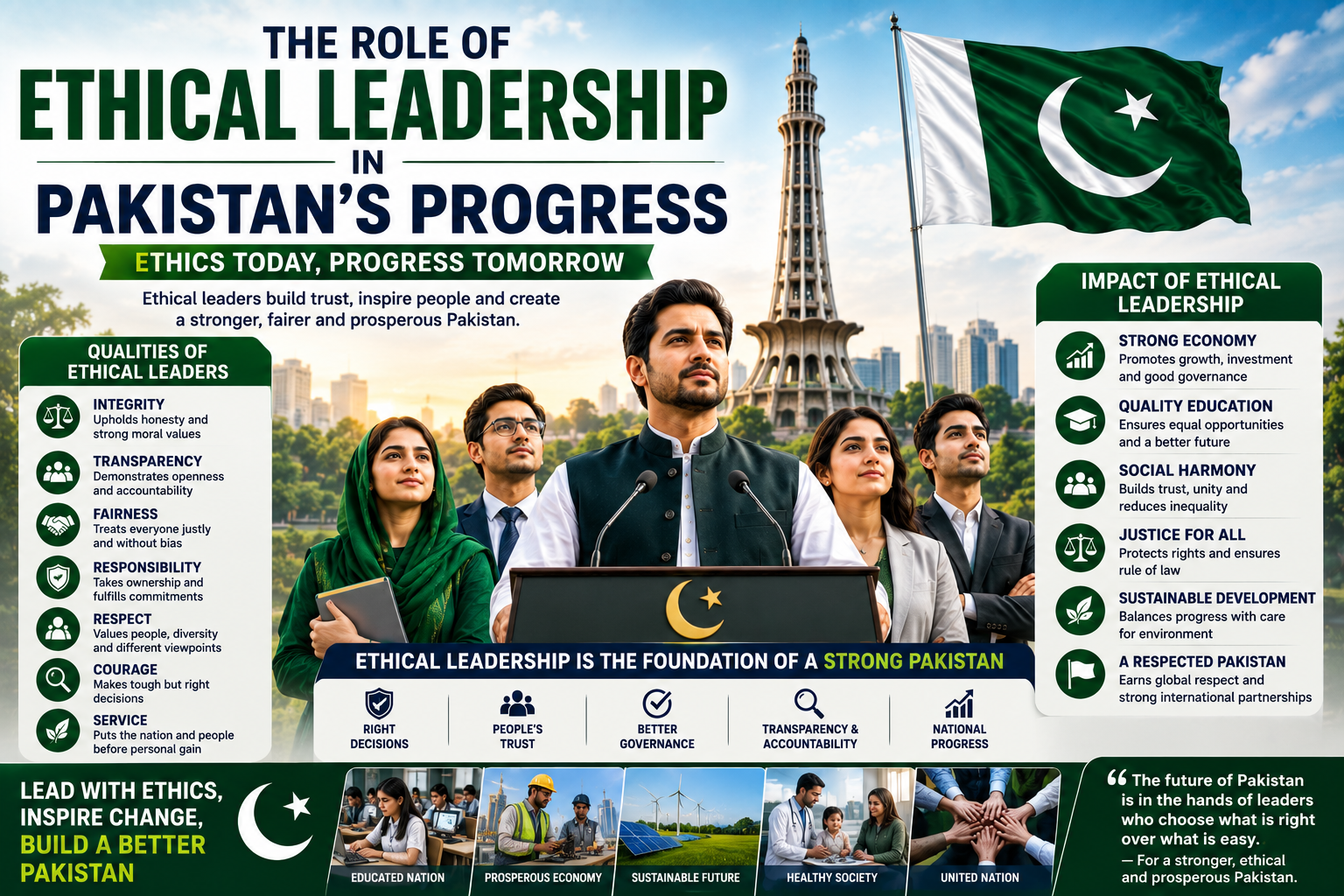
Ethical leadership means leading with honesty, fairness, responsibility, respect, and integrity. An ethical leader does not focus only on personal success. Instead, they consider the interests of the people, organization, community, and country.
Pakistan has many opportunities for development, but it also faces challenges such as economic pressure, unemployment, educational gaps, institutional weaknesses, and social problems. Ethical leadership can help address these challenges by encouraging responsible decision-making and building public trust.
What Is Ethical Leadership?
Ethical leadership is a style of leadership based on moral principles and responsible behavior. Ethical leaders try to make decisions that are fair, transparent, and beneficial to the people they serve.
An ethical leader should:
Be honest
Treat people fairly
Accept responsibility
Respect others
Follow rules and principles
Avoid misuse of authority
Listen to different viewpoints
Keep commitments
Make decisions responsibly
Ethical leadership is not limited to politics. It is important in schools, universities, businesses, government departments, hospitals, communities, and families.
Why Ethical Leadership Matters in Pakistan
Pakistan's development requires trust between people and institutions. When leaders behave ethically, they can create confidence among citizens, employees, students, and communities.
Ethical leadership can contribute to:
Better governance
Stronger institutions
Public trust
Economic stability
Fair opportunities
Better decision-making
Social cooperation
Responsible use of resources
The Pakistan Governance Forum has emphasized principles including transparency, accountability, merit, and citizen-centered public service as important elements of effective governance.
Honesty as the Foundation of Ethical Leadership
Honesty is one of the most important characteristics of an ethical leader.
An honest leader communicates truthfully and does not deliberately mislead people. Honesty also means accepting mistakes instead of hiding them.
When leaders demonstrate honesty, they can encourage the same behavior among their teams and institutions.
For Pakistan, promoting honesty in leadership can help create a culture in which people value responsibility and trustworthiness.
Integrity and Leadership
Integrity means following strong moral principles consistently.
A leader with integrity does not change their principles simply because circumstances become difficult. They try to make decisions according to fairness and responsibility.
Integrity is particularly important when leaders have significant authority. The greater the responsibility, the greater the need for ethical behavior.
Accountability in Ethical Leadership
Accountability means accepting responsibility for decisions and actions.
Ethical leaders do not believe that leadership gives them freedom from responsibility. Instead, they understand that authority comes with obligations.
Accountability can improve institutions by encouraging people to perform their duties carefully and responsibly.
In Pakistan, stronger accountability can contribute to better public services and more effective institutions.
Transparency and Public Trust
Transparency helps people understand how decisions are made.
When processes are clear and information is communicated appropriately, people are more likely to trust institutions.
Transparent leadership can also help reduce misunderstandings and encourage responsible participation.
For public institutions, transparency is particularly important because decisions can affect large numbers of people.
Ethical Leadership and Good Governance
Good governance requires more than policies and laws. It also requires people who implement those policies responsibly.
Ethical leaders can support good governance by promoting:
Fairness
Accountability
Transparency
Merit
Rule of law
Public participation
Responsible use of resources
When these principles become part of institutional culture, governance can become more effective.
Ethical Leadership and Economic Development
Economic development depends partly on confidence and stability.
Businesses and investors need reliable institutions and predictable rules. Ethical leadership can contribute to an environment where people have greater confidence in organizations and public institutions.
Ethical business leaders can also contribute by treating employees fairly, maintaining honest business practices, and focusing on sustainable growth.
Young entrepreneurs can benefit from learning ethical leadership because businesses are not only about making profits; they also have responsibilities toward customers, employees, and communities.
Ethical Leadership in Education
Education plays an important role in developing future leaders.
Schools and universities can teach students ethical values through both classroom learning and practical activities.
Students can learn leadership through:
Group projects
Debates
Volunteer work
Student organizations
Sports
Community activities
Teachers can demonstrate ethical leadership by treating students fairly, respecting their opinions, and encouraging responsible behavior.
The values learned during education can influence students throughout their professional lives.
The Role of Teachers as Ethical Leaders
Teachers are among the most influential leaders in society.
A teacher does more than deliver lessons. Teachers can influence students' attitudes toward honesty, responsibility, discipline, teamwork, and respect.
When teachers behave fairly and responsibly, students can learn from their example.
Therefore, supporting teachers and providing professional development can contribute to the development of ethical leadership in future generations.
Ethical Leadership and Youth
Pakistan's young population represents an important opportunity for national development.
Young people should be encouraged to develop leadership skills alongside academic and technical knowledge.
Youth leadership programs can teach:
Responsibility
Communication
Teamwork
Decision-making
Integrity
Community service
Problem-solving
Young people who learn ethical leadership early can carry these principles into their future careers.
Ethical Leadership and Technology
Technology is transforming Pakistan's economy and society. Artificial intelligence, digital platforms, e-commerce, software development, and online education are creating new opportunities.
However, technology also creates responsibilities.
Ethical leaders in technology should consider issues such as:
Privacy
Responsible use of data
Online safety
Accuracy of information
Digital inclusion
Responsible artificial intelligence
Pakistan needs leaders who can understand both the opportunities and responsibilities associated with technological development.
Ethical Leadership in Business
Businesses have an important role in Pakistan's economy. Ethical business leadership can help create healthier workplaces and stronger organizations.
An ethical business leader should:
Treat employees respectfully
Communicate honestly
Provide fair opportunities
Maintain responsible business practices
Respect customers
Follow applicable laws
Consider environmental and social responsibilities
Ethical businesses can build long-term reputations because trust is valuable in business relationships.
Ethical Leadership and Social Development
National progress is not only measured by economic growth. Social development is equally important.
Ethical leaders can promote:
Education
Community cooperation
Equal opportunities
Social responsibility
Respect
Environmental awareness
Leadership should encourage people to work together rather than create unnecessary divisions.
Ethical Leadership and National Unity
Pakistan is a diverse country with different cultures, languages, traditions, and regional identities.
Ethical leadership can support national unity by treating people fairly and respecting diversity.
Leaders can encourage citizens to focus on shared goals such as education, economic development, peace, innovation, and national progress.
Unity becomes stronger when people believe that they are treated with dignity and fairness.
Ethical Leadership and Merit
Merit is another important principle of ethical leadership.
People should receive opportunities based on relevant qualifications, abilities, effort, and performance.
Merit-based systems can encourage talented individuals to work hard and improve their skills.
In Pakistan, promoting merit in education, employment, and institutions can help ensure that capable people are given opportunities to contribute.
Ethical Leadership and Decision-Making
Leaders regularly face difficult choices. Ethical decision-making requires consideration of both short-term and long-term consequences.
A responsible leader should ask:
Is this decision fair?
Who will be affected?
Are the rules being respected?
Is the decision based on reliable information?
Can the decision be explained openly?
Does it support the long-term interest of the organization or community?
These questions can help leaders make more responsible decisions.
Challenges to Ethical Leadership in Pakistan
Developing ethical leadership can be difficult because leadership operates within complex social, economic, and institutional environments.
Some challenges include:
Short-Term Thinking
Leaders may sometimes focus on immediate results rather than long-term development.
Lack of Training
Leadership skills and ethical decision-making can be developed through education and training, but opportunities may not always be equally available.
Weak Institutional Practices
Strong ethical leadership requires institutions that support transparency, accountability, and fair procedures.
Limited Mentorship
Young people can benefit from experienced mentors who demonstrate responsible leadership.
Resistance to Change
New approaches can sometimes face resistance. Ethical leaders need patience and communication skills to introduce positive changes.
How Pakistan Can Promote Ethical Leadership
Pakistan can strengthen ethical leadership through several approaches.
1. Strengthen Education
Schools and universities should teach ethics, critical thinking, communication, and responsibility.
2. Develop Leadership Programs
Leadership programs can help students and professionals understand decision-making, teamwork, accountability, and ethical behavior.
3. Promote Merit
Fair opportunities can encourage competence and reduce favoritism.
4. Strengthen Institutions
Institutions should have clear rules and procedures that encourage responsible behavior.
5. Encourage Transparency
Clear communication and appropriate access to information can strengthen public confidence.
6. Support Youth
Young people should receive opportunities to participate in educational, professional, community, and entrepreneurial activities.
7. Promote Accountability
Leaders should be responsible for their decisions and performance.
The Role of Families in Ethical Leadership
Ethical leadership begins with basic values learned at home.
Parents and families can teach children:
Honesty
Respect
Responsibility
Kindness
Discipline
Fairness
These values can become the foundation for responsible leadership later in life.
The Role of Schools and Colleges
Educational institutions can provide practical opportunities for students to practice leadership.
For example, students can organize projects, participate in debates, work in teams, and volunteer in their communities.
These experiences can teach students how to communicate, cooperate, solve problems, and take responsibility.
The Role of Government Institutions
Government institutions have a major responsibility in promoting ethical leadership.
Clear procedures, transparency, accountability, professional standards, and merit-based systems can support responsible public administration.
Ethical leadership within institutions can also encourage employees to focus on public service and professional responsibility.
The Role of Civil Society
Community organizations and civil society groups can also contribute to ethical leadership.
They can promote awareness, education, volunteerism, community participation, and responsible citizenship.
Young people can gain valuable leadership experience by participating in constructive community activities.
Ethical Leadership and Environmental Responsibility
Pakistan faces environmental challenges that require responsible long-term planning.
Ethical leadership means considering the impact of today's decisions on future generations.
Leaders can encourage responsible approaches to:
Water conservation
Waste management
Clean energy
Tree planting
Pollution reduction
Sustainable development
Environmental responsibility is therefore an important part of modern leadership.
Ethical Leadership and Pakistan's Future
Pakistan's future will depend greatly on the quality of its institutions and leaders.
The country has talented students, professionals, entrepreneurs, researchers, farmers, workers, and businesspeople. Ethical leadership can help create an environment where these people can use their abilities effectively.
Future leaders should be prepared not only to achieve success but also to use authority responsibly.
Conclusion
Ethical leadership can play a major role in Pakistan's progress. Honesty, integrity, accountability, transparency, fairness, responsibility, and respect are essential qualities for leaders working in government, education, business, technology, and communities.
Pakistan can strengthen its future by developing ethical leaders through education, mentorship, leadership training, merit-based opportunities, and strong institutions.
Leadership is not simply about having power or authority. It is about using responsibility wisely and working toward the betterment of others.
When ethical leadership becomes a shared value across society, Pakistan can build stronger institutions, greater public trust, better opportunities, and sustainable national development.
FAQs
1. What is ethical leadership?
Ethical leadership means guiding others through honesty, fairness, integrity, responsibility, and respect.
2. Why is ethical leadership important for Pakistan?
It can strengthen public trust, improve institutions, support good governance, and encourage responsible decision-making.
3. What are the qualities of an ethical leader?
Honesty, integrity, accountability, fairness, transparency, respect, and responsibility are key qualities.
4. How can Pakistan develop ethical leaders?
Through education, leadership training, mentorship, merit-based opportunities, and strong institutions.
5. What role can youth play in ethical leadership?
Young people can develop responsible leadership through education, community participation, entrepreneurship, teamwork, and volunteering.