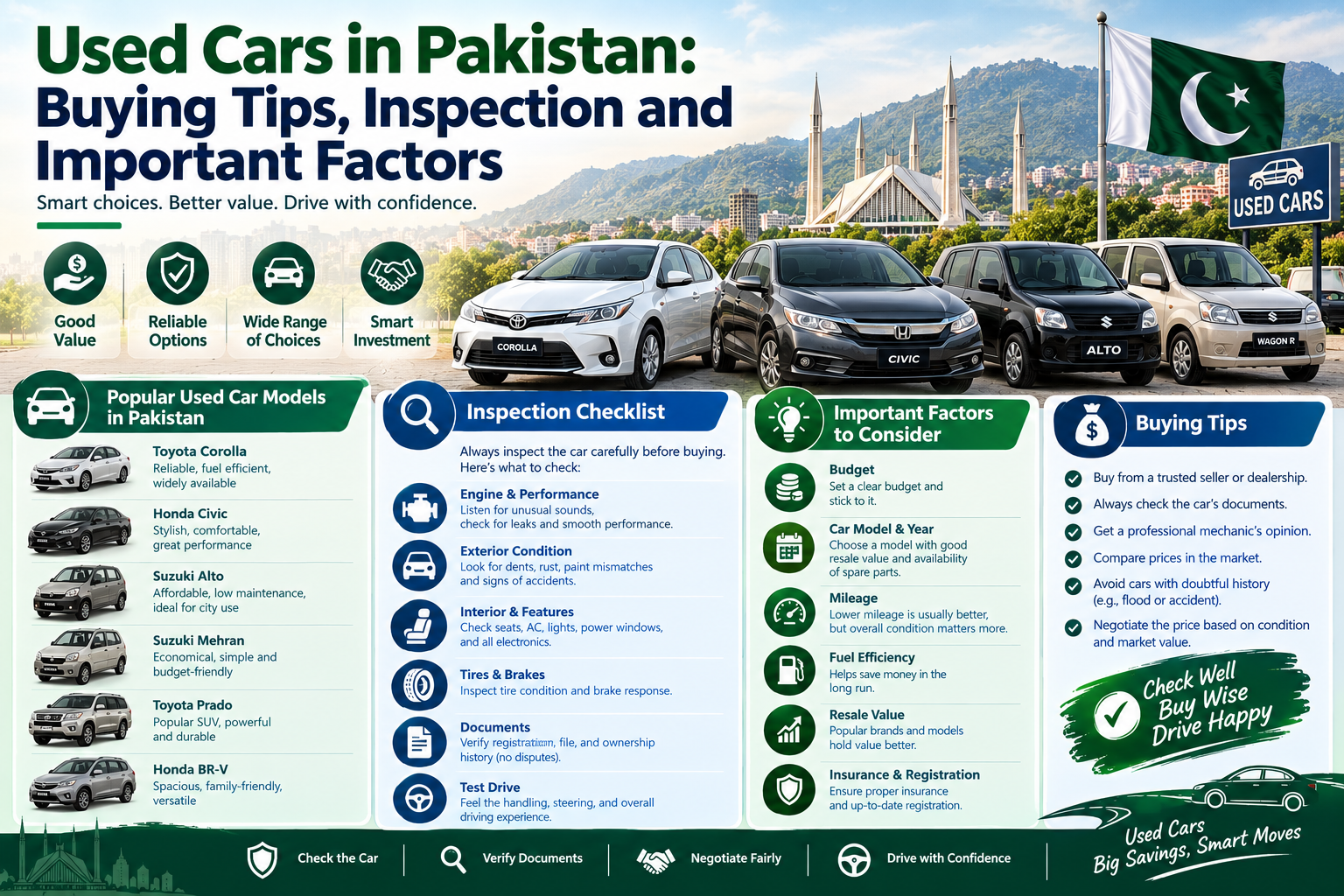
The used-car market is an important part of Pakistan’s automobile industry. Many people choose used cars because they can provide access to personal transportation at a lower initial cost than a new vehicle. Used cars are available in different price ranges, models, years, and conditions, giving buyers a wide variety of options.
However, buying a used car requires careful research. Two vehicles of the same model and year can have very different conditions depending on their maintenance, mileage, driving history, accident history, and previous ownership. A car that looks attractive from the outside may have mechanical or electrical problems that are not immediately visible.
For Pakistani buyers, checking the vehicle thoroughly before purchase is therefore extremely important. Buyers should examine the car's documents, physical condition, engine, transmission, suspension, tires, electrical systems, and maintenance history.
This guide explains the used-car market in Pakistan and provides practical information for people planning to purchase a second-hand vehicle.
Why Do People Buy Used Cars in Pakistan?
There are several reasons why buyers consider used cars.
Lower Initial Cost
A used car generally costs less than a comparable new vehicle, although the exact price depends on the model, year, condition, mileage, and market demand.
This can make used vehicles attractive to buyers working with a limited budget.
More Model Choices
The used-car market provides access to older models and variants that may no longer be available as new vehicles.
Buyers can compare different model years and equipment levels.
Lower Depreciation
New cars generally lose some value over time as they become used vehicles.
A buyer purchasing a used car has already avoided part of the initial depreciation that occurs after a new vehicle enters the market.
However, depreciation varies between models and market conditions.
Understanding the Used-Car Market
Used-car prices in Pakistan are influenced by several factors.
These include:
Model
Manufacturing year
Mileage
Vehicle condition
Accident history
Number of owners
Maintenance history
Registration location
Demand
Spare-parts availability
Vehicle variant
Transmission type
The same model may have different prices depending on these factors.
Set a Budget Before Buying
The first step should be setting a realistic budget.
Buyers should not spend their entire available amount on the purchase price. Additional expenses may include:
Registration or transfer charges
Insurance
Immediate maintenance
Tires
Battery
Oil and filters
Repairs
Documentation expenses
Keeping some money aside for initial maintenance can be useful when purchasing an older vehicle.
Research the Model
Before visiting sellers, buyers should research the vehicle they are considering.
Important areas to investigate include:
Fuel consumption
Common mechanical problems
Spare-parts prices
Service availability
Resale demand
Safety features
Engine specifications
Transmission
Typical maintenance costs
Learning about a model beforehand can help buyers recognize potential problems.
Check the Vehicle's Documents
Documentation is one of the most important parts of a used-car purchase.
Buyers should verify the vehicle's registration and ownership information and make sure the vehicle identification details match the relevant records.
Any required transfer process should be completed through the appropriate official channels.
Buyers should be cautious if a seller cannot provide proper documentation or gives unclear answers about ownership.
Check the Vehicle Identification Number
The vehicle identification information should match the documents.
Any inconsistency between the physical vehicle and its paperwork should be investigated before purchase.
A professional or relevant official authority can help verify vehicle records when necessary.
Inspect the Exterior
A careful exterior inspection can reveal signs of previous repairs.
Look for:
Different paint shades
Uneven panel gaps
Dents
Scratches
Replaced body panels
Rust
Damaged lights
Broken trim
Small cosmetic marks are not necessarily a serious problem, but major structural repairs may require additional investigation.
Check for Accident Damage
A vehicle involved in a serious accident may have structural or mechanical problems.
Buyers should inspect areas such as:
Chassis
Door frames
Bonnet area
Trunk area
Fenders
Pillars
Engine bay
A professional inspection can help identify repairs that may not be obvious to an ordinary buyer.
Inspect the Engine
The engine is one of the most important components of a used car.
Look for signs of:
Oil leakage
Coolant leakage
Unusual sounds
Excessive smoke
Poor starting
Rough idling
Overheating
A mechanic can perform a more detailed engine inspection and diagnostic test.
Check the Transmission
The transmission should operate smoothly.
During a test drive, buyers can pay attention to unusual noises, delayed engagement, harsh shifting, slipping, or other abnormal behavior.
Different transmission types have different maintenance requirements, so buyers should research the specific model.
Check the Suspension
Suspension components affect ride comfort and handling.
Drive over suitable road surfaces and listen for unusual sounds.
A mechanic can inspect suspension components for wear or damage.
Inspect the Brakes
Brake performance is an important safety issue.
During a test drive, the car should brake smoothly without unusual vibration, noise, or pulling.
Brake pads, discs, drums, and other components should be checked by a qualified mechanic.
Check the Tires
Tires can provide useful information about a vehicle's condition.
Check:
Tread depth
Uneven wear
Cracks
Tire age
Matching tire sizes
Spare tire condition
Uneven tire wear can sometimes indicate alignment, suspension, or other mechanical issues.
Check the Battery
The battery should be inspected for its age and condition.
An old battery may require replacement soon after purchasing the vehicle.
The charging system should also be checked to ensure the alternator and electrical system are functioning correctly.
Inspect the Interior
A used car's interior can provide clues about its usage.
Check:
Seats
Dashboard
Steering wheel
Door panels
Floor carpeting
Seat belts
Windows
Door locks
Air conditioning
Infotainment system
Excessive wear should be considered alongside the claimed mileage.
Verify the Mileage
Mileage is an important factor when evaluating a used car.
However, buyers should not rely solely on the number displayed on the odometer.
The overall condition of the vehicle, service records, tire condition, interior wear, and available history should be considered together.
If the mileage appears inconsistent with the vehicle's overall condition, further investigation may be appropriate.
Check the Air Conditioning
Pakistan's climate makes air conditioning particularly important for many drivers.
During the test drive, check whether the air conditioner cools the cabin effectively.
Also check the blower, fan speeds, vents, and other controls.
Repairing an air-conditioning system can sometimes be expensive, so it is better to identify problems before purchasing.
Test All Electrical Features
Used cars can develop electrical problems.
Test:
Headlights
Brake lights
Indicators
Horn
Power windows
Central locking
Interior lights
Wipers
Rear camera
Parking sensors
Infotainment system
Charging ports
Testing these systems can help identify faults that may otherwise be overlooked.
Take a Proper Test Drive
A test drive is one of the most important steps.
Drive the car under different suitable conditions and pay attention to:
Starting
Acceleration
Steering
Braking
Gear changes
Suspension
Engine noise
Cabin noise
Air conditioning
The vehicle should feel stable and predictable.
Hire a Qualified Mechanic
Buyers who do not have mechanical knowledge should consider hiring a trusted mechanic.
A professional can inspect areas that an ordinary buyer may not notice.
An inspection may identify problems with the engine, transmission, suspension, brakes, electrical systems, body, and chassis.
The cost of an inspection can be small compared with the expense of purchasing a vehicle with major hidden problems.
Check the Maintenance History
A maintenance history can provide valuable information.
Records may show:
Oil changes
Major repairs
Parts replacement
Accident repairs
Tire replacement
Battery replacement
Scheduled servicing
A vehicle with consistent maintenance records can provide more useful information about its ownership history.
Understand Ownership History
Knowing how many people have previously owned the vehicle can be useful.
A vehicle that has changed hands frequently may require additional investigation, although multiple ownership alone does not prove that a car has problems.
The buyer should focus on the vehicle's actual condition and documentation.
Buying from a Dealer vs Private Seller
Used cars can be purchased from dealerships or individual sellers.
Dealers
Dealers may offer a larger selection of vehicles and can sometimes provide additional services.
However, buyers should still independently inspect the vehicle.
Private Sellers
Private sellers may offer vehicles directly to consumers.
Buyers should carefully verify ownership and documentation and should not skip a professional inspection.
Online Used-Car Listings
Online platforms have made it easier to search for used vehicles.
Buyers can compare:
Prices
Model years
Mileage
Locations
Vehicle photographs
Features
However, online photographs do not provide a complete picture of a vehicle's condition.
The physical car should be inspected before making a final purchase.
Be Careful With Very Low Prices
A price that is significantly lower than similar vehicles may require additional investigation.
Possible reasons can include:
Mechanical problems
Accident damage
Urgent sale
Documentation issues
High mileage
Poor condition
A low price is not automatically a bargain.
Negotiating the Price
Once the vehicle has been inspected, buyers can discuss the price based on its actual condition.
Issues such as worn tires, damaged body panels, mechanical repairs, or expired components can affect the overall value.
Negotiation should be based on realistic market information and the vehicle's condition.
Do Not Pay Before Verification
Buyers should avoid making large payments before verifying the vehicle, seller, and documentation.
Payment arrangements should be clear and properly documented.
A safe transaction should involve appropriate ownership-transfer procedures.
Transfer of Ownership
After purchasing a used vehicle, the ownership transfer should be completed through the relevant official process.
The buyer should keep copies of important documents related to the transaction.
Proper transfer protects both the buyer and seller.
Insurance for Used Cars
Insurance options may be available for used vehicles depending on the provider, vehicle age, and policy terms.
Buyers should understand what is covered, applicable exclusions, deductibles, and other conditions before selecting an insurance policy.
Common Mistakes When Buying Used Cars
Several mistakes can make a used-car purchase more difficult.
Focusing Only on Appearance
A clean exterior does not guarantee good mechanical condition.
Ignoring Documents
Documentation problems can create serious difficulties later.
Skipping the Test Drive
A vehicle may appear good while showing problems during actual driving.
Not Hiring a Mechanic
Professional inspection can identify problems that buyers may miss.
Buying Because of Pressure
Buyers should take sufficient time to verify important details instead of making a rushed decision.
Benefits of Buying a Used Car
Used vehicles can provide several benefits:
Lower initial purchase price
More model choices
Access to older vehicles
Potentially lower depreciation
Flexible options across different budgets
Potential Disadvantages
Used cars can also involve risks:
Unknown maintenance history
Previous accident damage
Worn mechanical components
Higher repair requirements
Reduced warranty coverage
Older technology
Careful inspection can reduce some of these risks.
Used Hybrid and Electric Cars
Hybrid and electric vehicles are also entering the used-car market.
Buyers should pay particular attention to battery condition.
For hybrid vehicles, the condition of the hybrid battery and associated systems is important.
For electric cars, buyers should examine battery health, charging equipment, charging history where available, warranty status, and service support.
Specialist inspection may be useful.
Tips for First-Time Used-Car Buyers
First-time buyers can follow a simple process:
Set a budget.
Research suitable models.
Compare market prices.
Verify ownership documents.
Inspect the exterior.
Check the engine and transmission.
Test all electrical systems.
Take a test drive.
Hire a trusted mechanic.
Negotiate based on actual condition.
Complete the official ownership transfer.
Keep all transaction records.
Conclusion
Buying a used car in Pakistan can be a practical way to obtain personal transportation, but it requires careful research and inspection. A vehicle's appearance alone cannot tell the full story.
Buyers should examine the engine, transmission, suspension, brakes, tires, electrical systems, interior, body, documents, mileage, and maintenance history. A professional inspection can be particularly valuable for people who do not have mechanical experience.
It is also important to calculate the total cost of ownership. A lower purchase price may not remain economical if the vehicle requires expensive repairs soon after purchase.
With proper research, document verification, a detailed inspection, and a careful test drive, Pakistani consumers can make more informed decisions when purchasing used cars.
FAQs
1. Is buying a used car in Pakistan a good option?
A used car can be a practical option depending on its condition, price, maintenance history, and documentation. Buyers should have the vehicle professionally inspected before purchasing.
2. What should I check first when buying a used car?
Start with the ownership documents and vehicle identification information, then inspect the body, engine, transmission, tires, brakes, suspension, interior, and electrical systems.
3. Should I hire a mechanic before buying a used car?
Yes. A qualified mechanic can identify mechanical and structural problems that may not be obvious to an ordinary buyer.
4. How can I check whether a used car has been maintained properly?
Look for service records, receipts, maintenance history, and evidence of regular servicing. A professional inspection can provide additional information.
5. Why is a test drive important?
A test drive allows the buyer to evaluate the engine, transmission, steering, braking, suspension, comfort, and general driving behavior before making a purchase.